

Friday 31 January 2025
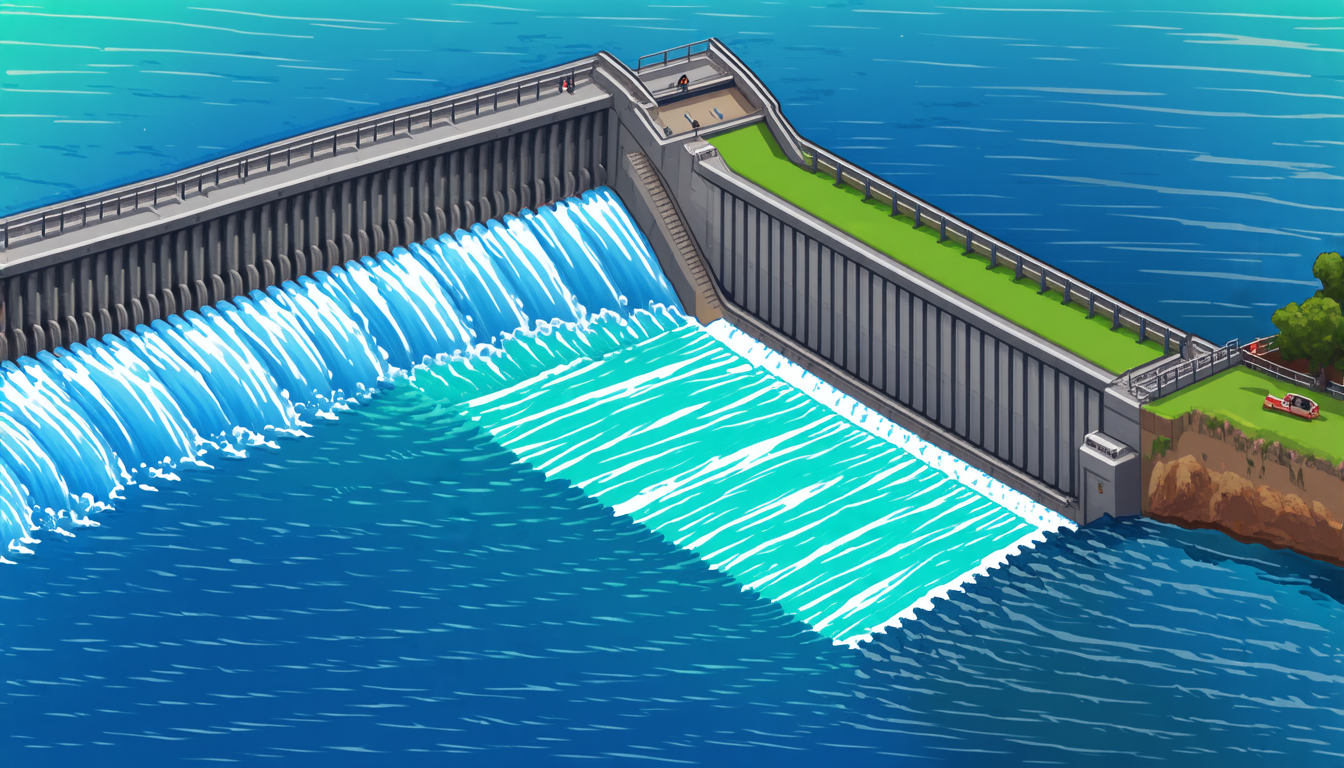
The Aghchai Dam, located in Iran, is a crucial structure that helps regulate flooding and ensure the safety of nearby communities. To better understand how this dam operates, researchers have used advanced computer simulations to study its performance under different flood scenarios.
The team used a software called Flow-3D to create a virtual model of the Aghchai Dam spillway, which is responsible for directing excess water away from the dam and into a relaxation basin. By simulating various flood rates, including the maximum design flood discharge of 4400 cubic meters per second, the researchers were able to analyze the flow behavior and identify areas where cavitation could occur.
Cavitation is a phenomenon that occurs when water flows over an object at high speeds, creating pockets of vacuum that can lead to damage or even collapse. In the case of the Aghchai Dam spillway, cavitation was identified as a potential risk at two critical locations: the crest peak and the slope transition. To mitigate this risk, the researchers recommended adjustments to the ogee crest curve and the slope transition geometry.
The simulations also revealed that the flow velocity over the spillway is highest at the flip bucket footer, reaching speeds of up to 32.8 meters per second. This high velocity creates significant turbulence localized near the spillway bed and flip bucket areas, which can lead to erosion and damage if not properly managed.
The researchers used another software called FLD4 to analyze flood propagation dynamics and evaluate the effects of changes in mountain flood events on reservoir performance. They found that as the flow rate increases, the potential for cavitation damage also escalates, with catastrophic damage possible at the maximum design flood discharge.
By combining these advanced simulations with traditional hydraulic engineering practices, the researchers were able to provide actionable recommendations for enhancing spillway design and addressing cavitation risks. Their findings highlight the importance of precise spillway bed profile design and the use of aeration techniques to minimize turbulence-induced damage.
The Aghchai Dam is just one example of how advanced computer simulations are being used to improve our understanding of complex hydraulic systems. By developing more accurate models, researchers can help ensure the safety and reliability of these critical structures, ultimately protecting communities from the devastating effects of flooding.
Cite this article: “Simulating Flood Behavior: Enhancing Spillway Design at the Aghchai Dam”, The Science Archive, 2025.
Aghchai Dam, Flow-3D, Fld4, Cavitation, Spillway, Flood, Simulation, Hydraulic Engineering, Turbulence, Erosion





