

Saturday 01 February 2025
The quest for high-resolution molecular spectroscopy has long been a challenge in the scientific community. Researchers have been working tirelessly to develop new technologies that can accurately measure the properties of molecules, which is crucial for understanding various phenomena in fields like climate science, medicine, and materials science.
Recently, scientists have made significant strides in this area by combining two cutting-edge techniques: terahertz frequency combs and high-frequency electronic mixers. The result is a novel approach to molecular spectroscopy that offers unprecedented resolution and coverage.
Terahertz frequency combs are devices that generate a series of precisely spaced frequencies, which can be used as a reference for measuring the properties of molecules. High-frequency electronic mixers, on the other hand, are capable of detecting the absorption or emission of radiation by molecules at extremely high frequencies.
By combining these two technologies, researchers have been able to create a spectrometer that can measure the properties of molecules with unprecedented precision and coverage. The device uses a technique called frequency comb spectroscopy, which involves using the terahertz frequency comb as a reference to measure the absorption or emission spectra of molecules.
The results are impressive. The new spectrometer has achieved resolution of 76 kHz, which is far surpassing previous state-of-the-art systems. Additionally, it can cover a bandwidth of up to 5 GHz, which is significant for many applications.
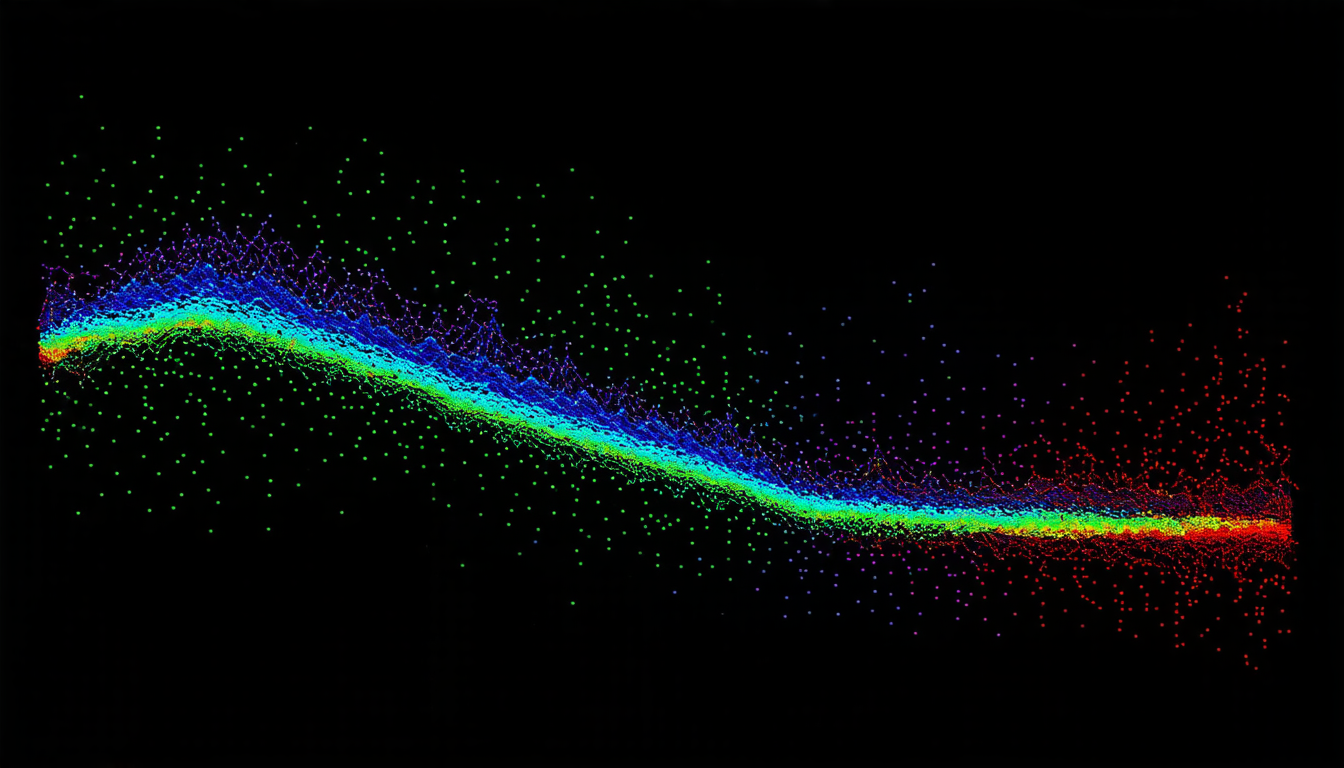
To demonstrate the capabilities of this new technology, researchers have measured the transmission spectrum of methanol, a molecule that plays a crucial role in various biological and chemical processes. The result is a detailed spectrum with over 150 molecular transitions identified, including some previously unknown lines.
The implications of this research are far-reaching. For one, it will enable scientists to study complex molecules and their interactions with greater precision than ever before. This could lead to breakthroughs in fields like climate science, where understanding the properties of greenhouse gases is crucial for predicting future changes in the Earth’s atmosphere.
Moreover, the new spectrometer has the potential to be used in a wide range of applications, from monitoring food spoilage to detecting diseases. The ability to accurately measure the properties of molecules will also enable researchers to develop new materials and technologies with improved performance characteristics.
In summary, this innovative approach to molecular spectroscopy represents a significant milestone in the development of high-resolution measurement tools. With its unprecedented resolution and coverage, it has the potential to revolutionize various fields of science and technology.
Cite this article: “High-Resolution Molecular Spectroscopy: A Breakthrough in Measuring Molecule Properties”, The Science Archive, 2025.
Molecular Spectroscopy, Terahertz Frequency Combs, High-Frequency Electronic Mixers, Frequency Comb Spectroscopy, Resolution, Coverage, Bandwidth, Methanol, Molecular Transitions, Precision.





