

Monday 03 February 2025
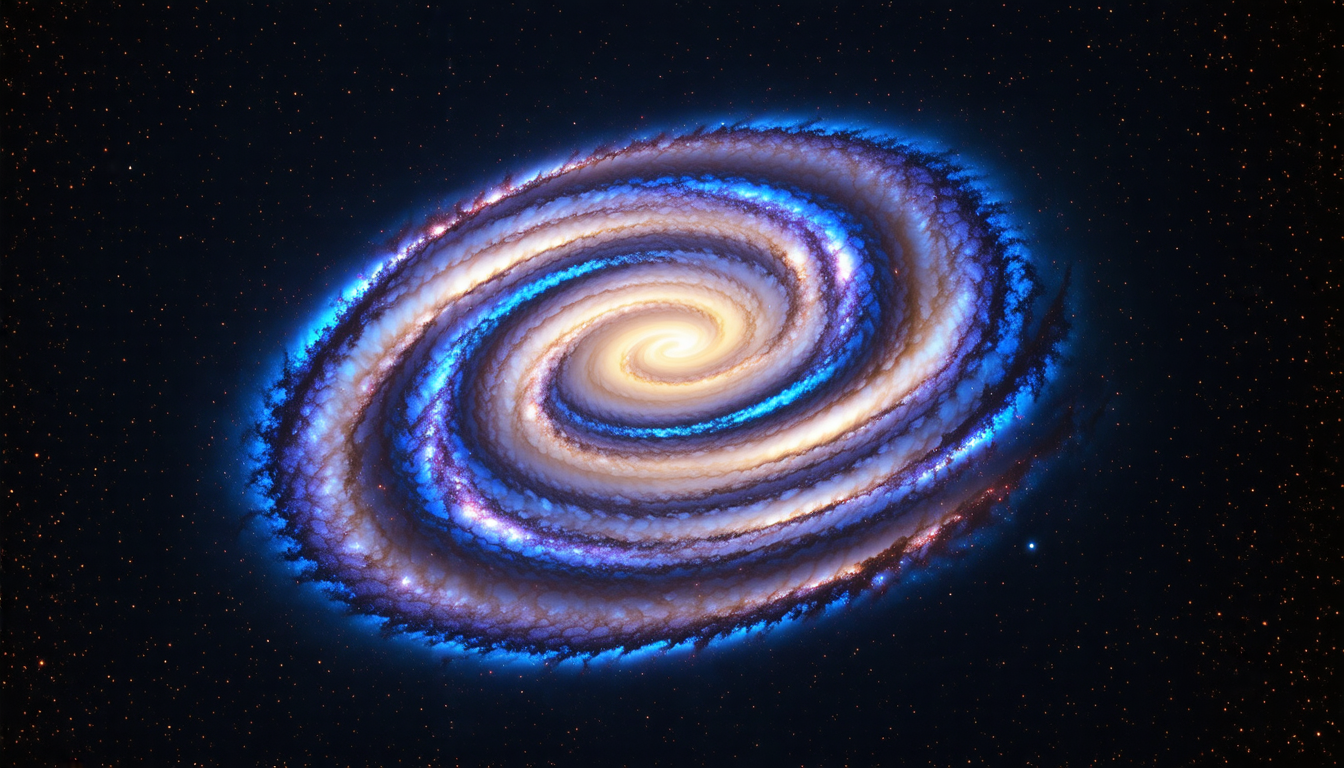
A team of scientists has been exploring the possibility that a nearby gamma-ray burst could pose a threat to life on Earth. The researchers used computer simulations to study the movement of stars within our galaxy, taking into account the presence of a bar-shaped structure and spiral arms.
Their findings suggest that there is a small chance that a gamma-ray burst could occur close enough to Earth to cause significant damage. Gamma-ray bursts are incredibly powerful explosions that occur when massive stars collapse or when neutron stars or black holes merge.
The team’s simulations show that the likelihood of a lethal gamma-ray burst occurring in our vicinity increases with time, due to the Sun’s movement within the galaxy. In about 4 billion years, the Sun will reach the center of the Milky Way, where it is more likely to encounter dense star-forming regions and potentially trigger a gamma-ray burst.
The researchers also found that there are some areas within the galaxy where the risk of a lethal gamma-ray burst is higher than others. These regions are located near the edges of the spiral arms, where stars are moving at high speeds and collisions between stars could lead to the formation of massive stars that eventually collapse into black holes or neutron stars.
The team’s study highlights the importance of understanding the movement of stars within our galaxy in order to better predict the likelihood of gamma-ray bursts occurring nearby. By studying the dynamics of our galaxy, scientists can gain a better understanding of how these powerful events occur and develop strategies for mitigating their impact on life on Earth.
The researchers used complex computer simulations to study the movement of stars within the Milky Way, taking into account the presence of a bar-shaped structure and spiral arms. They found that there is a small chance that a gamma-ray burst could occur close enough to Earth to cause significant damage, with the likelihood increasing over time as the Sun moves towards the center of the galaxy.
The team’s study also highlights the importance of understanding the movement of stars within our galaxy in order to better predict the likelihood of gamma-ray bursts occurring nearby. By studying the dynamics of our galaxy, scientists can gain a better understanding of how these powerful events occur and develop strategies for mitigating their impact on life on Earth.
The researchers used complex computer simulations to study the movement of stars within the Milky Way, taking into account the presence of a bar-shaped structure and spiral arms.
Cite this article: “Asteroid-like Threat from Gamma-Ray Bursts: Scientists Study Galactic Dynamics”, The Science Archive, 2025.
Gamma-Ray Burst, Milky Way Galaxy, Star Movement, Simulations, Sun’S Position, Black Holes, Neutron Stars, Spiral Arms, Bar-Shaped Structure, Cosmic Risks.





