

Sunday 23 February 2025
Scientists have long been fascinated by the intricate dance of cells and tissues within our bodies. To better understand this complex ballet, researchers have developed a new approach that uses AI-powered image analysis to predict gene expression patterns in tissue samples.
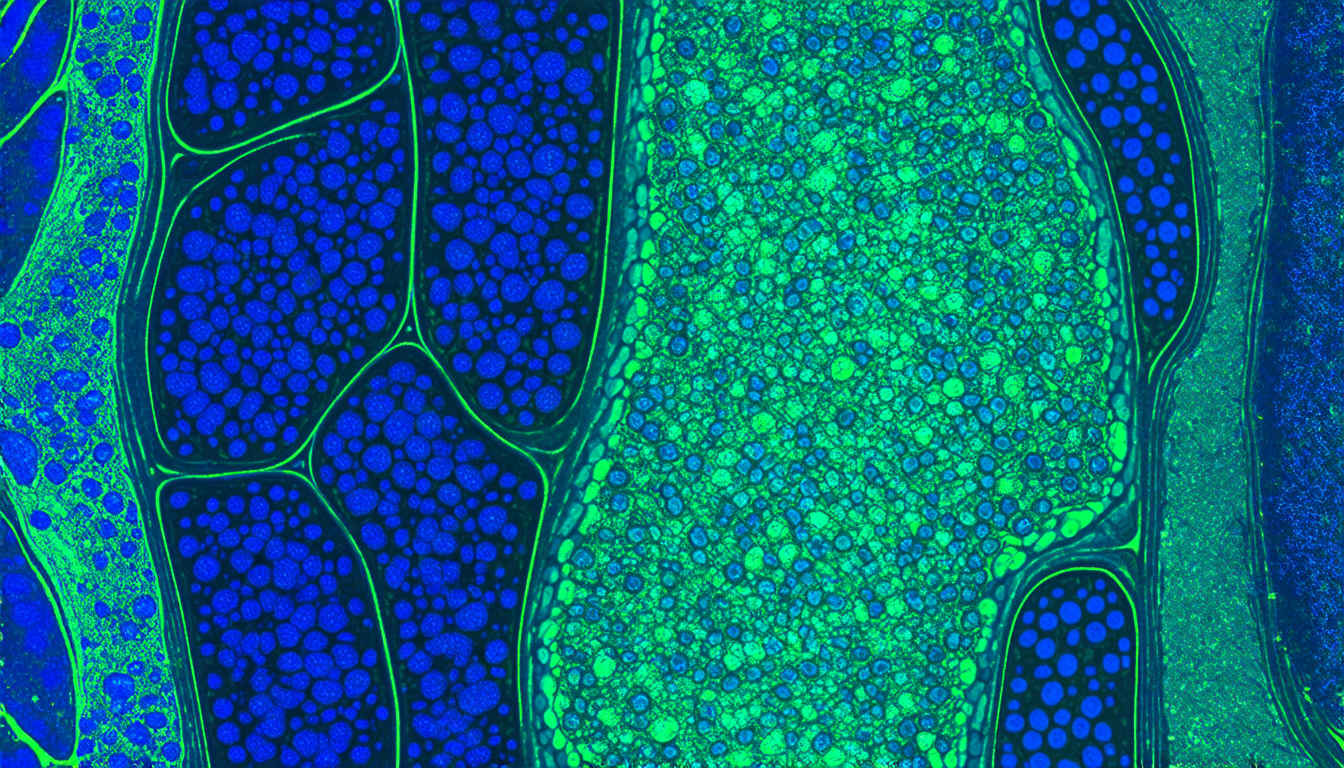
The technique, dubbed BG-TRIPLEX, combines machine learning with spatial transcriptomics – a method that maps the location and activity of genes within specific cells or tissues. By analyzing histology images, which are essentially high-resolution photographs of tissue sections stained with various dyes, researchers can identify specific cellular features and patterns.
In this study, scientists trained BG-TRIPLEX to predict gene expression patterns in breast cancer tissue samples. They fed the AI model a dataset consisting of spatial transcriptomics data from over 2,500 spots within these samples. The model was then tasked with predicting the gene expression levels at each spot based on the cellular features and patterns it had learned.
The results were impressive: BG-TRIPLEX accurately predicted gene expression patterns in breast cancer tissue samples, outperforming existing methods by a significant margin. The AI model was particularly effective at identifying genes involved in tumor progression and metastasis – crucial targets for cancer treatment.
So how does this technology work? Essentially, BG-TRIPLEX uses a combination of convolutional neural networks (CNNs) and attention mechanisms to analyze histology images. CNNs are designed to recognize patterns within large datasets, while attention mechanisms allow the model to focus on specific regions or features within those images.
In the context of spatial transcriptomics, this means that BG-TRIPLEX can identify specific cellular structures, such as nuclei or edges, and use this information to predict gene expression levels. The model’s attention mechanism allows it to selectively weigh the importance of different features in its predictions, ensuring that the most relevant information is used.
This technology has far-reaching implications for our understanding of human biology and disease. By enabling researchers to accurately predict gene expression patterns in tissue samples, BG-TRIPLEX could help scientists develop more targeted treatments for cancer and other diseases.
Furthermore, this approach could be applied to a wide range of biological systems, from the study of developmental biology to the analysis of neurological disorders. As our understanding of human biology becomes increasingly complex, AI-powered tools like BG-TRIPLEX will play an essential role in helping us make sense of it all.
Cite this article: “AI-Powered Gene Expression Prediction Revolutionizes Cancer Research”, The Science Archive, 2025.
Ai-Powered Image Analysis, Gene Expression Patterns, Tissue Samples, Breast Cancer, Machine Learning, Spatial Transcriptomics, Histology Images, Convolutional Neural Networks, Attention Mechanisms, Predictive Modeling





