

Sunday 23 February 2025
Researchers have made significant strides in developing a new approach to deep reinforcement learning, a technique used to train artificial intelligence agents to make decisions in complex environments. The new method, called action mapping, has been shown to improve performance and efficiency compared to traditional approaches.
Deep reinforcement learning involves training AI agents to learn from trial and error, by exploring their environment and receiving rewards or penalties for their actions. However, this process can be challenging, especially when the agent needs to make decisions that balance multiple objectives or constraints.
Action mapping addresses these challenges by decoupling the learning of feasible actions from policy optimization. The approach involves pre-training a feasibility model to evaluate whether proposed actions are safe and feasible, and then using this information to inform the agent’s decision-making process.
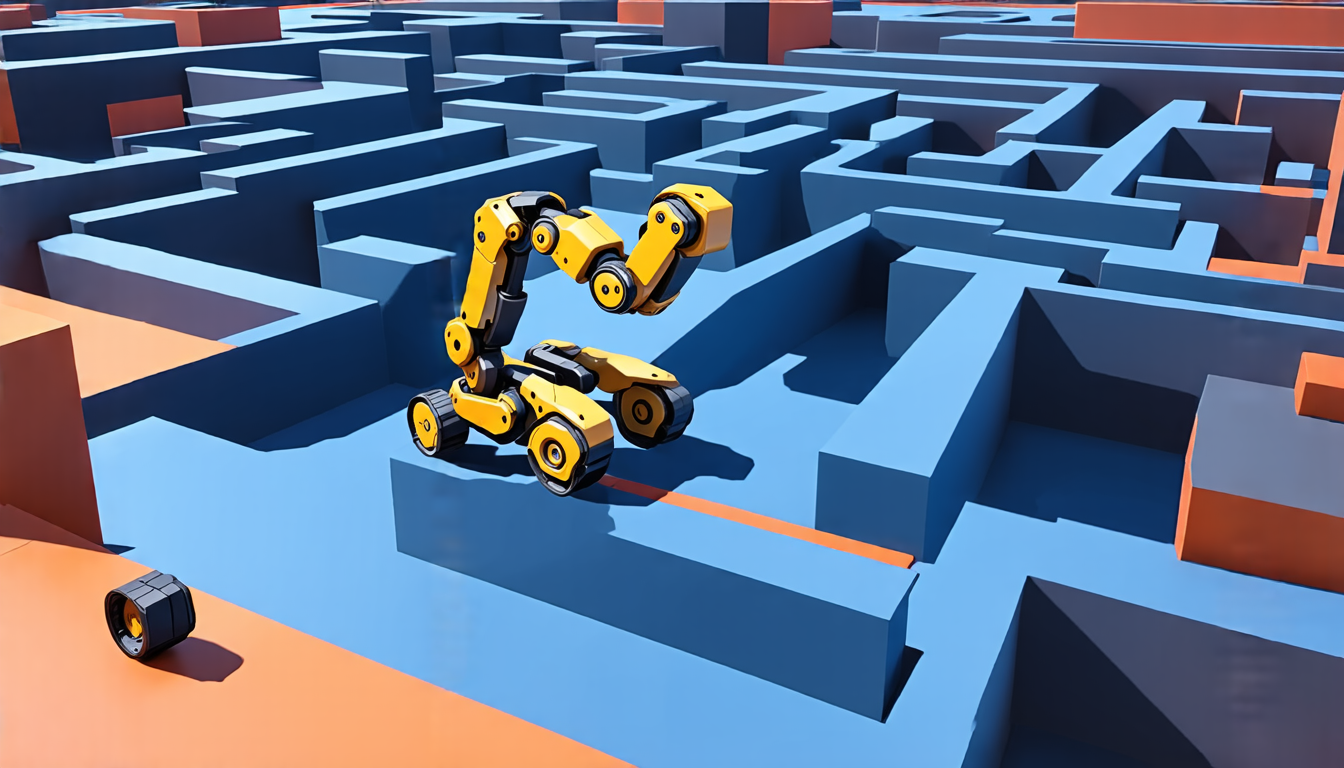
The researchers tested their action mapping approach in two environments: a robotic arm that needs to move objects while avoiding obstacles, and a path planning scenario where an autonomous vehicle must navigate through a complex route while respecting constraints. In both cases, they compared the performance of action mapping with traditional reinforcement learning methods.
The results showed that action mapping outperformed traditional approaches in terms of speed and efficiency. The agents trained using action mapping were able to learn faster and adapt more quickly to changing environments. Additionally, the approach was shown to be more robust to imperfect feasibility models, which is a common issue in real-world applications.
One key advantage of action mapping is its ability to handle complex constraints and objectives. In the robotic arm environment, for example, the agent needs to balance the reward for moving objects with the penalty for colliding with obstacles. Action mapping was able to effectively learn this trade-off, resulting in better performance than traditional methods.
The approach also has potential applications in a wide range of fields, from robotics and autonomous vehicles to healthcare and finance. In these domains, AI agents need to make decisions that balance multiple objectives or constraints, making action mapping a promising solution.
Overall, the researchers’ new approach to deep reinforcement learning has significant implications for the development of intelligent agents. By decoupling feasibility evaluation from policy optimization, action mapping offers a more efficient and effective way to train AI agents to make complex decisions in uncertain environments.
Cite this article: “Action Mapping: A New Approach to Deep Reinforcement Learning”, The Science Archive, 2025.
Artificial Intelligence, Reinforcement Learning, Deep Learning, Action Mapping, Feasibility Model, Policy Optimization, Robotics, Autonomous Vehicles, Healthcare, Finance.





