

Saturday 08 March 2025
A new approach has been proposed for detecting the elusive neutrino particles, which could help scientists unlock the secrets of these mysterious entities.
Neutrinos are notoriously difficult to detect because they interact so weakly with matter. To make matters worse, they come in three different flavors, which can change as they travel through space and time. This makes it challenging to pinpoint where and when they’re produced.
One way to detect neutrinos is by using lasers to excite certain atoms, which then emit light that can be detected. But this method has its own set of challenges, particularly when dealing with the complex energy levels of certain elements like barium.
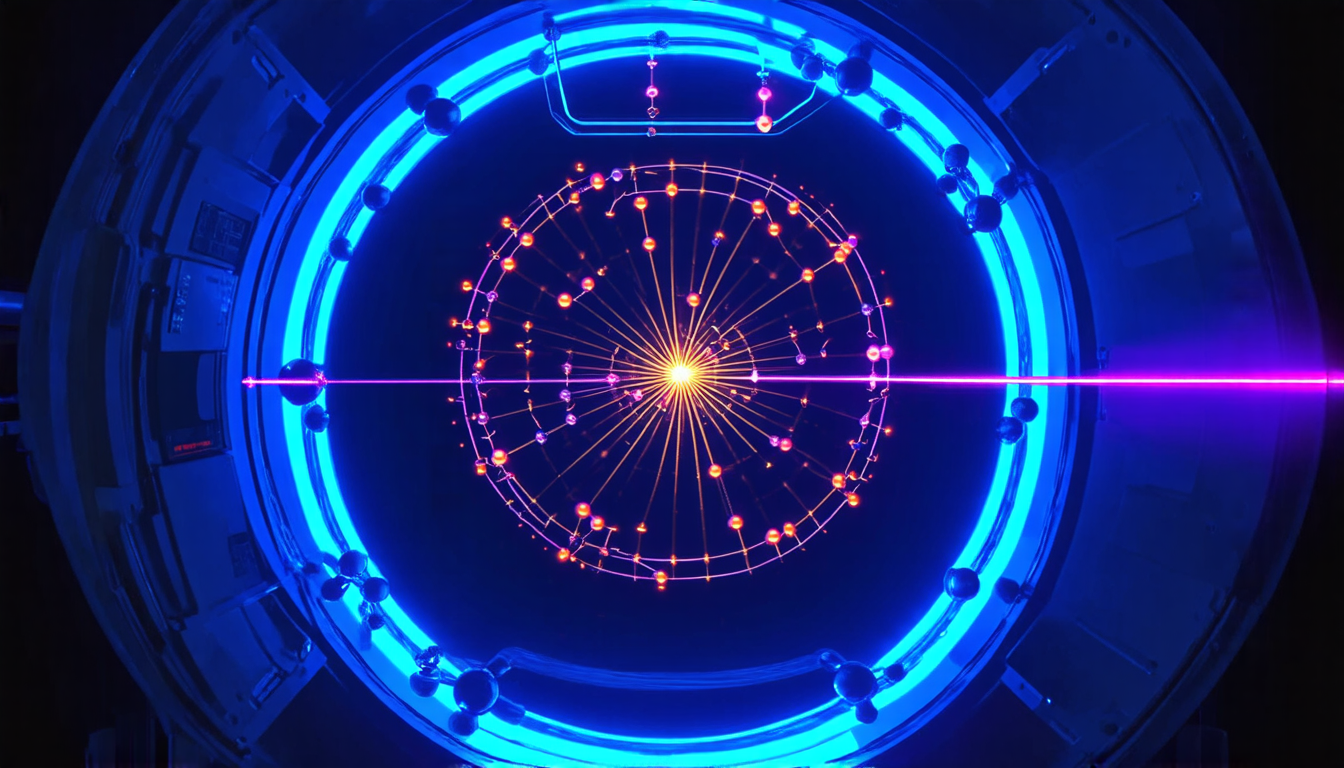
A team of researchers has now proposed a novel approach that uses laser-induced fluorescence to detect barium ions produced in neutrino interactions. The idea is to use two lasers: one to excite the barium atoms and another to repump those that have already decayed back to their ground state.
The simulations show that this method could be used to detect single barium ions, which would allow scientists to pinpoint the location of the neutrino interaction with much greater precision. This could be a major breakthrough in understanding neutrino properties and behavior.
One of the key challenges is ensuring that the lasers are precisely aligned and timed to maximize the detection signal. The researchers have developed a sophisticated simulation model to optimize these parameters, which should help make the experiment more successful.
The proposed experiment also has implications for other fields beyond particle physics. For example, it could be used to study the properties of matter at very high temperatures and pressures, or to develop new methods for detecting rare events in fields like astronomy.
While this approach is still in its infancy, it holds great promise for advancing our understanding of neutrinos and their role in the universe. With further development and refinement, it could become a powerful tool for scientists seeking to uncover the secrets of these enigmatic particles.
Cite this article: “Unlocking the Secrets of Neutrinos with Laser-Induced Fluorescence”, The Science Archive, 2025.
Neutrino Detection, Laser-Induced Fluorescence, Barium Ions, Particle Physics, Neutrino Properties, Behavior, Simulation Model, Precision Alignment, High Temperatures, Rare Events





