

Thursday 23 January 2025
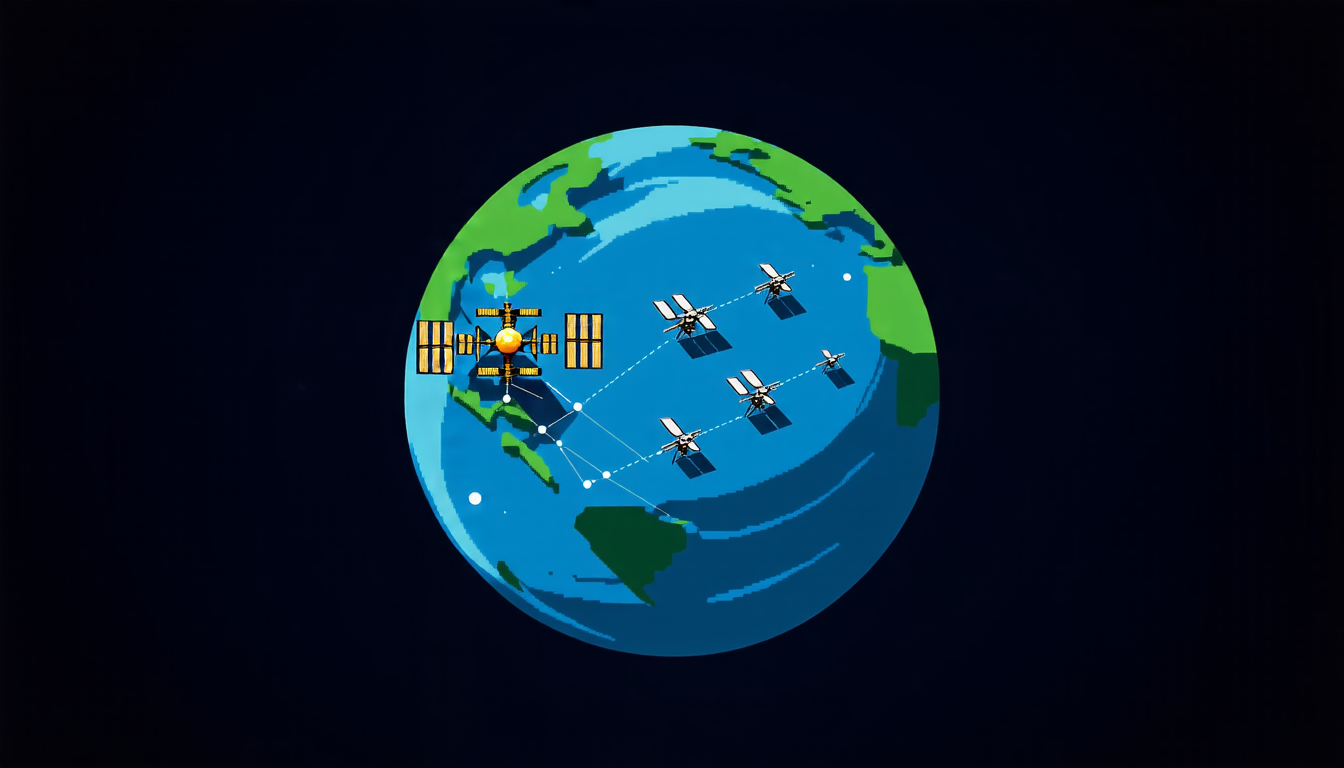
A novel approach to distributed machine learning has been proposed, one that leverages the unique characteristics of Low Earth Orbit (LEO) satellite constellations to enable efficient training of complex models. The research, published in a recent paper, presents a split learning architecture that divides the model between LEO satellites and ground terminals, allowing for a more scalable and energy-efficient approach to online learning.
The authors acknowledge that traditional distributed machine learning approaches often focus on offloading tasks from ground terminals to LEO satellites, but neglect the dynamic movement patterns of these satellites. By exploiting this cyclical movement, the proposed architecture enables a time-window-based model training process, where each satellite in the constellation contributes to the model training as it passes over the ground terminal.
The system is designed to optimize communication and processing resources, minimizing energy consumption while ensuring timely completion of tasks. The authors demonstrate that their approach can reduce energy expenditure by up to 97% compared to traditional direct data transmission methods.
To evaluate the effectiveness of this approach, the researchers implemented two distinct image processing tasks: image compression using an autoencoder neural network, and image classification with a ResNet-18 architecture. In both cases, the proposed split learning architecture outperformed traditional approaches in terms of energy efficiency, while maintaining acceptable levels of accuracy.
One of the key benefits of this approach is its ability to preserve data privacy, as raw images are never transmitted over long distances. Instead, only compressed latent representations or partial model updates are exchanged between satellites and ground terminals.
The authors also highlight the scalability of their architecture, which can be easily extended to larger satellite constellations without significant increases in computational complexity. This makes it an attractive solution for a wide range of applications, from Earth observation and surveillance to autonomous systems and IoT networks.
Overall, this research presents a promising new direction in distributed machine learning, one that leverages the unique capabilities of LEO satellite constellations to enable efficient, scalable, and energy-efficient online learning. As the demand for machine learning solutions continues to grow, innovative approaches like this will play an increasingly important role in driving progress and advancing our understanding of these complex systems.
Cite this article: “LEO Satellite Constellations Enable Efficient Distributed Machine Learning”, The Science Archive, 2025.
Machine Learning, Distributed Machine Learning, Low Earth Orbit, Satellite Constellations, Split Learning Architecture, Online Learning, Energy Efficiency, Image Processing, Autoencoder Neural Network, Resnet-18 Architecture





