

Wednesday 22 January 2025
The intricate dance of complex networks has long fascinated scientists and engineers. From social media platforms to power grids, these systems rely on delicate balances between individual components to function smoothly. But what happens when these networks become more complex, incorporating multiple layers of connections? Researchers have long struggled to understand how these multilayer networks behave, with many important questions remaining unanswered.
A new study published in the IEEE Transactions on Network Science and Engineering aims to shed light on this issue by developing a novel framework for analyzing multilayer networks. The researchers, from Colombia’s Universidad Nacional, have created a mathematical model that can capture the intricate dynamics of these complex systems, allowing them to better understand how they function and respond to changes.
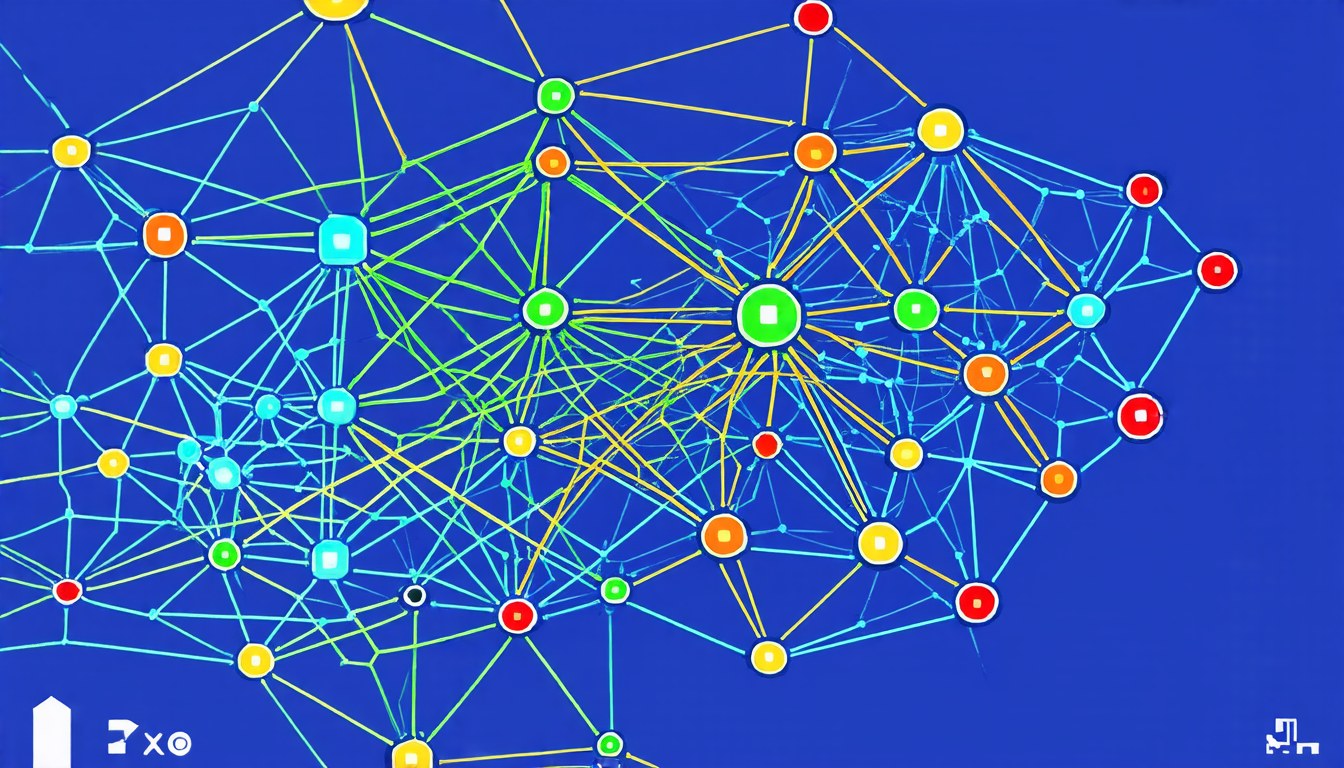
The study focuses on a specific type of multilayer network known as a multiplex network, where multiple layers of connections exist between nodes. This is in contrast to traditional networks, which are limited to a single layer of connections. The researchers have developed a new mathematical framework that can capture the intricate dynamics of these systems, allowing them to better understand how they function and respond to changes.
The key innovation of this study lies in its use of tensors, mathematical objects that can represent complex relationships between multiple variables. By using tensors to model multiplex networks, the researchers were able to develop a more accurate and comprehensive understanding of their behavior.
One of the key challenges in analyzing multilayer networks is capturing the interactions between different layers. The researchers achieved this by developing a new type of Laplacian matrix, which can be used to describe the structure of a network. This matrix allows them to analyze the flow of information between different layers and identify patterns that might not be visible at first glance.
The study also explores the potential applications of this framework in various fields, including social networks, power grids, and biological systems. By better understanding how multilayer networks function, researchers can develop more effective strategies for managing and optimizing these complex systems.
In summary, a new study has developed a novel framework for analyzing multiplex networks, using tensors to model the intricate dynamics of these complex systems. This breakthrough could have far-reaching implications for our understanding of complex networks, with potential applications in fields such as social media, power grids, and biology.
Cite this article: “Deciphering Complex Networks: A Novel Framework for Multiplex Analysis”, The Science Archive, 2025.
Multilayer Networks, Complex Systems, Network Science, Engineering, Tensors, Mathematical Modeling, Multiplex Networks, Laplacian Matrix, Information Flow, Optimization Strategies.





