

Wednesday 22 January 2025
Scientists have long been fascinated by the behavior of soft matter, a category that includes materials like liquids, gels, and polymers. These substances can exhibit complex and intriguing properties, such as shape-shifting and self-assembly, which are still not fully understood.
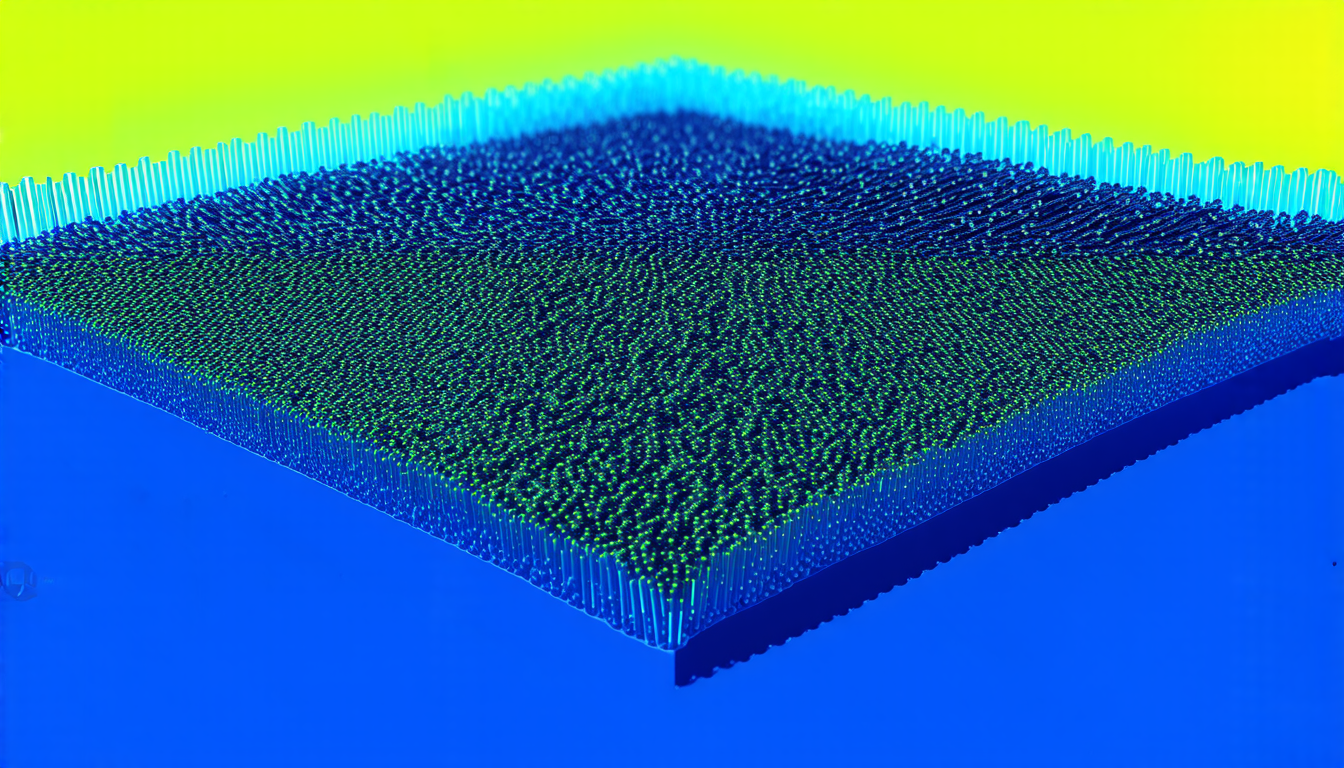
A recent study has shed new light on one type of soft matter: rod-shaped particles, also known as spherocylinders. These particles are similar to the ones found in biological systems, where they play a crucial role in processes like protein folding and cell division. In this study, researchers created a simulation of a layer of these particles confined to a flat surface, mimicking the conditions found in biological membranes.
The results were striking: at low densities, the particles formed a fluid-like state with no long-range order, similar to a liquid. However, as the density increased, the particles began to arrange themselves into a crystalline structure with hexagonal symmetry, characteristic of many biological systems.
But here’s the fascinating part: the researchers found that the transition from fluid to solid occurred at a surprisingly high packing fraction – meaning that the particles needed to be packed very tightly together before they started forming crystals. This is in contrast to other types of soft matter, where the transition occurs at much lower densities.
The study also revealed an interesting trend: as the density increased, the orientational order of the particles – their ability to align with each other – decreased. This means that while the particles were becoming more ordered in terms of their position, they were becoming less aligned with each other.
These findings have significant implications for our understanding of soft matter and its applications in fields like materials science and biotechnology. For example, the study suggests that it may be possible to create new types of materials with unique properties by carefully controlling the packing density and orientational order of rod-shaped particles.
Furthermore, the results could provide insights into biological systems where similar phenomena occur. For instance, the self-assembly of proteins and lipids in cell membranes is a complex process that involves both positional and orientational ordering. Understanding how these processes work at the molecular level could lead to new treatments for diseases related to membrane dysfunction.
In short, this study has opened up new avenues for research into soft matter and its applications. By exploring the behavior of rod-shaped particles under different conditions, scientists can gain a deeper understanding of the fundamental principles governing their behavior – and potentially create new materials with unique properties.
Cite this article: “Unraveling the Behavior of Rod-Shaped Particles in Soft Matter”, The Science Archive, 2025.
Soft Matter, Rod-Shaped Particles, Spherocylinders, Biological Systems, Protein Folding, Cell Division, Crystalline Structure, Hexagonal Symmetry, Packing Fraction, Orientational Order





