

Thursday 23 January 2025
The pursuit of understanding the fundamental building blocks of matter has long been a challenge for physicists. One crucial aspect of this quest is the ability to study the properties of subatomic particles, like quarks and gluons, which make up protons and neutrons. To do so, scientists rely on sophisticated computer simulations known as lattice QCD.
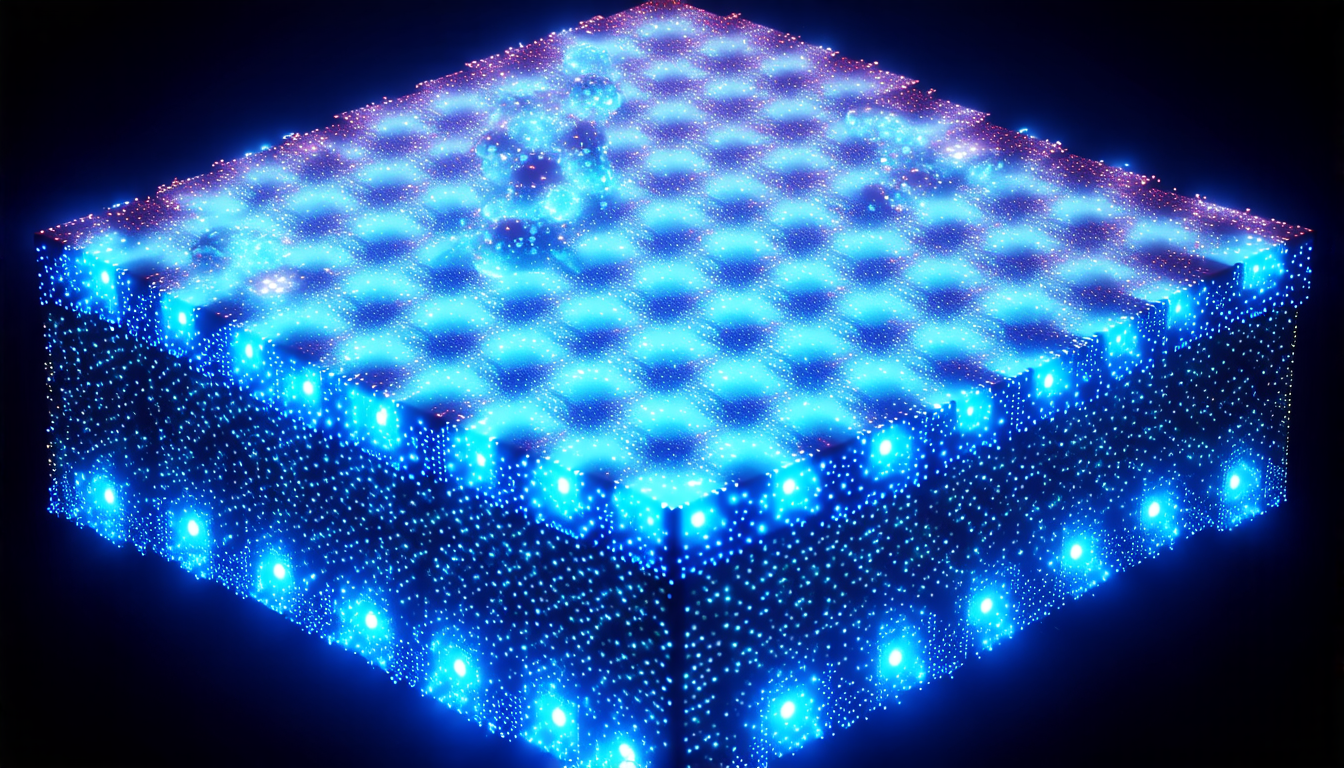
Lattice QCD involves creating a digital lattice, or grid, that mimics the behavior of particles in the universe. By simulating these interactions, researchers can extract valuable information about the properties of these particles, such as their masses and decay rates. However, this process is not without its challenges.
One major hurdle is the need to interpolate between the discrete points on the lattice to create a continuous picture of particle behavior. This is where the Wertevorrat comes in – a mathematical construct that provides a framework for systematically improving the accuracy of these interpolations.
The Wertevorrat is essentially a bound on the uncertainty associated with extrapolating data from a finite set of points to infinity. It’s like trying to draw a complete picture by only knowing what’s visible through a limited window: you can make educated guesses, but there will always be some uncertainty.
In recent years, researchers have made significant progress in developing methods for calculating the Wertevorrat using lattice QCD simulations. These advances have opened up new avenues for studying particle properties and understanding their behavior under different conditions.
One area of particular interest is the study of inclusive hadronic quantities, which describe the decay rates of particles into other particles. By analyzing these rates, scientists can gain insights into the fundamental forces that govern the universe.
For instance, researchers are working to calculate the anomalous magnetic moment of the muon – a property that has implications for our understanding of the Standard Model of particle physics. The Wertevorrat provides a powerful tool for refining these calculations and reducing errors.
The development of more accurate methods for calculating the Wertevorrat also has far-reaching implications for other areas of research, such as the study of quark-gluon plasma and heavy-ion collisions.
As scientists continue to push the boundaries of lattice QCD simulations, the Wertevorrat will remain a crucial component in their toolkit. By harnessing its power, researchers can unlock new secrets about the behavior of subatomic particles and shed light on some of the universe’s most fundamental mysteries.
Cite this article: “Unlocking the Secrets of Subatomic Particles with Lattice QCD”, The Science Archive, 2025.
Lattice Qcd, Wertevorrat, Particle Physics, Subatomic Particles, Quarks, Gluons, Simulations, Interpolation, Uncertainty, Standard Model





