

Monday 24 March 2025
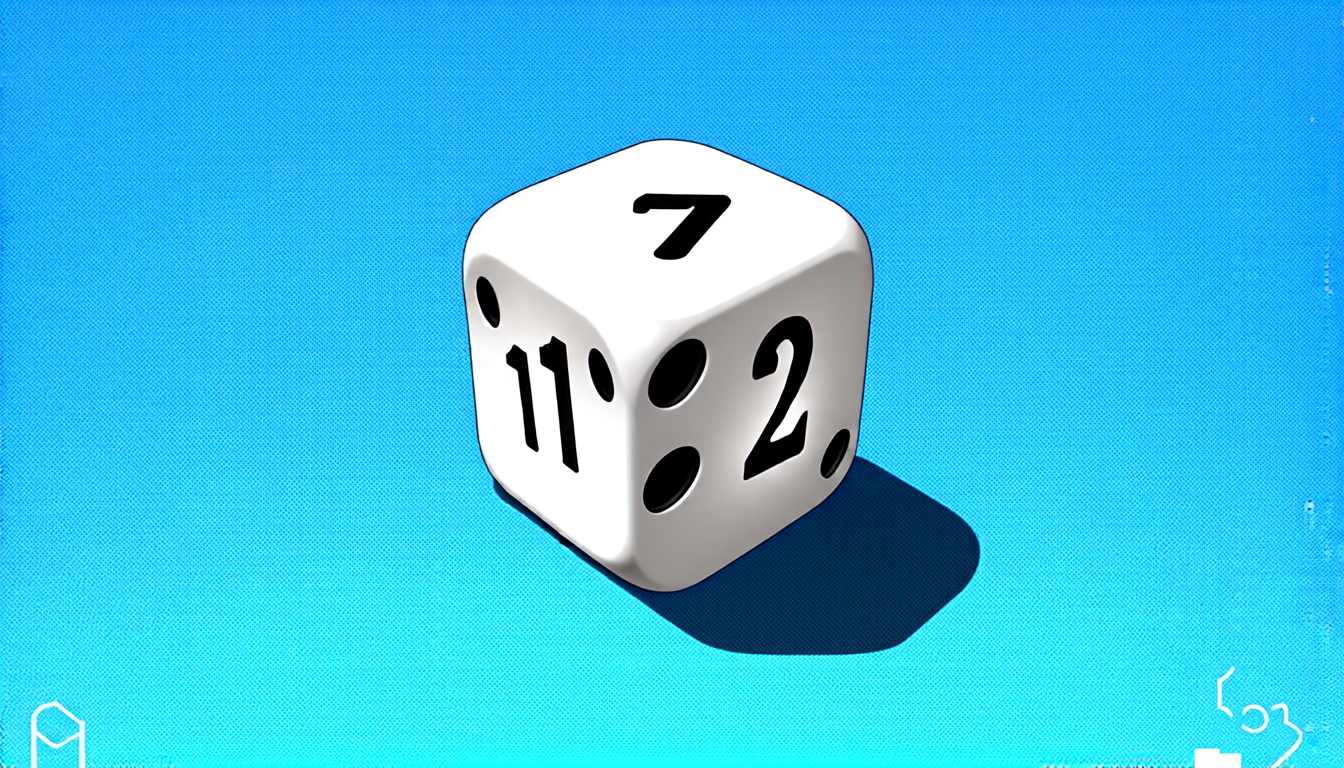
Rolling dice can be a thrilling way to pass the time, but for mathematicians, it’s also a way to unlock secrets of probability and statistics. A recent study has shed light on how long it takes, on average, to hit a prime number when rolling multiple fair dice.
Prime numbers are those that can only be divided by 1 and themselves – think 7, 11, or 23. They’re the building blocks of all other numbers, yet they seem to appear randomly throughout the sequence of whole numbers. Mathematicians have long been fascinated by primes, and their properties have led to numerous breakthroughs in fields like cryptography and coding theory.
In this study, researchers explored how often you’d need to roll a fair six-sided die before hitting a prime number. They discovered that it takes, on average, about 2.43 rolls to hit a prime – not too shabby! But what’s more surprising is that this number remains roughly the same even when rolling multiple dice.
To understand why, let’s dive into some probability theory. When you roll a die, each side has an equal chance of landing face-up (1/6, in this case). The sum of these rolls follows a predictable pattern, with some numbers appearing more frequently than others. Primes are relatively rare among the possible outcomes, but they do show up eventually.
The researchers used advanced mathematical techniques to model the behavior of rolling multiple dice and hitting primes. They found that as you increase the number of dice, the probability of hitting a prime in each roll remains roughly constant – around 1/3.5, to be precise.
This result has significant implications for fields like cryptography, where generating random numbers is crucial for secure communication. By understanding how often primes appear in random sequences, mathematicians can develop more efficient algorithms for encrypting and decrypting data.
Beyond its practical applications, this study also deepens our understanding of the fundamental nature of prime numbers. Why do they appear so randomly throughout the sequence of whole numbers? And what’s behind their peculiar distribution among the possible outcomes when rolling dice?
These questions may seem esoteric to some, but they’re actually at the heart of many mathematical mysteries. By probing the properties of prime numbers and their relationship to probability theory, researchers can gain insights into the underlying structure of mathematics itself.
In this sense, the study of rolling dice is not just a game – it’s an exploration of the very fabric of reality.
Cite this article: “The Prime Number Paradox”, The Science Archive, 2025.
Probability, Prime Numbers, Dice Rolling, Statistics, Mathematics, Cryptography, Coding Theory, Probability Theory, Randomness, Pattern





