

Tuesday 25 March 2025
A new approach has been developed to tackle a major challenge in computing: how to efficiently manage memory and processing power on systems with multiple processors and non-uniform memory access (NUMA). This issue, known as the NUMA effect, can significantly impact the performance of applications that rely on shared resources.
In traditional computers, each processor has its own dedicated memory, making it easy for the operating system to manage. However, in NUMA systems, processors share a common memory pool, which can lead to slower access times and reduced performance. The reason is that data may be stored on different nodes of the system, far from the processor that needs to access it.
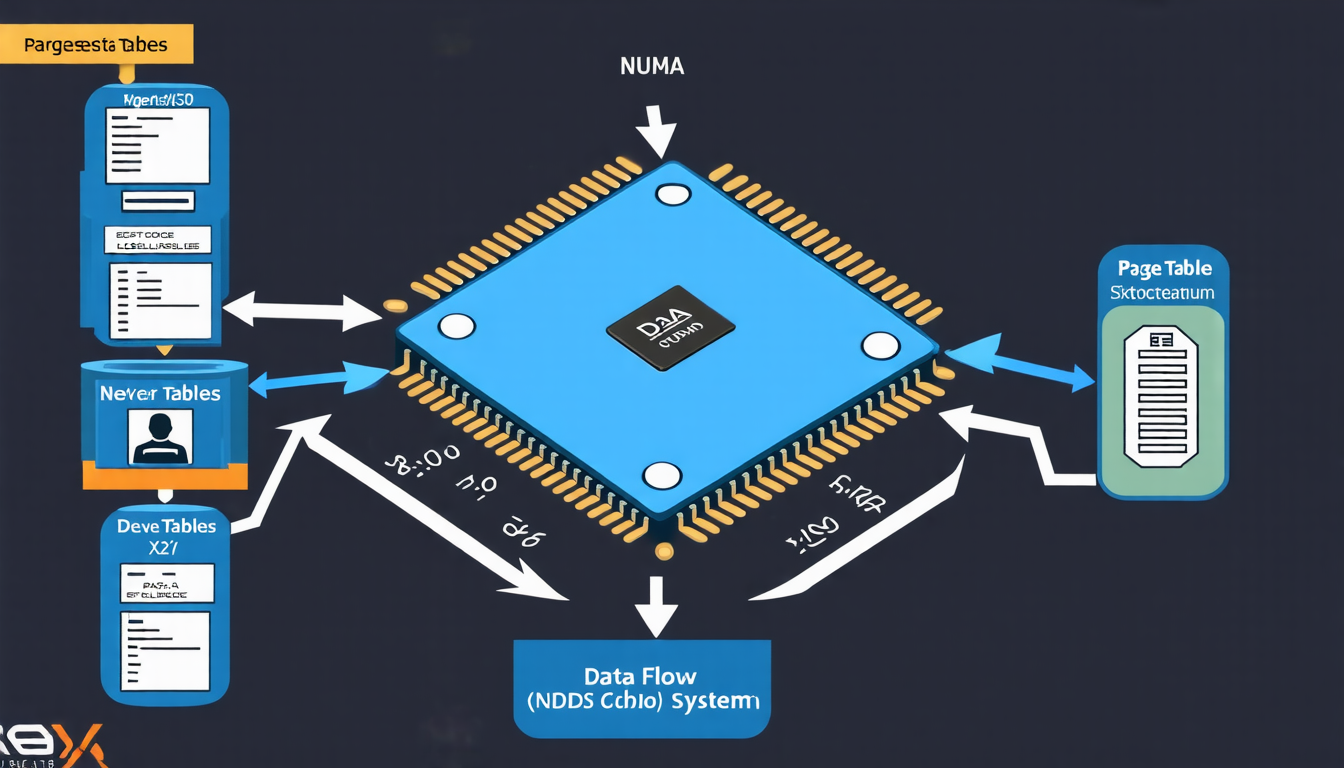
To address this problem, researchers have developed a new technique called Phoenix, an integrated CPU scheduler and memory manager that coordinates thread and page table placement to maximize locality and minimize remote memory accesses. This approach involves replicating page tables, which contain information about memory locations, on all NUMA nodes, allowing processors to quickly access the data they need.
Phoenix achieves this by differentiating between data and page table pages, enabling direct migration or replication of page tables based on application behavior. This allows the system to adapt to changing workloads and optimize performance accordingly. Additionally, Phoenix employs a memory bandwidth management mechanism to maintain quality of service (QoS) while reducing coherency maintenance overhead.
To evaluate the effectiveness of Phoenix, researchers tested it on real hardware with various applications, including scientific simulations, web servers, and databases. The results showed significant improvements in CPU cycles reduced by 2.09x and page-walk cycles reduced by 1.58x compared to existing solutions.
Phoenix’s innovative approach has far-reaching implications for the development of future computing systems. As systems continue to scale up with more processors and memory, efficient management of shared resources will become increasingly important. By addressing the NUMA effect head-on, Phoenix paves the way for faster, more scalable, and more powerful computing infrastructure.
The researchers’ work also highlights the importance of considering the interplay between CPU scheduling and memory management in modern computing systems. As applications continue to push the boundaries of processing power and memory requirements, it is crucial that operating systems adapt and evolve to meet these demands.
In a nutshell, Phoenix represents a major step forward in addressing the NUMA effect, offering a promising solution for efficient memory and processing power management on modern computing systems.
Cite this article: “Phoenix Rises: A New Approach to Efficiently Managing Memory and Processing Power in NUMA Systems”, The Science Archive, 2025.
Numa, Cpu Scheduling, Memory Management, Phoenix, Numa Effect, Page Tables, Thread Placement, Remote Memory Access, Qos, Scalability.





