

Wednesday 09 April 2025
In a fascinating experiment, scientists have created a computer model that mimics the behavior of particles in a system, showcasing the emergence of complex patterns and structures. This remarkable simulation has shed new light on how simple rules can lead to intricate and dynamic outcomes.
The researchers designed a program that starts with a set of particles moving randomly within a defined space. Each particle interacts with its neighbors based on a few basic principles: if they get too close, they repel each other; if they’re far apart, they attract. These interactions are simple yet powerful enough to give rise to remarkable patterns.
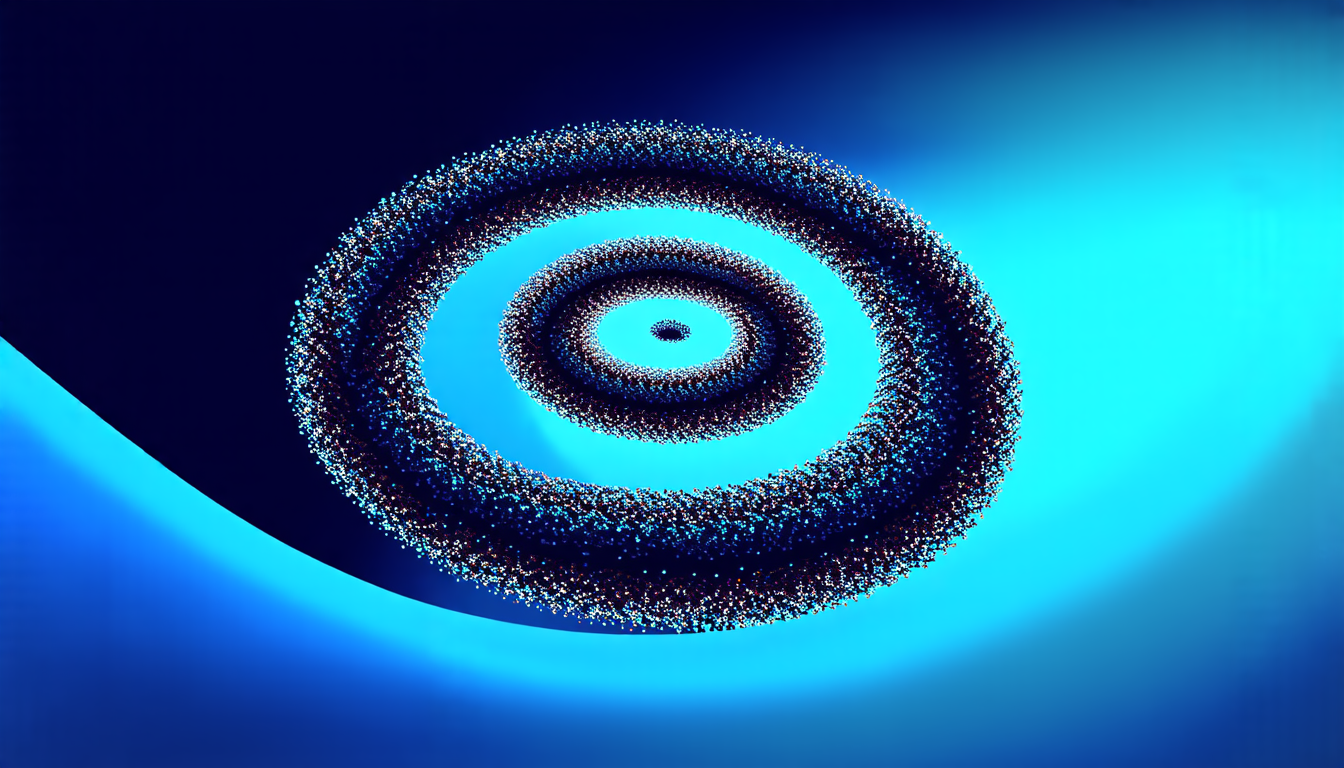
As the simulation runs, the particles begin to organize themselves into distinct groups and structures. Some particles form clusters, while others create sprawling networks. Over time, these patterns evolve and adapt in response to changes in their environment and the behavior of their neighbors.
The model’s creators were surprised by the range of complex behaviors that emerged from this simple framework. They observed waves, spirals, and even fractals – intricate, self-similar patterns that repeat at different scales. These structures are reminiscent of natural phenomena like snowflakes or Romanesco broccoli, which exhibit similar symmetries.
One of the most striking aspects of this simulation is its ability to generate novel and unexpected behaviors. The researchers found that small changes in the initial conditions or interactions could lead to drastically different outcomes. This sensitivity to initial conditions is a hallmark of complex systems, where tiny variations can have profound effects on the overall behavior.
The implications of this research are far-reaching. By understanding how simple rules can give rise to complex patterns, scientists may gain insights into natural phenomena that were previously difficult to explain. For example, the model could help researchers better understand flocking behaviors in birds or schooling in fish.
Moreover, this experiment highlights the potential for computer simulations to uncover new scientific principles and laws. By manipulating the parameters of the simulation, scientists can test hypotheses and explore different scenarios, which may lead to breakthroughs in our understanding of complex systems.
The beauty of this model lies not only in its ability to generate intricate patterns but also in its simplicity and elegance. It demonstrates that complexity can arise from basic rules, challenging the notion that intricate phenomena require elaborate mechanisms. This research has opened up new avenues for exploration, inviting scientists to continue pushing the boundaries of what is possible.
As we continue to explore and refine this model, we may uncover even more surprising and fascinating behaviors.
Cite this article: “Unlocking Emergent Behavior: A Novel Particle Model for STEM Education”, The Science Archive, 2025.
Computer, Simulation, Particles, Complex Systems, Patterns, Structures, Fractals, Waves, Spirals, Emergence





