

Wednesday 04 June 2025
As we navigate through our daily lives, it’s easy to take for granted the technology that enables us to find our way around. From GPS on our phones to mapping apps on our computers, navigation has become second nature. But what happens when these systems fail? In environments where traditional methods of localization – like using satellites or visual landmarks – are unavailable, finding one’s bearings can be a daunting task.
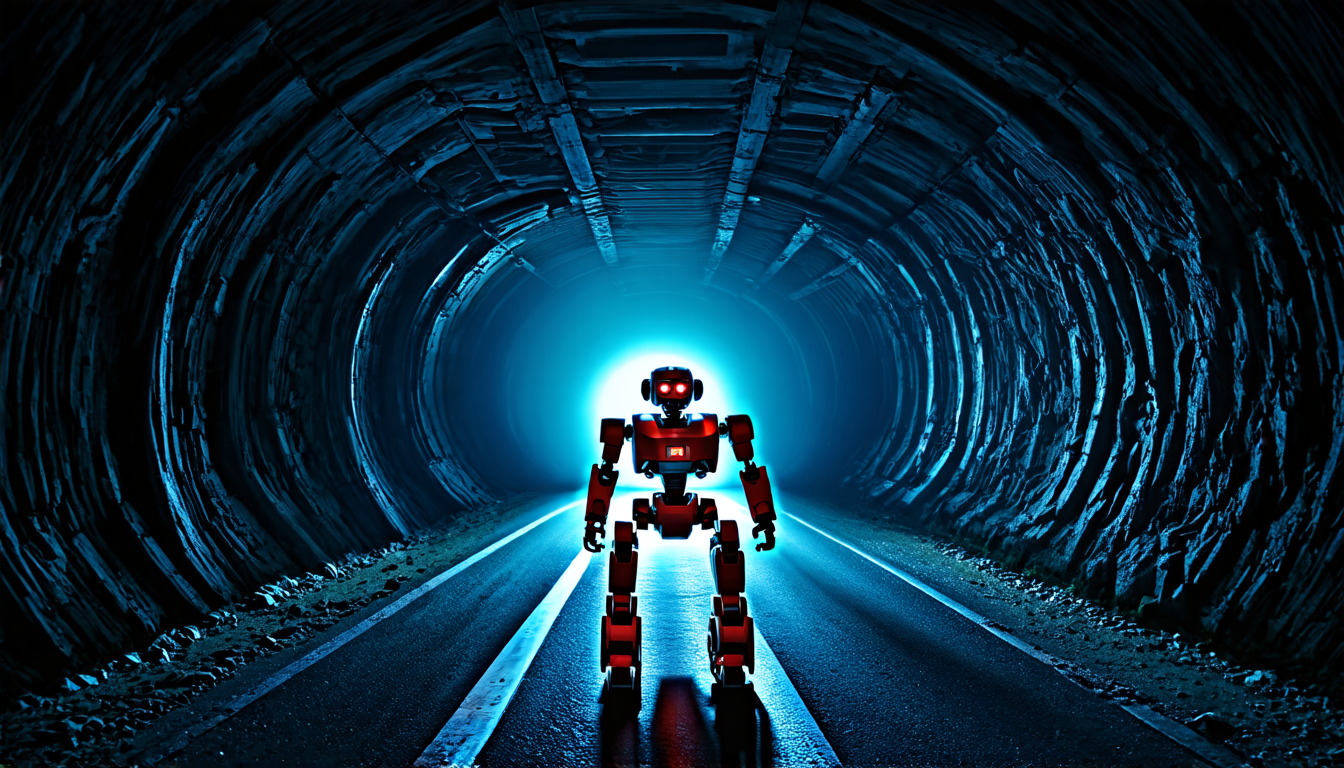
Researchers have been working on developing more reliable and resilient methods for localizing objects in hazardous environments, such as tunnels, urban disaster zones, and underground structures. These areas pose significant challenges to traditional navigation systems due to their featureless geometry and poor lighting conditions.
To tackle this problem, scientists have combined two sensors – a LiDAR (Light Detection and Ranging) scanner and a thermal camera – to create a robust localization system. LiDAR uses laser beams to create high-resolution 3D maps of its surroundings, while the thermal camera captures images in low-light conditions.
The researchers developed an extended Kalman filter, a sophisticated algorithm that combines data from both sensors to estimate the object’s position and orientation. This fusion of information allows the system to adapt to changing environments and maintain accuracy even when individual sensors fail.
In simulations, the new localization method demonstrated significant improvements over traditional LiDAR-based odometry systems. The system was able to accurately track an object’s movement through a virtual tunnel environment, despite the lack of visual features or satellite signals.
The implications of this research are far-reaching. Autonomous vehicles, inspection robots, and other cyber-physical systems could benefit from this technology, enabling them to navigate complex environments with greater reliability and accuracy.
This study highlights the importance of interdisciplinary collaboration in advancing our understanding of navigation and localization. By combining insights from computer science, robotics, and engineering, researchers can develop innovative solutions that push the boundaries of what is possible.
As we continue to explore new frontiers in technology, it’s exciting to think about how this research could be applied in real-world scenarios. From search and rescue missions to environmental monitoring, a more robust localization system could make all the difference in achieving critical goals.
Cite this article: “Robust Localization System for Hazardous Environments”, The Science Archive, 2025.
Localization, Navigation, Sensors, Lidar, Thermal Camera, Kalman Filter, Robotics, Autonomous Vehicles, Computer Science, Engineering





