

Monday 08 September 2025
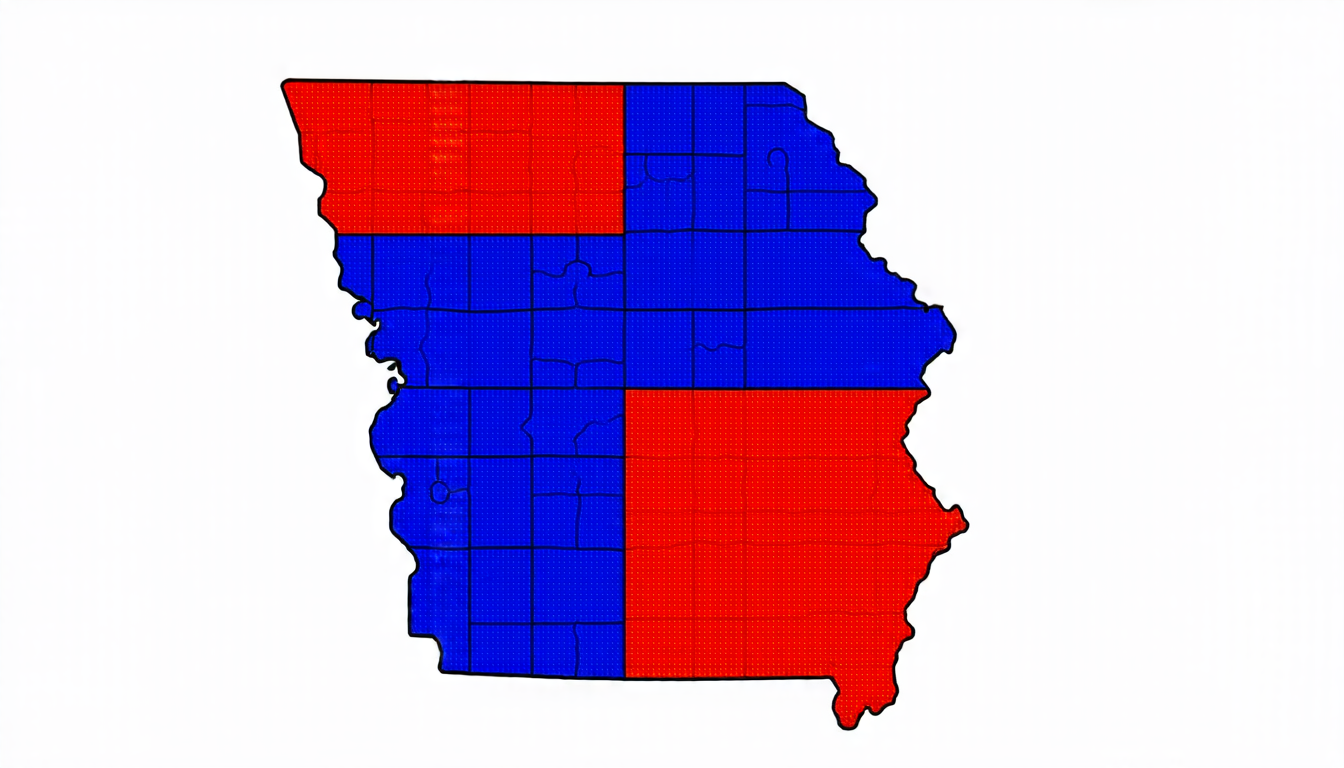
The Iowa congressional redistricting process, which is designed to be nonpartisan and data-driven, has been called into question due to its potential bias towards Republicans. A recent analysis of the maps proposed by the state’s legislative service bureau suggests that the enacted map is less compact than alternative proposals and may have been rejected for reasons not supported by the data.
The redistricting process in Iowa is unique in that it involves a nonpartisan agency drawing initial maps, which are then subject to approval or rejection by the state legislature. This approach is designed to reduce the influence of politics on the redistricting process, but some argue that it may still be vulnerable to bias.
The analysis in question used a random simulation algorithm to generate 215 alternative maps, each with its own unique characteristics. The results showed that the enacted map ranks poorly compared to these simulated maps, particularly when it comes to compactness.
Compactness is an important criterion for redistricting, as it helps ensure that districts are geographically cohesive and easier to govern. The analysis found that the enacted map has a minimum Reock score of 0.35, which is lower than the median score of 0.38 achieved by the simulated maps.
In addition to compactness, the analysis also examined population distribution and contiguity. The results showed that the enacted map performs well in these areas, with an absolute mean district population deviation from ideal population size of just 0.0033%. This suggests that the map is fair and balanced when it comes to population distribution.
However, the results also suggest that the enacted map may have been rejected for reasons not supported by the data. The efficiency gap, a measure of partisan bias, was found to be relatively high in the enacted map compared to the simulated maps.
The efficiency gap is calculated by comparing the difference between wasted votes for each party and dividing it by the total number of votes cast statewide. A high efficiency gap suggests that one party has an advantage over the other.
In this case, the efficiency gap was found to be 37%, which is higher than in most previous elections. This suggests that the enacted map may have been designed to favor Republicans, although it’s difficult to say for certain without more data.
The implications of these findings are significant, as they suggest that the redistricting process in Iowa may not be as nonpartisan as previously thought.
Cite this article: “Iowa Redistricting Process Questioned Over Potential Republican Bias”, The Science Archive, 2025.
Iowa, Redistricting, Nonpartisan, Data-Driven, Bias, Republicans, Compactness, Reock Score, Population Distribution, Contiguity, Efficiency Gap.





