

Thursday 18 September 2025
A team of astronomers has made a significant breakthrough in our understanding of the dusty halos that surround galaxies like our own Milky Way. By analyzing data from a massive survey of distant galaxies, they’ve been able to measure the amount of dust in these halos and how it affects the light we see coming from background objects.
The researchers used a technique called gravitational lensing, which involves looking at how the light from distant galaxies is bent by the gravity of foreground galaxies. By studying this bending, they can infer the presence of dark matter and even estimate its mass. But in this case, they also detected a subtle effect caused by dust in the halos surrounding these foreground galaxies.
Dust is a crucial component of galaxy evolution, as it plays a key role in regulating the formation of stars and planets. By studying its distribution within these dusty halos, astronomers can gain insights into how galaxies formed and evolved over billions of years.
The team used data from the Kilo-Degree Survey (KiDS), which has mapped the sky in unprecedented detail, to analyze the light coming from background objects as it passes through these dusty halos. By comparing their observations with simulations, they were able to infer the amount of dust present and how it affects the light we see.
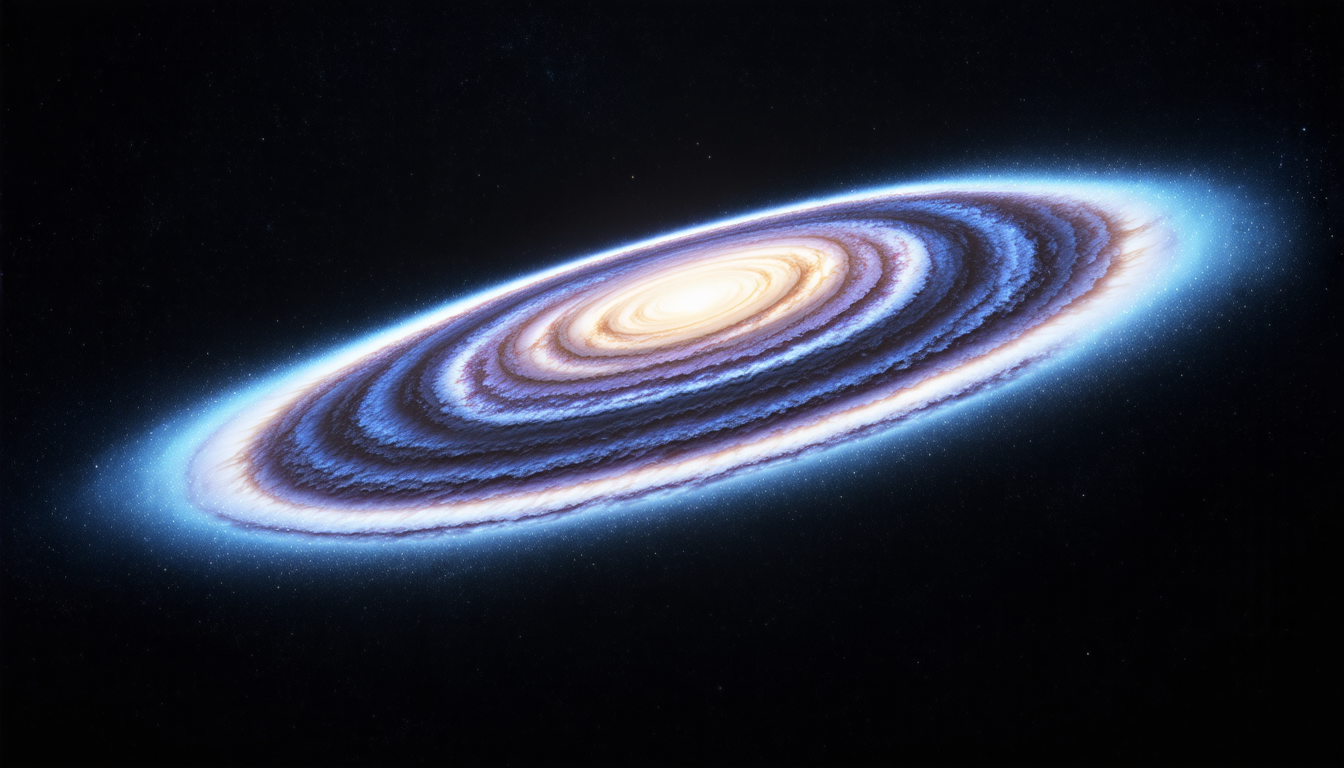
The results suggest that galaxies are surrounded by vast halos of dust, which can stretch millions of light-years across space. This dust scatters and absorbs shorter wavelengths of light, such as blue and ultraviolet radiation, making it appear redder than it would if there were no dust present.
The researchers also found that the amount of dust in these halos is closely tied to the mass of the surrounding dark matter halo. This suggests that the formation of stars and planets within galaxies may be influenced by the presence of dark matter.
While this study has focused on the dusty halos around individual galaxies, it’s likely that similar structures are present throughout the universe. Understanding their properties could help us better comprehend the evolution of galaxies and the role they play in shaping the cosmos as we know it.
The findings of this research have significant implications for our understanding of galaxy formation and evolution. By studying the dusty halos surrounding galaxies, astronomers can gain valuable insights into the processes that shaped the universe and continue to shape it today.
Cite this article: “Astrophysicists Uncover Vast Dusty Halos Surrounding Galaxies”, The Science Archive, 2025.
Galaxies, Dusty Halos, Dark Matter, Gravitational Lensing, Kids Survey, Galaxy Evolution, Star Formation, Planetary Formation, Cosmology, Astrophysics





