

Tuesday 23 September 2025
Researchers have made a breakthrough in developing magnetic-free optical isolators, which could revolutionize the field of photonics. The team, led by scientists at the University of Science and Technology of China, has successfully demonstrated a non-reciprocal propagation mechanism that relies on phonon-induced effects rather than magnetic fields.
Traditionally, optical isolators have relied on magnetism to break time-reversal symmetry and achieve non-reciprocal behavior. However, this approach is not compatible with silicon photonics, which is a crucial technology for integrated optics. The new method, on the other hand, uses acoustic waves to create an effective non-reciprocity in micro-ring resonators.
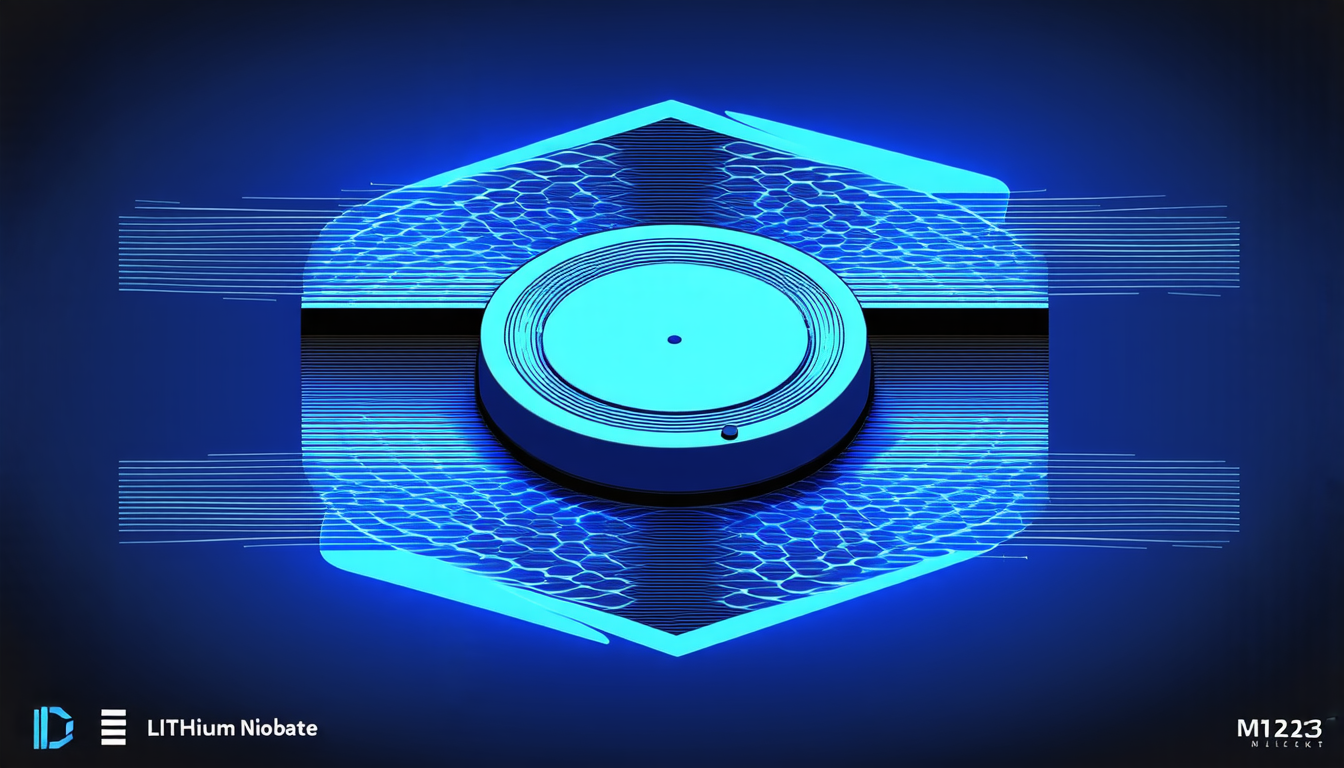
The team’s experiment involved fabricating interdigital transducers (IDTs) on lithium niobate substrates. These IDTs were used to convert microwave signals into phonons, which then interacted with optical modes in the micro-ring resonator. The resulting non-reciprocal behavior was observed and characterized using vector network analyzers.
One of the key advantages of this approach is its simplicity. Unlike traditional magnetic-based isolators, which require complex photonic structures and intermodal conversion, the new method can be achieved using a single IDT and fundamental optical modes. This makes it easier to integrate into existing systems and more scalable for large-scale applications.
The researchers also demonstrated that the non-reciprocal behavior is dynamically controllable through microwave excitation of the IDTs. This allows for real-time reconfiguration of the isolator’s response across a wide range of optical wavelengths. The linear relationship between acoustic power and mode splitting also enables precise control over the isolation performance.
These findings have significant implications for the development of future photonic systems. Magnetic-free optical isolators could enable more efficient and compact optical communication networks, as well as new applications in areas such as sensing and spectroscopy. The team’s approach also opens up possibilities for exploring novel topological photonics phenomena that were previously inaccessible due to magnetic field requirements.
The work is a testament to the power of interdisciplinary research, combining insights from materials science, optics, and acoustics to achieve a major breakthrough. As researchers continue to push the boundaries of what is possible with photonic systems, it’s clear that we can expect even more innovative solutions to emerge in the years to come.
Cite this article: “Magnetic-Free Optical Isolators: A Breakthrough for Photonics”, The Science Archive, 2025.
Optical Isolators, Non-Reciprocal Behavior, Phonon-Induced Effects, Magnetic-Free, Silicon Photonics, Integrated Optics, Micro-Ring Resonators, Interdigital Transducers, Lithium Niobate Substrates, Acoustic Waves





