

Thursday 25 September 2025
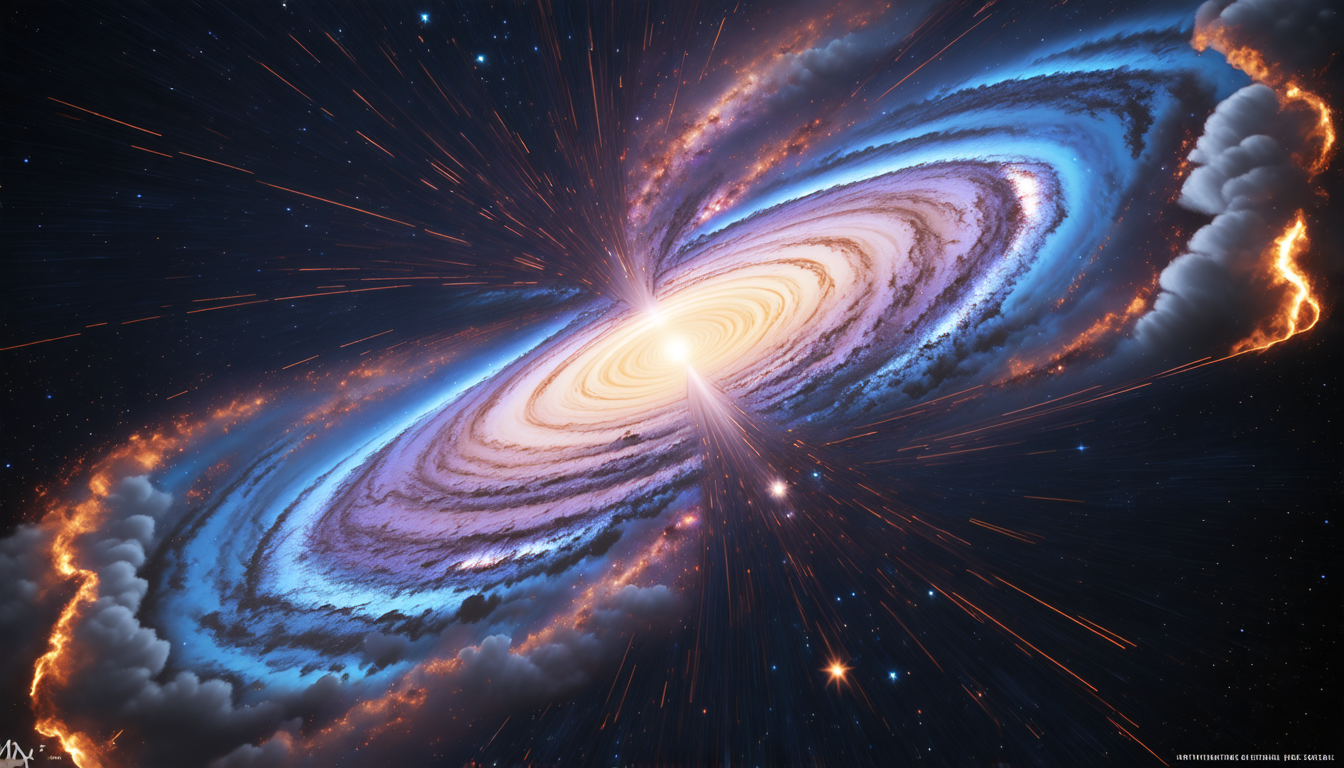
Scientists have long been fascinated by a peculiar phenomenon known as Quasi-Periodic Eruptions (QPEs), which occur at the centers of low-mass galaxies. These bursts of energy are thought to arise from interactions between stars and accretion disks, but exactly how they work has remained elusive.
A new study delves into the mysteries of QPEs by investigating whether these events can produce detectable high-energy neutrinos. Neutrinos are ghostly particles that barely interact with matter, making them notoriously difficult to detect. However, if we can capture a significant number of neutrinos from QPEs, it could provide valuable insights into the physics behind these enigmatic events.
The research team focused on ten observed QPE sources, evaluating their luminosities, recurrence periods, and flare durations. They then used computer simulations to model proton acceleration during the breakout phase, when the star intersects with the accretion disk. This process can produce neutrinos through two main mechanisms: pp interactions between protons and disk material, and pγ interactions between protons and gamma rays.
The team’s calculations suggest that protons can be accelerated up to tens of TeV, a significant fraction of which could produce detectable neutrinos. The optimized neutrino fluence for these ten QPE sources ranges from 7.0 × 10⁻⁷ to 1.5 × 10⁻⁴ GeV cm−2.
Next-generation neutrino telescopes with improved detection sensitivities in the TeV range could significantly enhance our ability to capture the cumulative neutrino signal from QPEs. This would not only provide a new window into the physics of these events but also offer a means to test theoretical models and constrain astrophysical parameters.
While the study’s findings are promising, detecting neutrinos from QPEs remains an ambitious task. The signals are expected to be faint, and the background noise in current detectors is high. Nevertheless, the potential payoff could be substantial, offering insights into the complex interplay between stars, accretion disks, and gravity.
As scientists continue to explore the mysteries of QPEs, this research provides a crucial step forward in understanding these enigmatic events. By pushing the boundaries of what we can detect and measure, we may yet uncover new secrets about the universe’s most energetic and mysterious phenomena.
Cite this article: “Neutrino Signals from Quasi-Periodic Eruptions: A New Window into Low-Mass Galaxy Physics”, The Science Archive, 2025.
Quasi-Periodic Eruptions, Neutrinos, Accretion Disks, Proton Acceleration, Tev, Gamma Rays, Astrophysics, Gravity, Stars, Low-Mass Galaxies





