

Monday 01 December 2025
The quest for realistic traffic simulation has long been a challenge for researchers and developers working on autonomous vehicles. While existing methods have made significant strides, they often fall short in capturing the complexity of real-world urban intersections, where multiple agents interact in intricate ways. A new dataset and simulator aim to bridge this gap by providing a more accurate representation of dense, heterogeneous traffic dynamics.
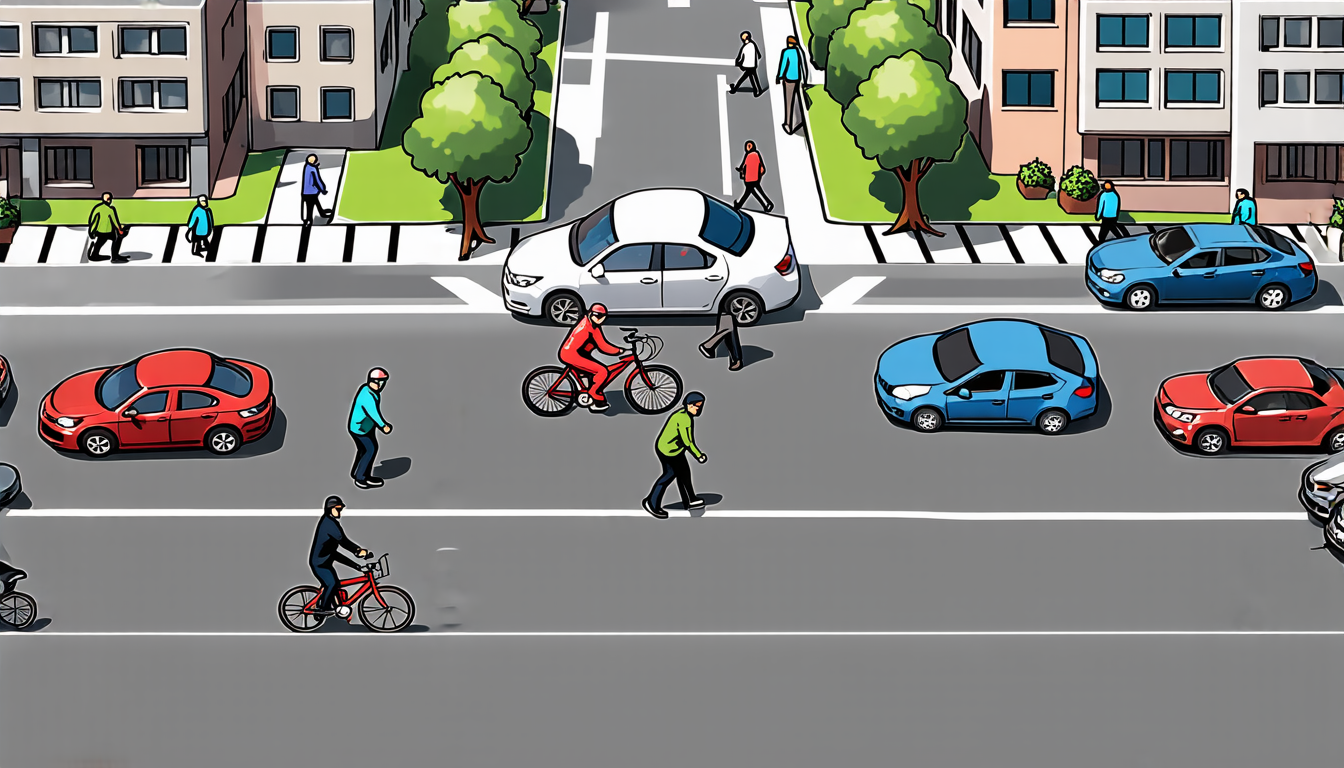
CiCross, a large-scale dataset collected from a real-world urban intersection, captures the interactions between motorized vehicles, non-motorized vehicles, and pedestrians. This unique focus allows researchers to explore the intricacies of these complex scenes, where multiple agents with different characteristics and behaviors intersect in unexpected ways.
The IntersectioNDE simulator is built upon CiCross and leverages a novel Interaction Decoupling Strategy (IDS) to learn compositional dynamics from agent subsets. This approach enables the marginal-to-joint simulation of complex urban traffic scenarios, resulting in more accurate and stable predictions. By integrating IDS with a scene-aware Transformer network, IntersectioNDE improves its ability to model heterogeneous interactions, ensuring robustness and long-term stability.
The simulator’s performance is demonstrated through case studies of representative scenarios from the CiCross test set. These examples showcase the ability of IntersectioNDE to accurately capture complex interactions, such as a non-motorized vehicle running a red light and slowing down due to obstruction from motorized vehicles approaching perpendicularly.
One of the key advantages of IntersectioNDE is its ability to generalize to unseen interaction combinations within the same scene. This is particularly important for autonomous vehicles, which must be able to adapt to unexpected situations and respond accordingly. By providing a more realistic representation of urban traffic dynamics, IntersectioNDE can help improve the development of safer and more reliable self-driving systems.
The success of IntersectioNDE highlights the importance of continued investment in data-driven research and simulation methods for autonomous vehicles. As the technology continues to evolve, it is crucial that researchers prioritize the development of more accurate and realistic simulators, allowing them to test and refine their approaches in a controlled environment before deploying them on the road.
In the future, IntersectioNDE has the potential to be used as a foundation for developing more advanced autonomous driving systems. By providing a more detailed understanding of complex urban traffic scenarios, it can help researchers and developers create safer, more efficient, and more reliable self-driving vehicles that better interact with their surroundings.
Cite this article: “Realistic Urban Traffic Simulation for Autonomous Vehicles”, The Science Archive, 2025.
Autonomous Vehicles, Traffic Simulation, Realistic Scenarios, Urban Intersections, Non-Motorized Vehicles, Pedestrians, Machine Learning, Transformer Network, Interaction Decoupling Strategy, Cicross Dataset






diflucan medication
diflucan medication
lisinopril
lisinopril
metoclopramide 10mg
metoclopramide 10mg
vidalista
vidalista