

Tuesday 02 December 2025
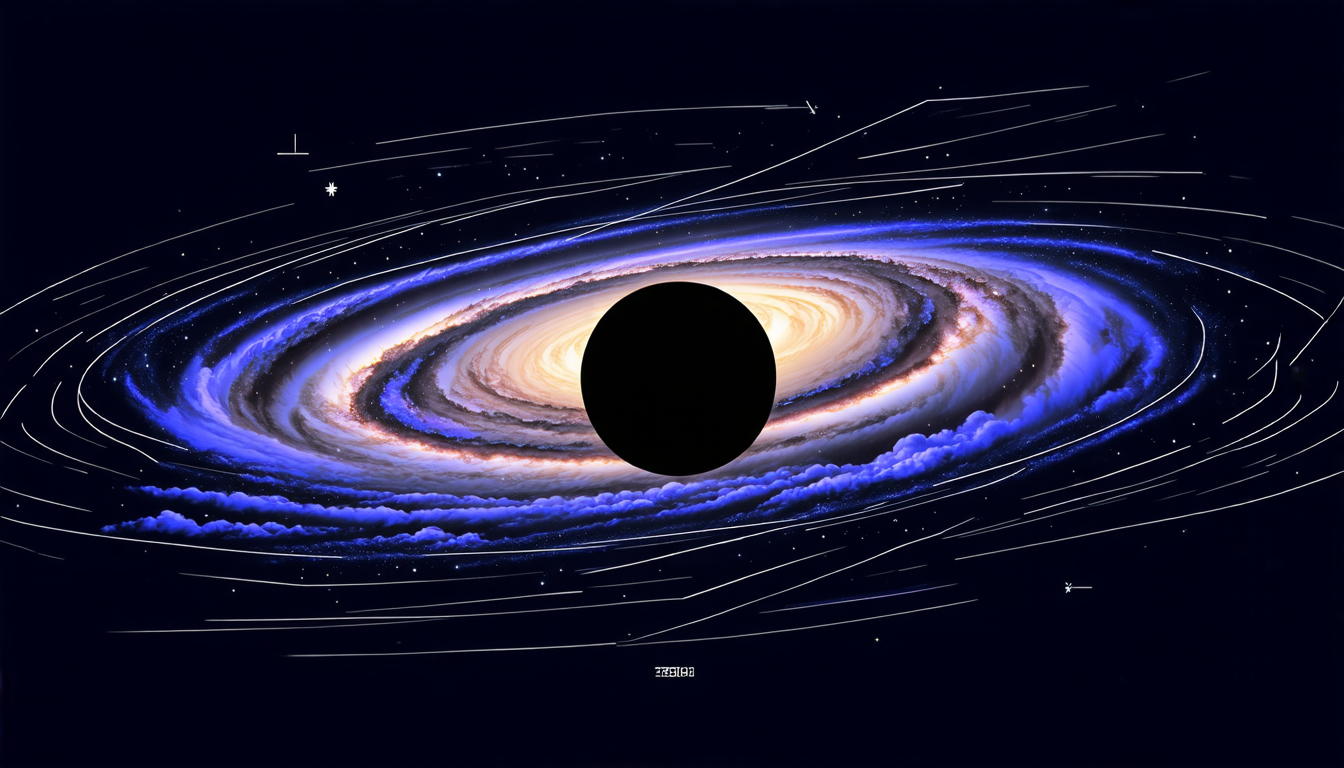
Deep in space, there are massive black holes at the centers of galaxies that are surrounded by swirling disks of hot gas and dust. These supermassive black holes can have millions or even billions of times the mass of our sun, and they play a crucial role in shaping the evolution of their host galaxies.
A team of scientists has been studying the behavior of these black holes and has made some fascinating discoveries. By observing the light emitted by the hot gas swirling around the black hole, they were able to learn more about its properties, such as its mass and spin.
One of the key findings is that the magnetic field surrounding the black hole plays a significant role in determining how it affects the surrounding environment. The researchers found that when the magnetic field is strong, it can actually slow down the spin of the black hole, while a weaker magnetic field allows it to spin faster.
Another important discovery is the relationship between the black hole’s mass and its optical variability timescale. The optical variability timescale is a measure of how quickly the light emitted by the hot gas changes over time. The researchers found that there is a strong correlation between these two values, meaning that as the black hole gets more massive, its optical variability timescale increases.
This finding has important implications for our understanding of the behavior of supermassive black holes in galaxies. It suggests that the mass of the black hole plays a key role in determining how it affects the surrounding environment and the way it varies over time.
The researchers also found that there is a correlation between the jet magnetic field, black hole spin, and optical variability timescale. This means that the properties of the magnetic field surrounding the black hole are closely tied to its spin and the way it varies over time.
These findings have significant implications for our understanding of the behavior of supermassive black holes in galaxies. They suggest that the properties of the magnetic field surrounding the black hole play a crucial role in determining how it affects the surrounding environment and the way it varies over time.
The research also sheds light on the process by which supermassive black holes form and evolve over billions of years. The findings suggest that the mass of the black hole plays a key role in determining its properties, such as its spin and magnetic field, which in turn affect the surrounding environment.
Overall, this research provides new insights into the behavior of supermassive black holes in galaxies and has important implications for our understanding of the evolution of galaxies over billions of years.
Cite this article: “Magnetic Fields and Mass Shape the Behavior of Supermassive Black Holes”, The Science Archive, 2025.
Supermassive Black Holes, Galactic Centers, Magnetic Fields, Spin, Optical Variability, Timescale, Galaxy Evolution, Black Hole Formation, Jet Magnetic Field, Astrophysics






levitra price
levitra price