

Tuesday 02 December 2025
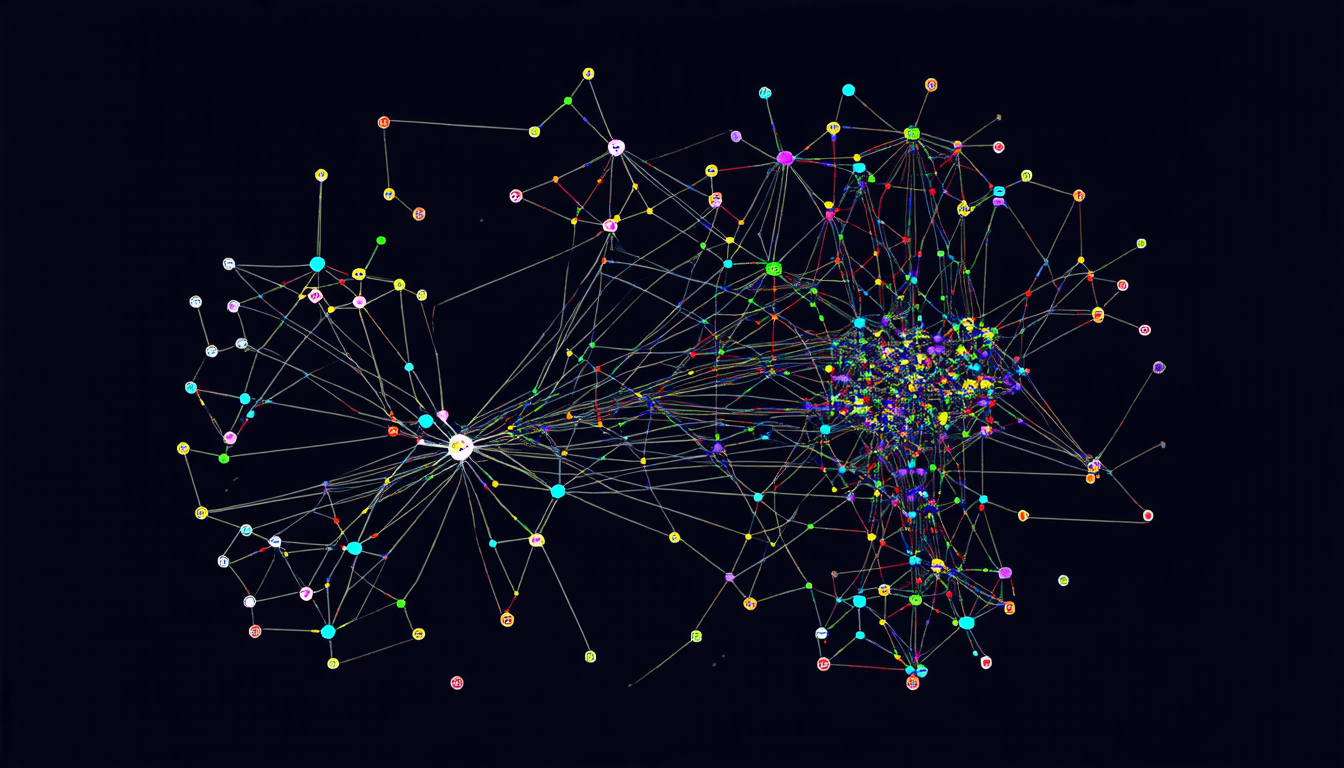
Scientists have long been fascinated by the concept of distributed graph algorithms, which involve solving complex problems on networks of computers or devices. Recently, a team of researchers made a significant breakthrough in this field, developing an innovative algorithm that can efficiently color graphs with bounded neighborhood independence.
For those unfamiliar with the topic, graph theory is a branch of mathematics that deals with the study of graphs, which are collections of nodes and edges. In the context of distributed computing, graphs represent networks of devices or computers, where each node represents a device and the edges represent communication links between them.
The problem of coloring graphs is a classic one in computer science. Given a graph, the goal is to assign colors to its nodes such that adjacent nodes have different colors. This may seem like a simple task, but it can be computationally challenging, especially when dealing with large networks.
In recent years, researchers have been focusing on developing algorithms for coloring graphs in a distributed manner, where each node in the network makes decisions based only on local information. This approach is particularly useful in real-world scenarios, where data is often decentralized and nodes may not have access to global information.
The new algorithm developed by the researchers is designed specifically for graphs with bounded neighborhood independence, which means that any two nodes in the graph are at most a certain distance from each other. This property is important because it allows the algorithm to take advantage of local structure in the graph, reducing the amount of communication required between nodes.
The algorithm works by first dividing the graph into smaller subgraphs, known as clusters. Each node in the graph then communicates with its neighbors within its cluster to determine a color for itself. The key innovation is that each node uses a combination of local information and global constraints to make its decision, rather than relying solely on local information.
The results are impressive: the algorithm can efficiently color graphs with bounded neighborhood independence in polylogarithmic time, which is significantly faster than previous algorithms. This has important implications for real-world applications, such as network optimization and distributed systems management.
One of the most exciting aspects of this research is its potential to enable more efficient and scalable solutions for complex problems. By developing algorithms that can take advantage of local structure in graphs, researchers may be able to create more robust and resilient networks that are better equipped to handle large amounts of data.
As scientists continue to push the boundaries of distributed graph algorithms, we can expect to see even more innovative solutions emerge.
Cite this article: “Breaking Barriers in Distributed Graph Algorithms: A New Algorithm for Efficiently Coloring Graphs with Bounded Neighborhood Independence”, The Science Archive, 2025.
Distributed Graph Algorithms, Graph Theory, Coloring Graphs, Bounded Neighborhood Independence, Local Information, Global Constraints, Clusters, Polylogarithmic Time, Network Optimization, Distributed Systems Management






levitra generic
levitra generic
ursodiol cost
ursodiol cost
buy stromectol online no prescription
buy stromectol online no prescription
mobic 7.5 mg oral tablet
mobic 7.5 mg oral tablet