

Friday 28 November 2025
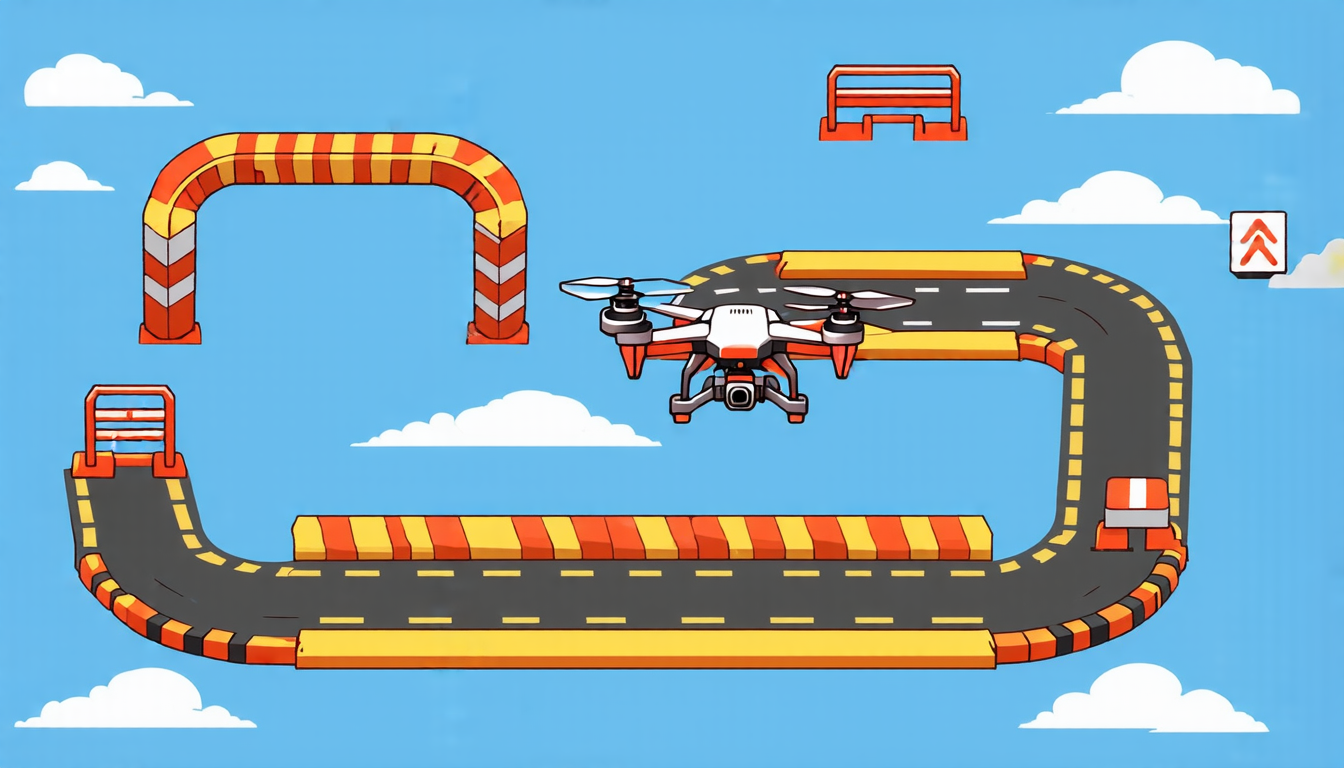
Drone racing, a sport that has captured the imagination of many, has taken another significant leap forward. A new approach to training autonomous drones for this high-speed activity has been developed, allowing them to learn and adapt in increasingly complex environments.
The traditional method of teaching drones to fly quickly and precisely involves simulating real-world scenarios in a virtual environment. However, this approach has limitations, as it can be difficult to accurately replicate the complexities of real-world racing tracks and obstacles. To overcome these challenges, researchers have turned to reinforcement learning, a type of machine learning that enables machines to learn from trial and error.
The new approach, called CRUISE (Curriculum-Based Iterative Self-Play for Scalable Multi-Drone Racing), uses a structured curriculum to teach drones the skills they need to succeed in drone racing. The curriculum is designed to gradually increase in difficulty, with each stage building upon the previous one to help the drone learn and adapt.
The first stage of the curriculum focuses on teaching the drone basic flight skills, such as taking off and landing safely. As the drone becomes more confident and proficient, it moves on to more challenging stages, where it must navigate increasingly complex tracks and obstacles.
One of the key innovations of CRUISE is its use of self-play, a technique that allows the drones to learn from each other’s experiences. In traditional reinforcement learning, machines are trained using human-designed rewards or penalties. However, this approach can be time-consuming and may not always lead to the best results. By allowing the drones to learn from each other, CRUISE can more efficiently and effectively train them for drone racing.
The researchers behind CRUISE have tested their approach in high-fidelity simulations of real-world drone racing tracks. Their results are impressive: the drones trained using CRUISE were able to achieve significantly higher speeds and success rates than those trained using traditional methods.
The implications of this technology extend beyond drone racing. The ability to train autonomous machines to learn and adapt in complex environments has significant potential for a wide range of applications, from search and rescue operations to environmental monitoring.
While there are still challenges to overcome before CRUISE can be used in real-world scenarios, the results so far are promising. As researchers continue to refine their approach, we can expect to see even more impressive advancements in autonomous drone technology.
Cite this article: “Revving Up Autonomous Drone Racing with CRUISE”, The Science Archive, 2025.
Drone Racing, Autonomous Drones, Reinforcement Learning, Machine Learning, Curriculum-Based Training, Self-Play, High-Fidelity Simulations, Search And Rescue, Environmental Monitoring, Robotics.
Reference: Onur Akgün, “Curriculum-Based Iterative Self-Play for Scalable Multi-Drone Racing” (2025).





