

Wednesday 26 November 2025
The quest for a deeper understanding of the electromagnetic near-field has long been a fascinating pursuit in the world of physics. Researchers have been working tirelessly to develop new techniques that can capture this elusive phenomenon, which plays a crucial role in determining how light interacts with matter at the nanoscale.
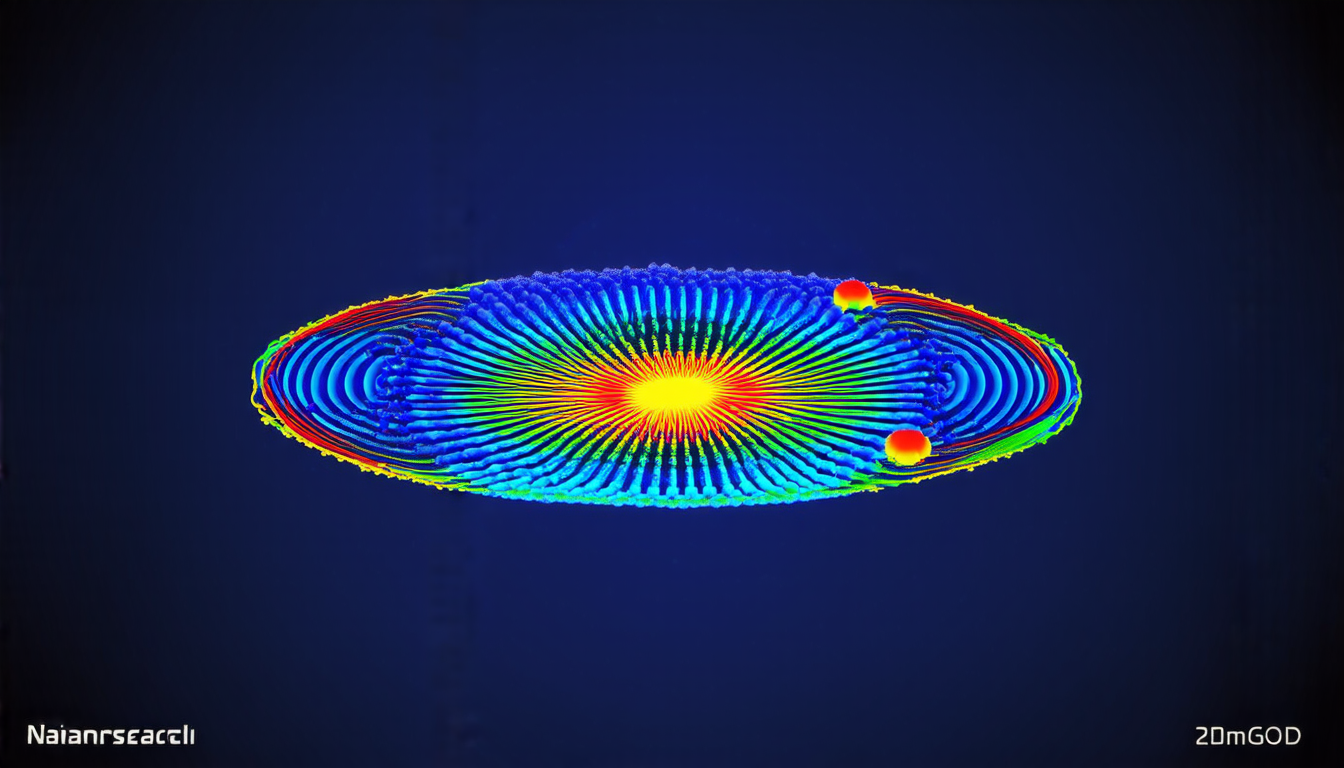
One such technique is called electron near-field tomography, and it’s an innovative approach that uses free electrons to reconstruct 3D images of electromagnetic fields. By manipulating these electrons using advanced optics and electronics, scientists can create highly detailed pictures of the near-field patterns that govern the behavior of light in complex nanostructures.
The idea behind this technique is simple yet brilliant: by carefully controlling the trajectory of a free electron as it interacts with the electromagnetic field, researchers can extract valuable information about the field’s spatial distribution. This information can then be used to reconstruct a 3D image of the near-field pattern using advanced algorithms and computational power.
One of the key challenges in developing this technique has been overcoming the limitations imposed by the electron’s wave-like nature. Electrons are notoriously difficult to control, as their behavior is influenced by a multitude of factors including their energy, momentum, and spin. To overcome these limitations, researchers have had to develop sophisticated methods for manipulating the electron’s trajectory, such as using carefully designed optical traps or exploiting the electron’s intrinsic spin properties.
The potential applications of this technique are vast and varied. By allowing researchers to visualize the near-field patterns in complex nanostructures, electron near-field tomography could revolutionize our understanding of how light interacts with matter at the nanoscale. This knowledge could be used to develop new materials and devices with unique optical properties, such as super-efficient solar cells or ultra-fast data storage systems.
In addition to its potential applications in materials science and engineering, this technique also has implications for our fundamental understanding of the electromagnetic near-field. By providing a new window into the behavior of light at the nanoscale, electron near-field tomography could help us better understand some of the most mysterious phenomena in physics, such as quantum entanglement and the nature of space-time itself.
As researchers continue to refine this technique and push its capabilities to the limit, we can expect to see a new era of scientific discovery and innovation emerge. By harnessing the power of free electrons to reveal the secrets of the electromagnetic near-field, scientists are one step closer to unlocking the mysteries of the universe.
Cite this article: “Unveiling the Secrets of Light’s Nanoscale Behavior”, The Science Archive, 2025.
Electromagnetic Field, Near-Field, Electron Tomography, Free Electrons, Nanoscale, Light-Matter Interaction, Quantum Entanglement, Space-Time, Materials Science, Optics





