

Thursday 23 January 2025
Uranus, our seventh planet from the sun, has long been a mystery to astronomers and scientists alike. For decades, researchers have been studying the planet’s upper atmosphere, trying to understand its temperature fluctuations and the factors that contribute to them.
Recently, a team of scientists used the IGRINS (Immersion Grating Infrared Spectrometer) instrument at the Discovery Channel Telescope to study Uranus’ near-infrared spectrum. The team’s findings revealed a long-term cooling trend in the planet’s upper atmosphere, which has puzzled astronomers for years.
The researchers analyzed data from three apparitions of Uranus – 2018, 2020, and 2023 – using IGRINS and Gemini South observatories. They focused on the planet’s H2 emission lines, which are sensitive to temperature changes in the thermosphere.
The results showed that the temperature of Uranus’ upper atmosphere has been steadily decreasing over the past few decades, with a notable drop during the 2018 apparition. This cooling trend is not entirely unexpected, as solar activity and auroral heating can affect the planet’s temperature. However, the magnitude of the cooling trend was more significant than anticipated.
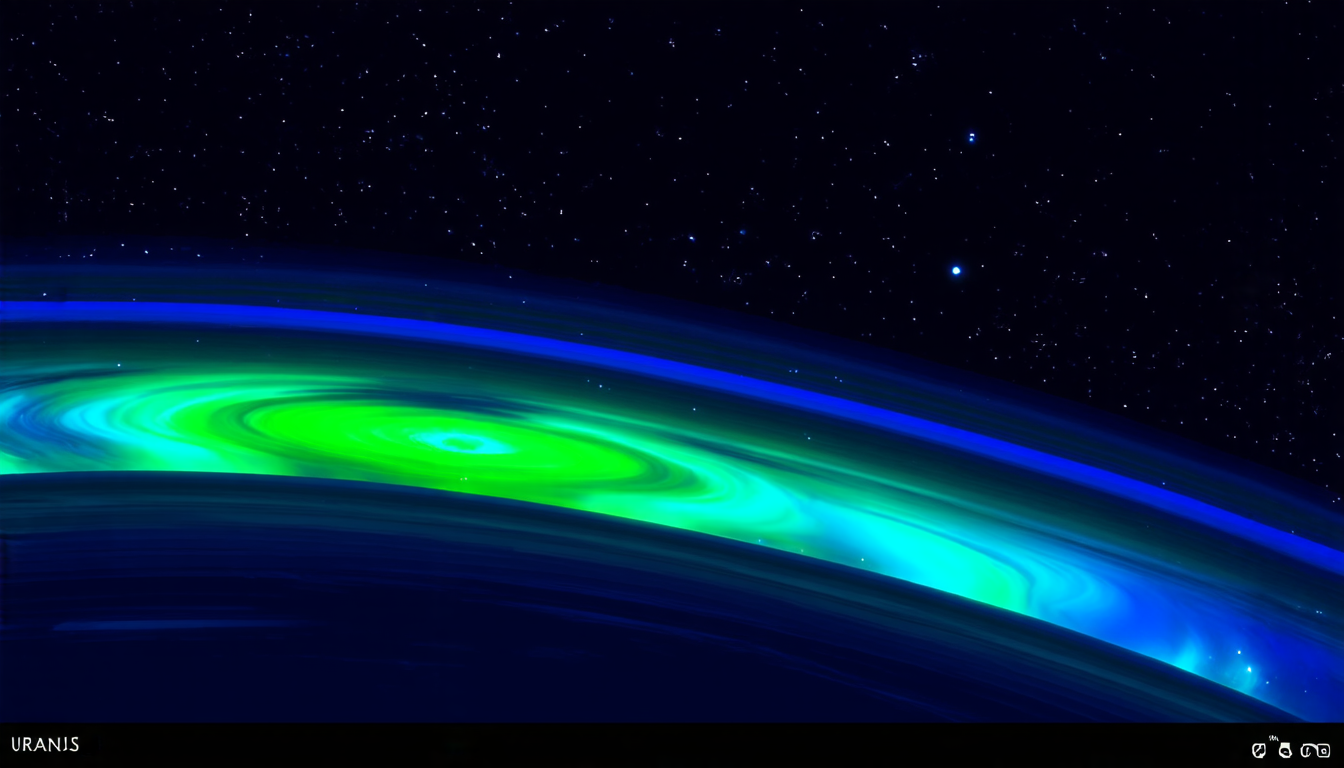
The team’s analysis also revealed that the aurorae at Uranus’ magnetic poles play a crucial role in heating the thermosphere. Aurorae are intense displays of light that occur when charged particles from the solar wind interact with a planet’s magnetic field. In the case of Uranus, these aurorae can heat up the upper atmosphere, contributing to the temperature fluctuations observed by the researchers.
However, the team found that the auroral heating is not consistent over time, which could be due to changes in the solar wind and its interaction with Uranus’ magnetic field. This variability can lead to a cooling trend in the long term.
The study’s findings have significant implications for our understanding of Uranus’ upper atmosphere and the factors that influence it. The research highlights the importance of continued monitoring and observation of the planet, as well as the need to better understand the complex interactions between solar activity, aurorae, and temperature fluctuations in the thermosphere.
As scientists continue to study Uranus, they will likely uncover more secrets about this enigmatic planet. The IGRINS instrument has proven itself to be a valuable tool for studying Uranus’ near-infrared spectrum, providing insights into the planet’s temperature fluctuations and auroral activity.
Cite this article: “Unraveling the Mysteries of Uranus Upper Atmosphere”, The Science Archive, 2025.
Uranus, Igrins, Infrared, Spectrum, Temperature, Cooling, Trend, Aurorae, Magnetic Poles, Thermosphere





