

Thursday 23 January 2025
Scientists have long been fascinated by the potential of van der Waals materials, a class of extremely thin and versatile substances that can be used to create a wide range of technologies, from superconducting devices to advanced sensors. In a recent breakthrough, researchers at IISER Thiruvananthapuram in India have successfully engineered overdamped Josephson junctions using these materials.
A Josephson junction is a critical component in many modern electronic devices, including supercomputers and quantum computers. It’s essentially a tiny bridge that connects two pieces of material, allowing electricity to flow between them. The key challenge is creating a reliable and controllable connection, as even the slightest imperfection can disrupt the flow of electricity.
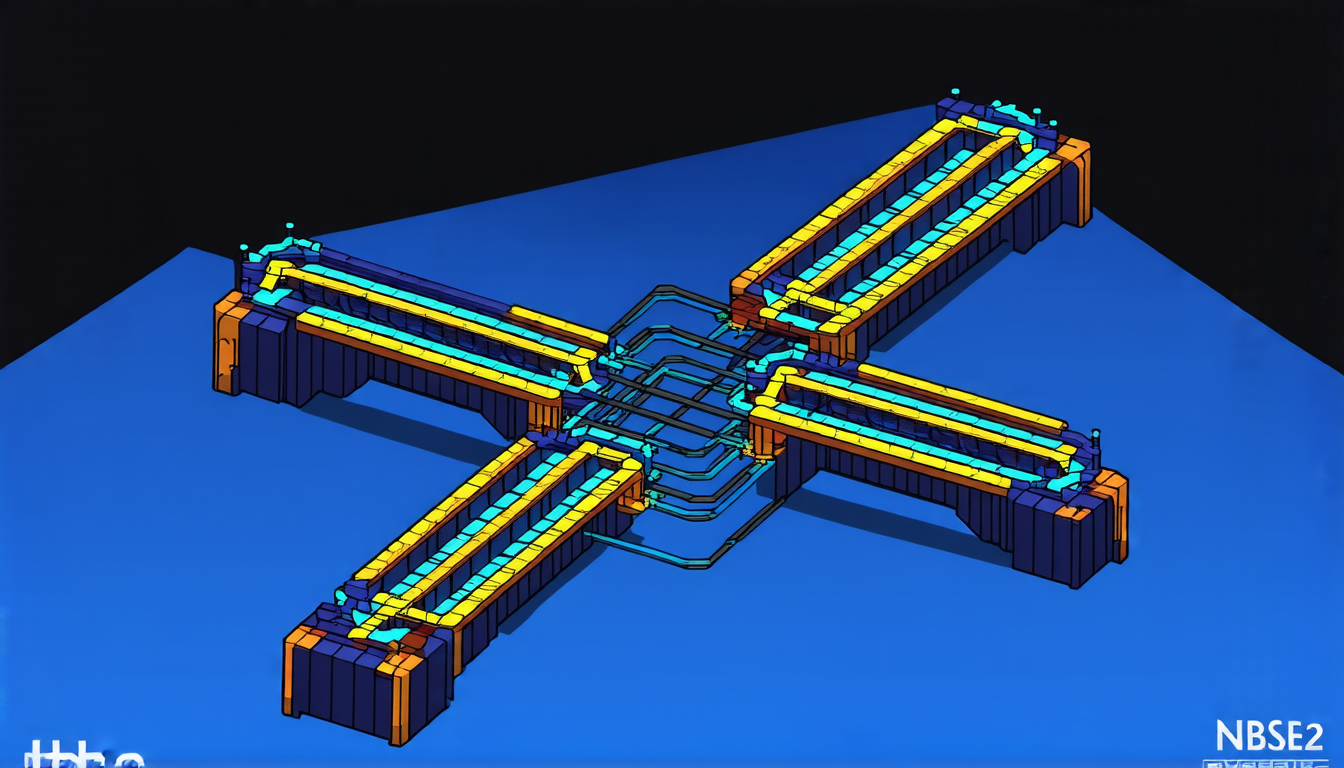
The Indian researchers tackled this problem by using van der Waals materials, specifically a type called NbSe2, which has been shown to exhibit superconducting properties at very low temperatures. By carefully controlling the size and shape of these flakes, the team was able to create a series of Josephson junctions with remarkably consistent performance.
One of the most significant breakthroughs came when the researchers discovered that by reducing the area of the junction, they could significantly increase its critical current – the point at which it begins to carry electricity. This finding has major implications for the development of more efficient and powerful electronic devices.
The team’s results were achieved through a combination of advanced techniques, including microfabrication and optical microscopy. By carefully studying the behavior of these tiny junctions, they were able to identify key factors that influence their performance, such as temperature and magnetic field.
The potential applications of this technology are vast and varied. For example, it could be used to create more powerful supercomputers or even quantum computers, which have the potential to solve complex problems that are currently unsolvable with traditional computing methods. It could also be used to develop advanced sensors that can detect even the slightest changes in their environment.
The Indian researchers’ achievement is a testament to the power of interdisciplinary collaboration and innovative thinking. By combining cutting-edge materials science with advanced techniques from physics and engineering, they have opened up new possibilities for the development of next-generation electronic devices.
Cite this article: “Engineering Versatile Josephson Junctions with Van der Waals Materials”, The Science Archive, 2025.
Van Der Waals Materials, Josephson Junctions, Superconducting Properties, Nbse2, Microfabrication, Optical Microscopy, Critical Current, Temperature, Magnetic Field, Quantum Computers





