

Thursday 23 January 2025
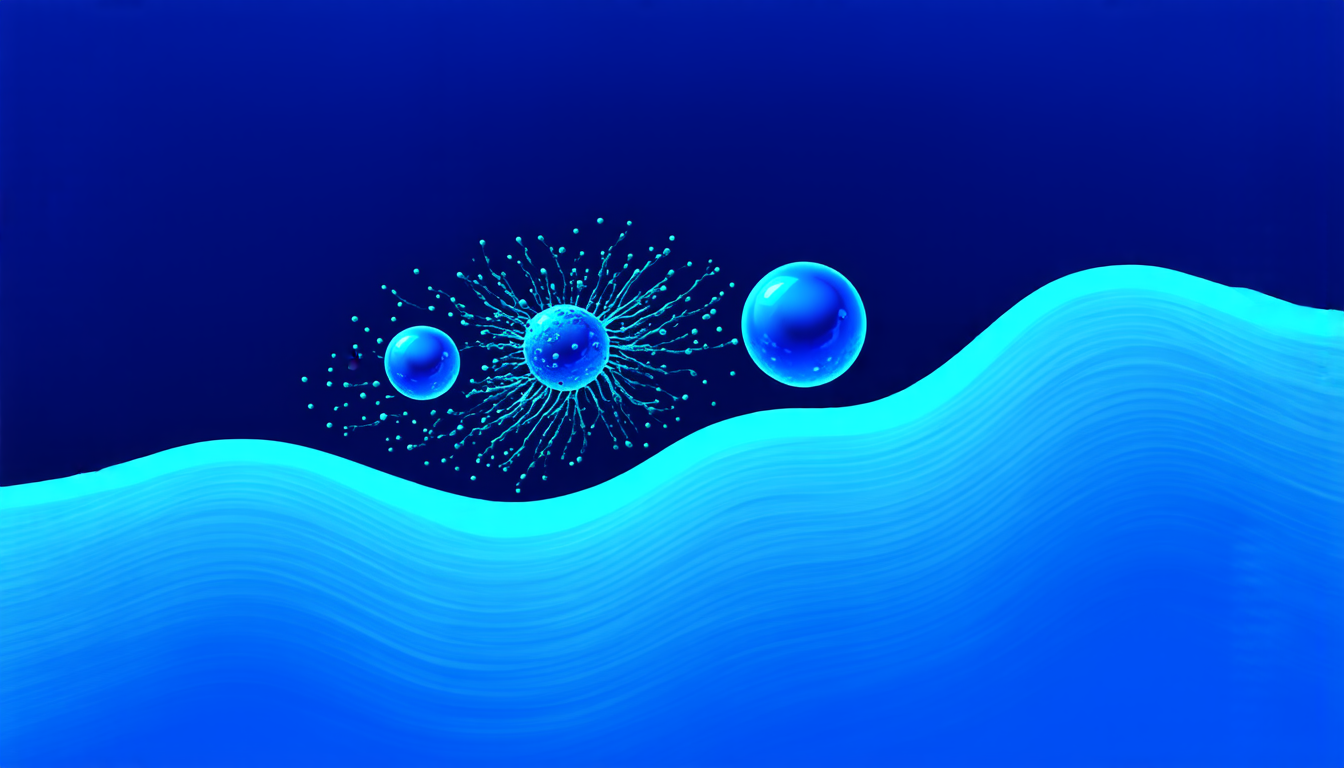
Run-and-tumble particles are a type of tiny, self-propelled organisms that are found in nature, such as bacteria and cells. They move by changing direction randomly, which allows them to navigate their environment and find food or other resources. Recently, scientists have been studying these particles to understand how they behave and interact with each other.
In a new study, researchers used mathematical models to simulate the behavior of two interacting run-and-tumble particles in one dimension. They found that when these particles are close together, they can form a bound state where they stick together for a long time before separating again. This is similar to how atoms bond together to form molecules.
The scientists also discovered that the properties of this bound state depend on the speed at which the particles move and the strength of their interactions with each other. For example, if the particles are moving very slowly, they are more likely to form a tight bond, while faster-moving particles will have a weaker bond.
This research has important implications for understanding how these particles interact in nature. For example, it could help us understand how bacteria move and find food in their environment. It could also shed light on how cells communicate with each other and coordinate their behavior.
The study used advanced mathematical techniques to simulate the behavior of the particles. The researchers developed a new type of Markov process that allows them to model the interactions between the particles and the random changes in direction they undergo.
Markov processes are a type of mathematical model that is commonly used to describe random phenomena, such as the movement of molecules or the behavior of financial markets. In this case, the researchers used a special type of Markov process called a piecewise-deterministic Markov process (PDMP), which allows them to model the particles’ interactions and changes in direction.
The PDMP is a powerful tool for modeling complex systems, but it can be challenging to work with because it involves solving a series of complex mathematical equations. The researchers used advanced computational techniques to solve these equations and simulate the behavior of the particles.
Overall, this study provides new insights into the behavior of run-and-tumble particles and their interactions. It highlights the importance of understanding these complex systems and how they can be modeled using advanced mathematical techniques.
Cite this article: “Interacting Run-and-Tumble Particles Form Bound States in One Dimension”, The Science Archive, 2025.
Run-And-Tumble Particles, Bacteria, Cells, Mathematical Models, Simulations, Markov Processes, Pdmp, Interactions, Bound State, Stochastic Systems





