

Friday 31 January 2025
In a recent study, researchers have delved into the world of linear codes and their corresponding graphs. These codes are used in various fields such as coding theory, cryptography, and computer science to transmit information efficiently and reliably.
The graph of a linear code is a mathematical structure that represents the relationships between different elements of the code. In this context, researchers have focused on finding the maximum cliques within these graphs – cliques being groups of nodes (or vertices) in the graph where each node is connected to every other node in the group.
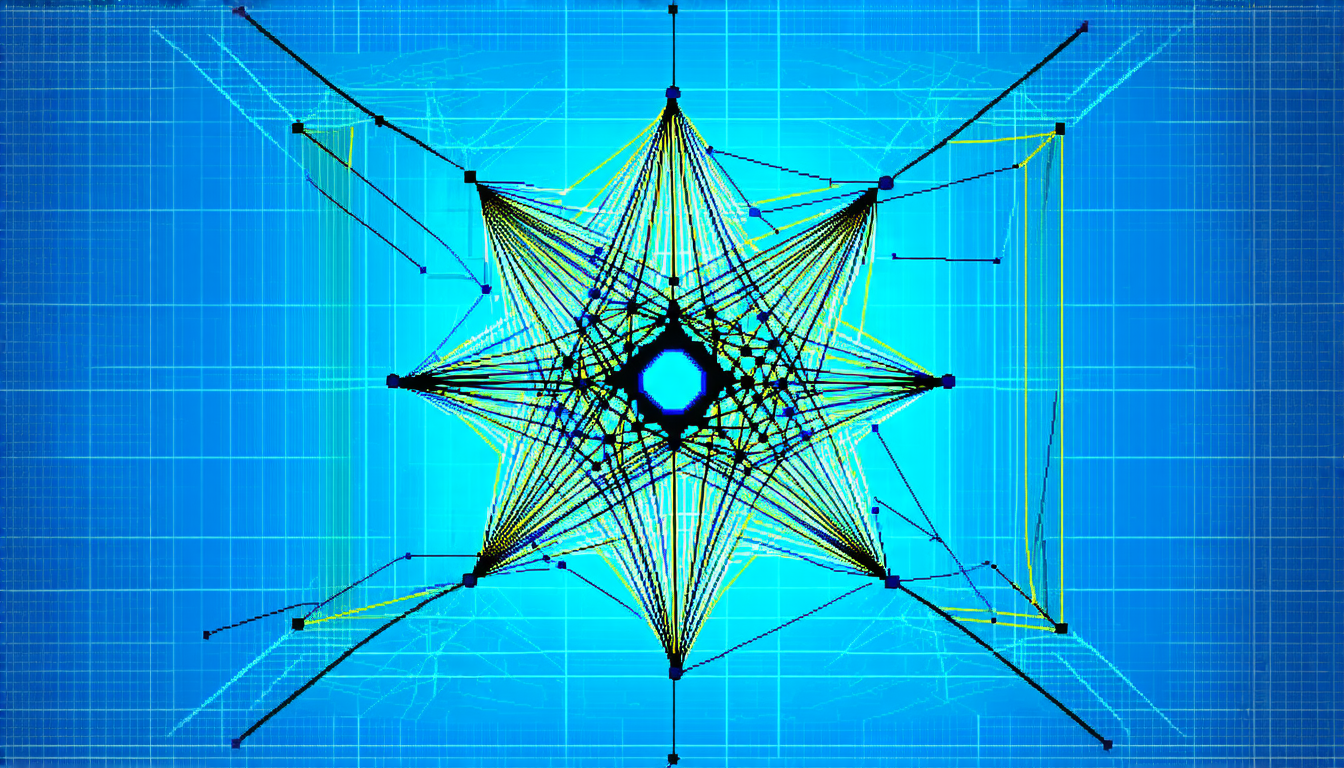
The study reveals that there are two types of cliques: stars and maximal cliques. Stars are cliques with a single hub node, while maximal cliques are those that cannot be extended by adding more nodes without violating the clique property.
Researchers have found that for certain types of linear codes, called degenerate codes, the graph can be divided into stars. In fact, they discovered that if a degenerate code has at least one zero column in its generator matrix, then the corresponding graph is a star. This result has significant implications for coding theory and cryptography.
On the other hand, non-degenerate linear codes do not have this property. Instead, their graphs can be divided into maximal cliques. Researchers found that if a non-degenerate code has at least two zero columns in its generator matrix, then the corresponding graph is a maximal clique.
The study also explores the relationship between the size of the code and the number of cliques it contains. Researchers discovered that for codes with a certain type of structure, called simplexcodes, the number of cliques grows exponentially with the size of the code. This result has important implications for coding theory and cryptography.
In addition to these findings, researchers also investigated the properties of the graphs themselves. They found that some graphs have a unique property called projectivity, which means that any two nodes in the graph can be connected by a path that passes through every other node in the graph.
These results have significant implications for coding theory and cryptography. For example, they provide new insights into how to construct efficient and reliable codes for transmitting information. They also shed light on the structure of these graphs, which can help researchers develop more robust cryptographic systems.
Overall, this study provides a deeper understanding of the complex relationships between linear codes and their corresponding graphs. It has important implications for coding theory, cryptography, and computer science, and it opens up new avenues for future research in these areas.
Cite this article: “Decoding the Structure of Linear Codes: New Insights into Graph Theory”, The Science Archive, 2025.
Linear Codes, Graph Theory, Coding Theory, Cryptography, Computer Science, Cliques, Maximal Cliques, Stars, Degenerate Codes, Non-Degenerate Codes
Reference: Edyta Bartnicka, “Stars of graphs of projective codes” (2024).





