

Friday 31 January 2025
Scientists have long struggled to accurately model the behavior of waves in ice-covered seas. This is because the interaction between ocean waves and sea ice is complex, involving a delicate balance of factors such as wave height, frequency, and ice thickness. To address this challenge, researchers have developed a novel approach that uses the concept of bounds on effective material properties to study wave attenuation in different types of ice covers.
The new method, described in a recent paper, relies on a quasistatic dispersion relation that combines laboratory and field data from various ice morphologies and spatial scales. By analyzing these datasets, the researchers were able to derive rigorous bounds on the complex viscoelasticity of sea ice, which is essential for understanding wave behavior.
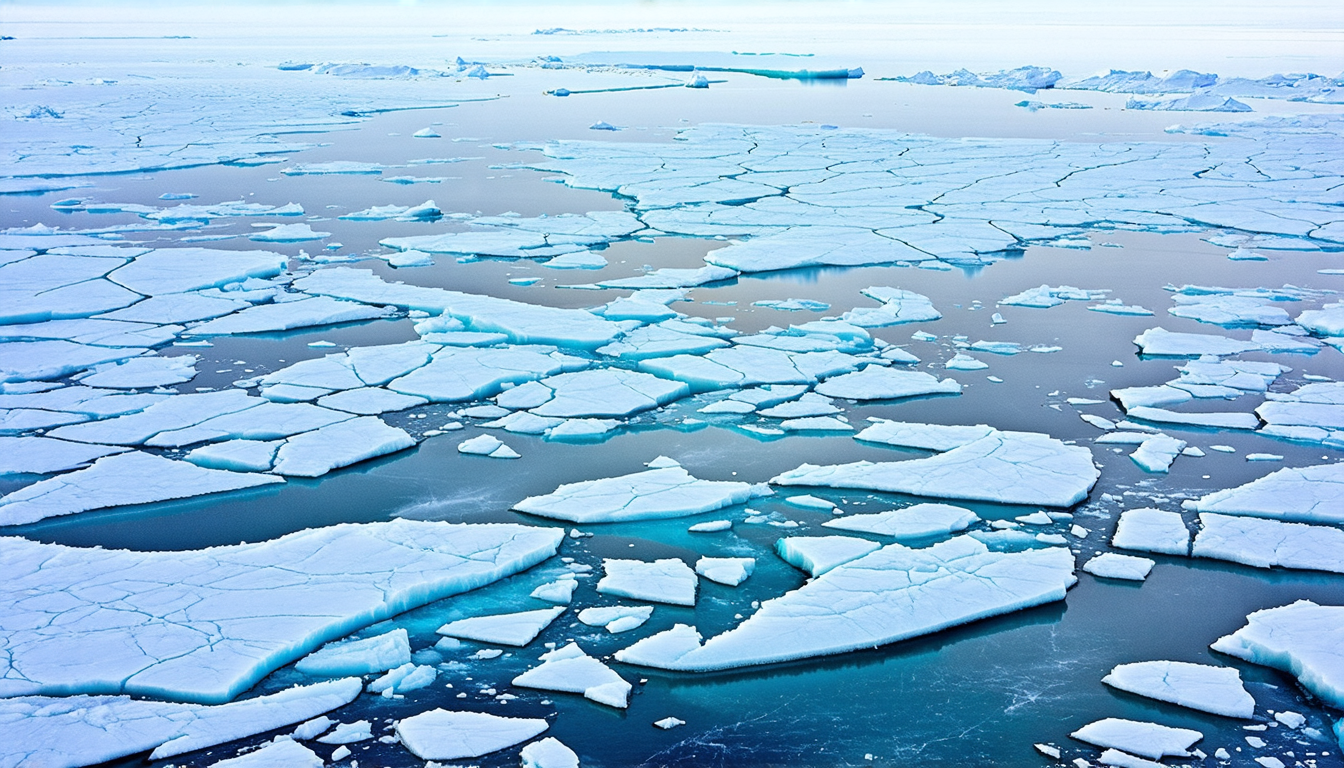
The study used a combination of laboratory and field experiments to collect data on wave attenuation in different types of ice covers, including grease ice, broken floes, pancake ice, and continuous ice cover. The researchers then applied their novel approach to analyze these datasets and derive bounds on the effective material properties of sea ice.
One of the key findings of the study is that the bounds on the complex viscoelasticity of sea ice are remarkably consistent across different ice morphologies and spatial scales. This suggests that there may be a universal set of physical principles that govern wave behavior in ice-covered seas, regardless of the specific type of ice cover or location.
The researchers also found that the bounds on the effective material properties of sea ice can be used to improve the accuracy of wave-ice models, which are essential for predicting the behavior of ocean waves and sea ice in a rapidly changing climate. By incorporating these bounds into their models, scientists may be able to better understand the complex interactions between ocean waves and sea ice, which could have important implications for our understanding of climate change and its impacts on marine ecosystems.
Overall, this study represents an important step forward in our understanding of wave behavior in ice-covered seas. By developing a novel approach that combines laboratory and field data with rigorous mathematical analysis, researchers may be able to gain new insights into the complex interactions between ocean waves and sea ice, which could have important implications for climate change research and beyond.
Cite this article: “New Approach Yields Insights into Wave Behavior in Ice-Covered Seas”, The Science Archive, 2025.
Wave Behavior, Sea Ice, Ocean Waves, Viscoelasticity, Complex Interactions, Wave Attenuation, Laboratory Experiments, Field Data, Climate Change, Material Properties





