

Saturday 01 February 2025
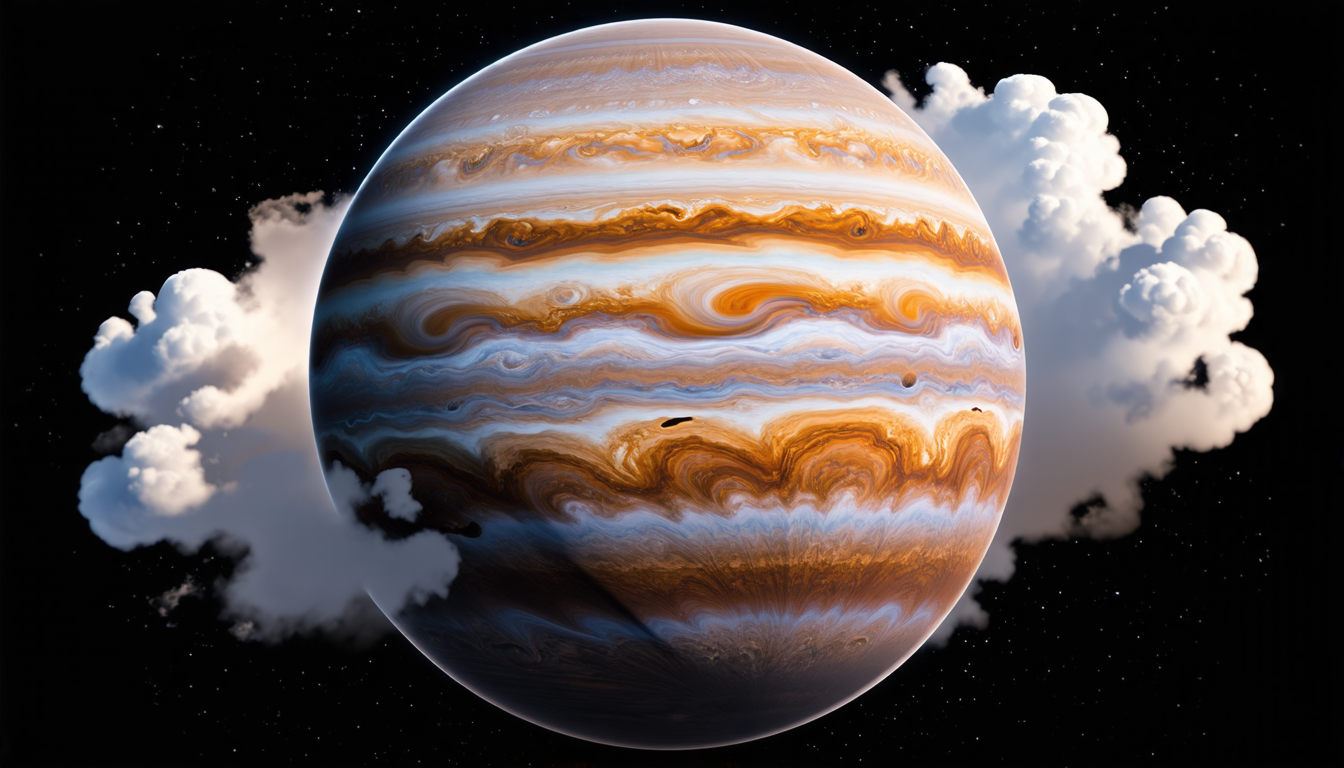
Jupiter, the gas giant planet in our solar system, has long been a subject of fascination and study for scientists. Despite its massive size and complex composition, the interior of Jupiter remains somewhat of a mystery. Recent research has shed new light on this enigmatic planet, revealing four distinct structures that make up its core.
Using machine learning techniques, researchers have analyzed a vast array of data to create a comprehensive model of Jupiter’s interior. The study, published in the journal Astronomy and Astrophysics, presents a nuanced understanding of the planet’s composition, temperature, and pressure.
At the heart of Jupiter lies a dense, hot core made up of elements like hydrogen and helium. This core is surrounded by a thick layer of liquid metal, which is thought to be responsible for the planet’s powerful magnetic field. The researchers found that this layer plays a crucial role in shaping Jupiter’s interior structure, with its size and composition influencing the movement of heat and energy throughout the planet.
The study also revealed four distinct structures within Jupiter’s core: two envelopes and two cores. The first envelope is hot and heavy, made up of elements like iron and nickel, while the second is cooler and lighter, comprised mainly of hydrogen and helium. The two cores are thought to be composed of different materials, with one being a dense, rocky region and the other a lighter, gas-like substance.
These findings have significant implications for our understanding of Jupiter’s formation and evolution. The researchers believe that the planet’s unique structure is the result of a combination of factors, including its massive size, intense gravity, and the presence of various elements in its composition.
The study also provides insight into the processes that shape Jupiter’s atmosphere. The researchers found that the planet’s magnetic field plays a crucial role in controlling the movement of charged particles in its upper atmosphere, which in turn affects the formation of clouds and storm systems.
This research has far-reaching implications for our understanding of the solar system and beyond. By studying the interior structure of Jupiter, scientists can gain valuable insights into the formation and evolution of other gas giant planets, as well as the potential for life on these distant worlds.
In addition to providing new knowledge about Jupiter’s core, this study demonstrates the power of machine learning techniques in analyzing complex data sets. The researchers used a neural network model to identify patterns and relationships within the data, allowing them to create a more accurate and comprehensive understanding of Jupiter’s interior structure.
Cite this article: “Unveiling Jupiters Core: New Insights into the Gas Giants Structure and Composition”, The Science Archive, 2025.
Jupiter, Gas Giant, Core, Composition, Temperature, Pressure, Magnetic Field, Machine Learning, Neural Network, Astronomy.





