

Saturday 01 February 2025
Physicists have long been fascinated by the behavior of particles at extremely low energies, where the usual rules of quantum mechanics no longer apply. In a recent study, researchers have made significant progress in understanding the scattering of electrons and muons off hydrogen atoms at energies just above the threshold of excited states.
Scattering is a fundamental process in physics, where two particles collide and change direction. At high energies, this process is well understood, but as energies decrease, things get complicated. In particular, the behavior of particles at very low energies is influenced by subtle effects, such as the presence of dipole interactions between charged particles.
In their study, the researchers used a combination of advanced computational techniques and theoretical models to calculate the scattering cross sections for electrons and muons off hydrogen atoms at energies just above the threshold of excited states. They found that the behavior of these particles is governed by a phenomenon known as Gailitis-Damburg oscillations, which are caused by the presence of dipole interactions.
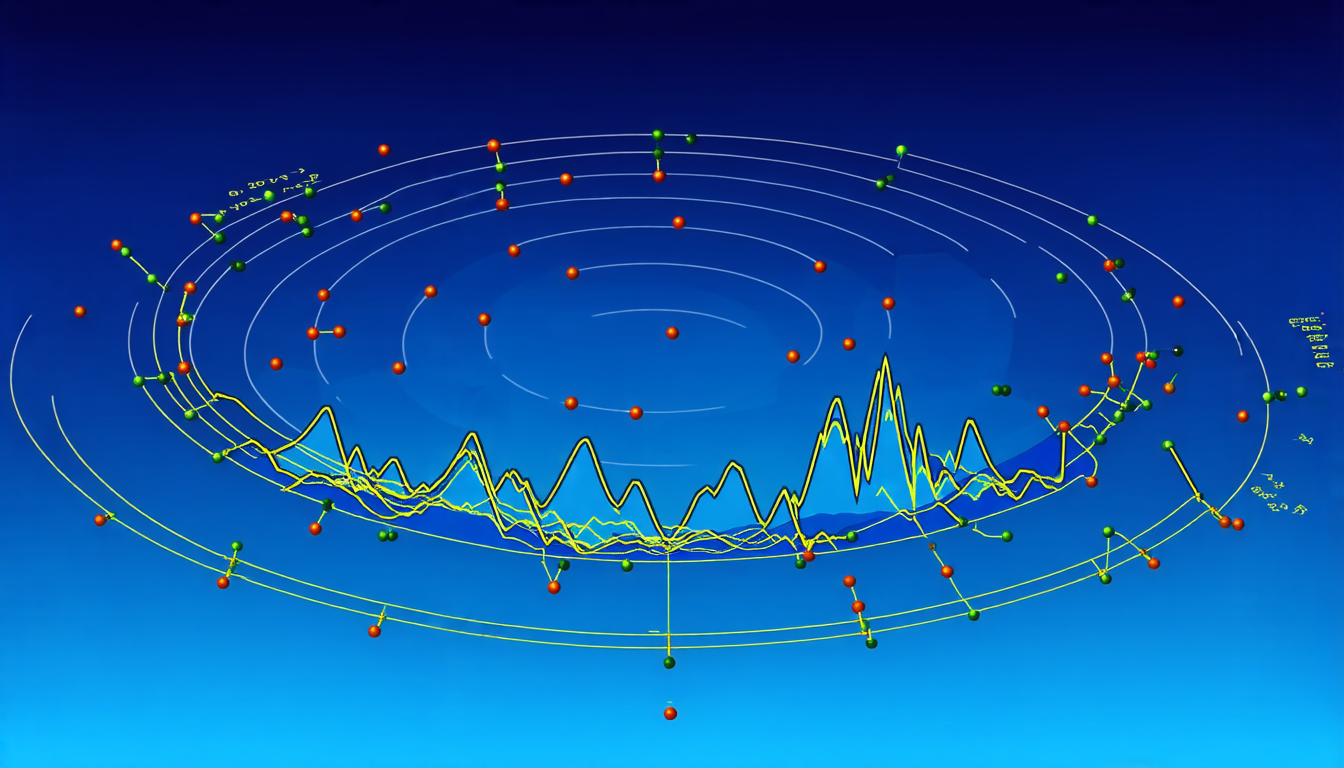
Gailitis-Damburg oscillations were first predicted in the 1960s, but until now, they had never been observed experimentally. The researchers’ calculations show that these oscillations are responsible for the complex patterns seen in the scattering cross sections at low energies. These patterns are characterized by peaks and valleys, which are a signature of the Gailitis-Damburg effect.
The study’s findings have important implications for our understanding of particle physics at very low energies. The researchers’ calculations suggest that similar phenomena may occur in other systems, such as positron-hydrogen scattering, where the presence of dipole interactions could give rise to new and unexpected effects.
The researchers used advanced computational techniques to solve the Faddeev-Merkuriev equations, which describe the behavior of three charged particles interacting with each other. They also developed a novel approach to incorporating the long-range dipole potential into the calculation, which allowed them to accurately model the scattering process at very low energies.
The study’s findings have significant implications for our understanding of particle physics at very low energies. The researchers’ calculations suggest that similar phenomena may occur in other systems, such as positron-hydrogen scattering, where the presence of dipole interactions could give rise to new and unexpected effects.
In addition, the study highlights the importance of computational simulations in advancing our understanding of complex physical systems. By combining advanced theoretical models with powerful computational techniques, researchers can gain insights into phenomena that are difficult or impossible to observe experimentally.
Cite this article: “Unveiling the Secrets of Particle Scattering at Low Energies”, The Science Archive, 2025.
Quantum Mechanics, Particle Physics, Scattering, Electrons, Muons, Hydrogen Atoms, Dipole Interactions, Gailitis-Damburg Oscillations, Faddeev-Merkuriev Equations, Computational Simulations





