

Saturday 01 February 2025
Physicists have been studying the production of J/ψ mesons, which are subatomic particles that can help us better understand the strong nuclear force and the behavior of quarks and gluons. One way to study these particles is by looking at the process where a J/ψ meson is produced in association with a photon, which is a particle of light.
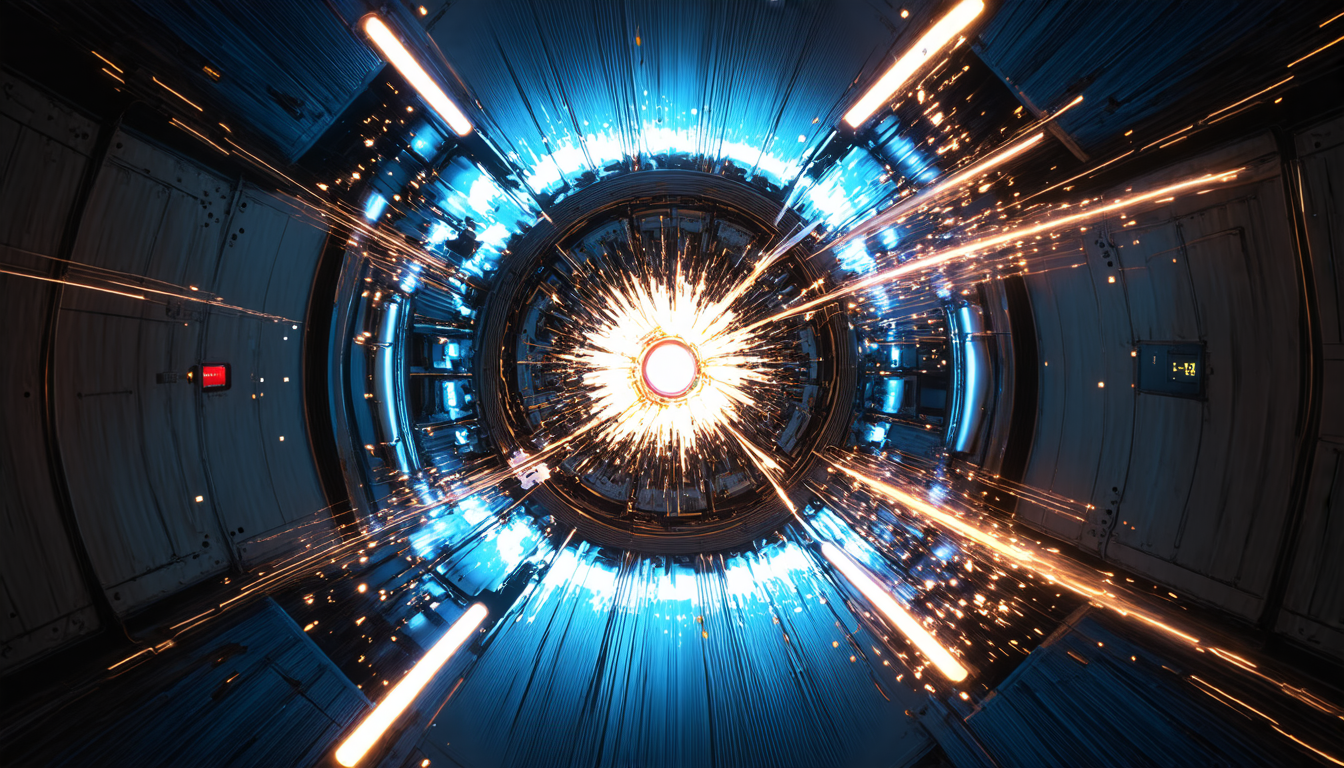
Researchers have been using powerful machines like the Large Hadron Collider (LHC) to collide protons together, creating showers of subatomic particles that can be analyzed to learn more about the fundamental forces of nature. By studying these collisions, scientists can gain insights into the behavior of quarks and gluons, which are the building blocks of protons and neutrons.
A recent study published in a scientific journal looked at the production of J/ψ mesons in association with photons using data from the LHC. The researchers used a theoretical framework called non-relativistic quantum chromodynamics (NRQCD) to predict what they should see when looking at these collisions. They also compared their predictions to actual data collected by the ATLAS and CMS experiments, which are two of the largest particle physics detectors in the world.
The study found that the NRQCD framework did a good job of predicting the production rates for J/ψ mesons associated with photons. However, the researchers also found some discrepancies between their theoretical predictions and the actual data collected by the ATLAS and CMS experiments. These discrepancies could be due to various factors, such as the presence of other particles that were not included in the NRQCD framework or the limitations of the theoretical models used.
Despite these challenges, the study provides valuable insights into the behavior of quarks and gluons at high energies. The researchers believe that further studies will help to shed more light on the strong nuclear force and the fundamental forces of nature.
The study also highlights the importance of experimental data in testing theoretical predictions. By comparing theoretical models with actual data collected from particle collisions, scientists can gain a better understanding of the underlying physics. This approach has been instrumental in our current understanding of the universe and will continue to play a crucial role in advancing our knowledge in the future.
In summary, physicists have made significant progress in studying the production of J/ψ mesons in association with photons using data from the LHC. While the NRQCD framework did a good job of predicting the production rates, there were some discrepancies between theoretical predictions and actual data.
Cite this article: “Uncovering the Strong Nuclear Force: Insights from J/ψ Meson Production”, The Science Archive, 2025.
J/Ψ Mesons, Photons, Strong Nuclear Force, Quarks, Gluons, Large Hadron Collider, Nrqcd, Particle Collisions, Experimental Data, Fundamental Forces Of Nature





