

Saturday 01 February 2025
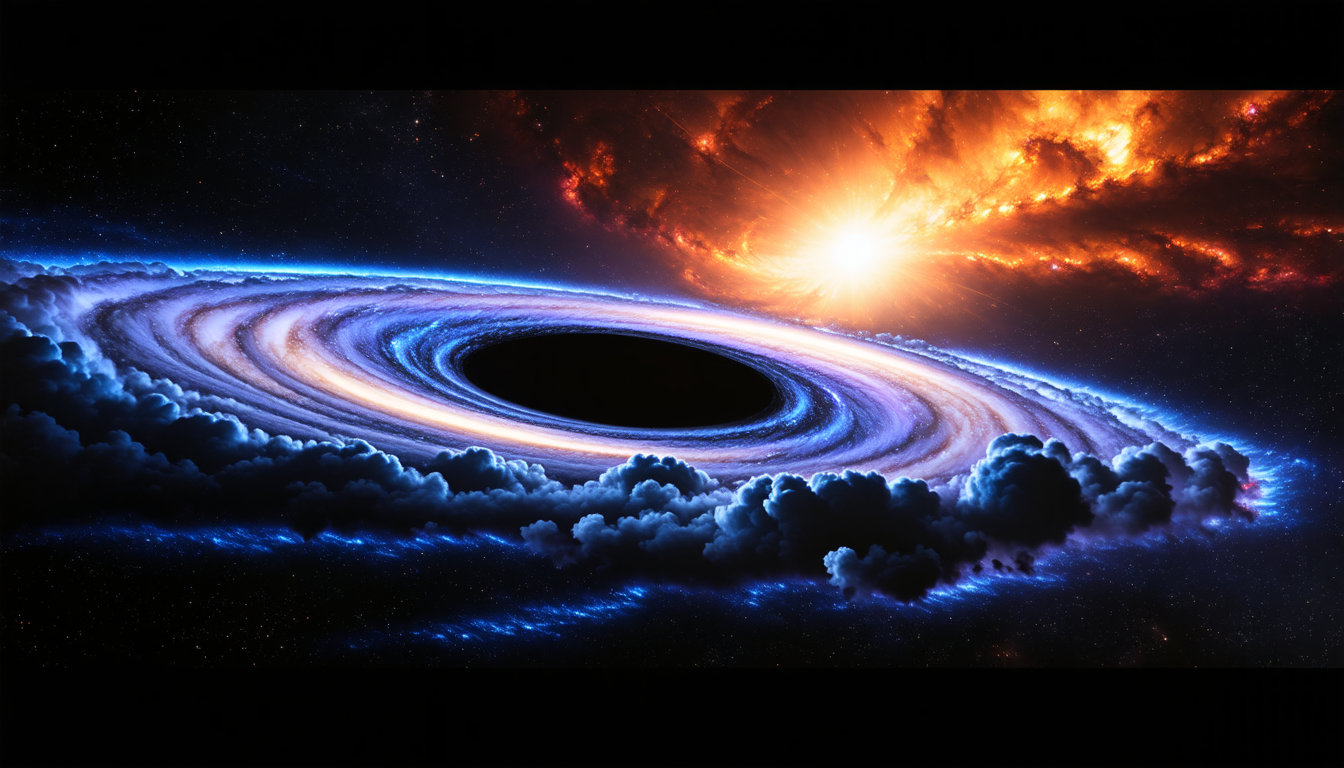
A team of astronomers has been studying the aftermath of a catastrophic event known as a tidal disruption event (TDE), where a star gets too close to a supermassive black hole at the center of a galaxy and is torn apart by its strong gravity. In this process, a significant amount of matter is released into space, which can be seen from Earth.
The researchers used computer simulations to model what happens to this matter as it falls towards the black hole. They found that the matter forms an accretion disk around the black hole, which heats up due to friction and eventually emits intense radiation across a wide range of wavelengths.
One of the most fascinating aspects of TDEs is their ability to produce powerful flares in the radio band. These flares are thought to occur when the hot material in the accretion disk interacts with the surrounding environment, leading to the acceleration of particles and the emission of radiation.
The researchers used their simulations to predict the properties of these flares, including their duration and intensity. They found that the flares can be very bright and last for several months or even years after the initial TDE event.
To test their predictions, the team analyzed data from a recent TDE observed by the Swift satellite. They compared their results with observations made by other telescopes, such as the Hubble Space Telescope and the Very Large Array (VLA) radio telescope.
The analysis revealed that the flares were indeed very bright and long-lived, consistent with the predictions of the simulations. The study provides new insights into the physics of TDEs and their potential for producing powerful radiation flares.
Tidal disruption events are relatively rare occurrences in the universe, but they offer a unique opportunity to study the strong-field gravity and high-energy processes that occur near black holes. This research has important implications for our understanding of these extreme environments and how they affect the surrounding matter.
The findings of this study also have practical applications for future surveys of distant galaxies using telescopes such as the Square Kilometer Array (SKA) and the Next Generation Very Large Array (ngVLA). By better understanding the properties of TDEs, astronomers can design more effective strategies for detecting these events and studying their aftermath.
In summary, this study provides new insights into the physics of tidal disruption events and their potential for producing powerful radiation flares. The findings have important implications for our understanding of extreme environments in the universe and will inform future surveys of distant galaxies.
Cite this article: “Unraveling the Physics of Tidal Disruption Events”, The Science Archive, 2025.
Tidal Disruption Event, Supermassive Black Hole, Accretion Disk, Radiation Flare, Computer Simulation, Galaxy Center, Strong-Field Gravity, High-Energy Process, Square Kilometer Array, Next Generation Very Large Array





