

Saturday 01 February 2025
The art of breaking things down into smaller pieces has been a crucial aspect of many scientific and engineering disciplines for centuries. From the fragmentation of rocks in geology to the shattering of molecules in chemistry, understanding how objects break apart is essential for advancing our knowledge and developing new technologies.
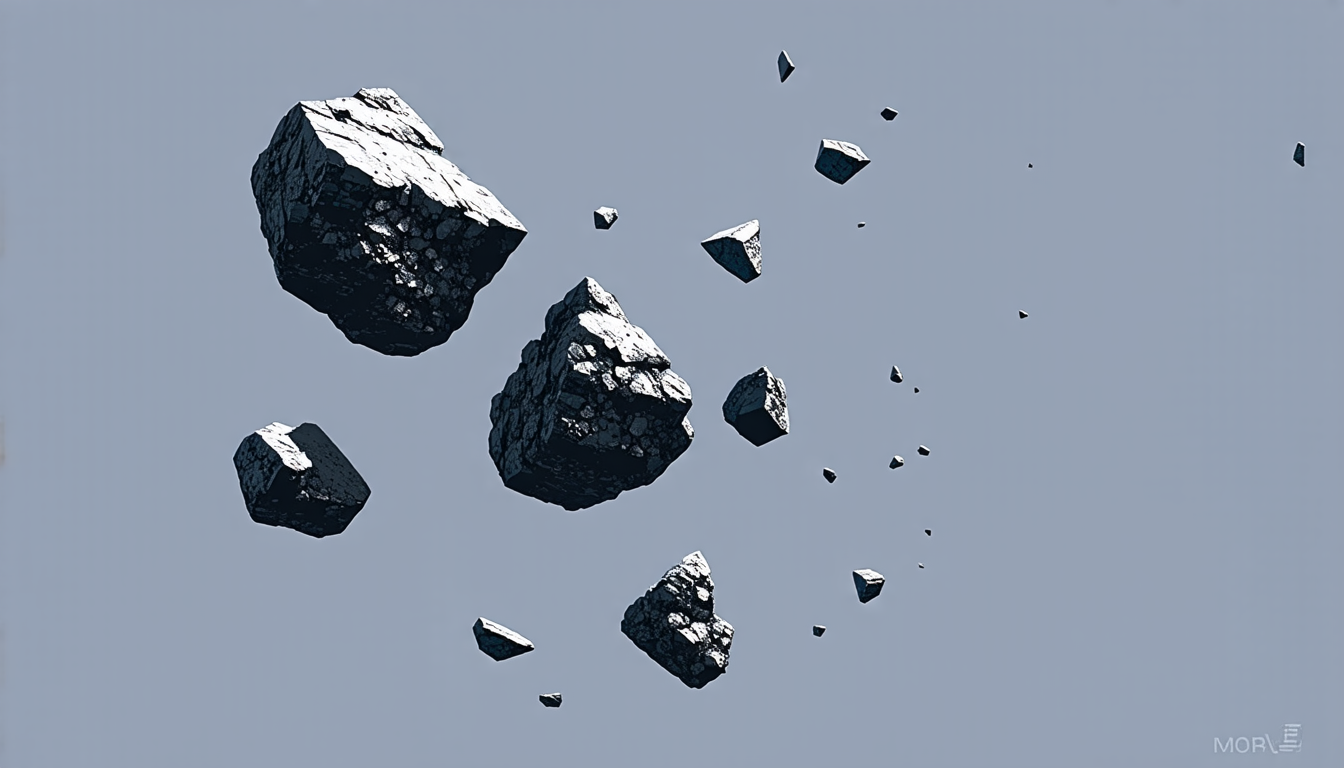
Recently, researchers have made significant progress in developing mathematical models that can accurately predict the behavior of particles as they fragment into smaller pieces. These models, known as population balance equations, take into account various factors such as the size and shape of the particles, the force of the collision, and the rate at which the fragments break apart.
One of the key challenges in developing these models is ensuring that they accurately capture the complex dynamics involved in particle fragmentation. This requires a deep understanding of the underlying physics and mathematics, as well as the ability to develop numerical methods that can efficiently solve the equations.
In this context, a team of researchers has made significant progress in developing a new numerical method for solving population balance equations. Their approach, known as the finite volume method, uses a combination of mathematical techniques and computational algorithms to accurately simulate the behavior of particles as they fragment into smaller pieces.
The key innovation behind the finite volume method is its ability to handle complex geometries and boundary conditions, which are often encountered in real-world applications. This allows researchers to model systems that were previously difficult or impossible to study, such as the fragmentation of rocks in geological processes or the shattering of molecules in chemical reactions.
The potential applications of the finite volume method are vast and varied. For example, it could be used to develop new materials with improved properties, such as stronger ceramics or more durable composites. It could also be used to improve our understanding of complex natural phenomena, such as the formation of mountains or the behavior of planetary atmospheres.
In addition to its practical applications, the finite volume method has significant implications for our fundamental understanding of particle fragmentation. By providing a more accurate and comprehensive framework for modeling these processes, it has the potential to revolutionize our understanding of the underlying physics and mathematics involved.
Overall, the development of the finite volume method represents an important milestone in the field of population balance equations. Its ability to accurately model complex geometries and boundary conditions makes it a powerful tool for researchers seeking to understand and predict the behavior of particles as they fragment into smaller pieces.
Cite this article: “Advances in Modeling Particle Fragmentation: A New Numerical Method”, The Science Archive, 2025.
Particle Fragmentation, Population Balance Equations, Finite Volume Method, Numerical Methods, Mathematical Models, Particle Size Distribution, Collision Dynamics, Geometric Complexity, Boundary Conditions, Computational Algorithms.





