

Saturday 01 February 2025
A team of astronomers has made a significant breakthrough in understanding the behavior of supermassive black holes at the centers of galaxies. These massive objects are thought to power quasars, incredibly luminous objects that can be seen billions of light-years away.
To study these black holes, scientists use computer simulations to model their behavior. But until now, these simulations have had a major limitation: they assumed that the hot gas surrounding the black hole was uniform in temperature. In reality, this gas is likely to be turbulent and hotspots may form.
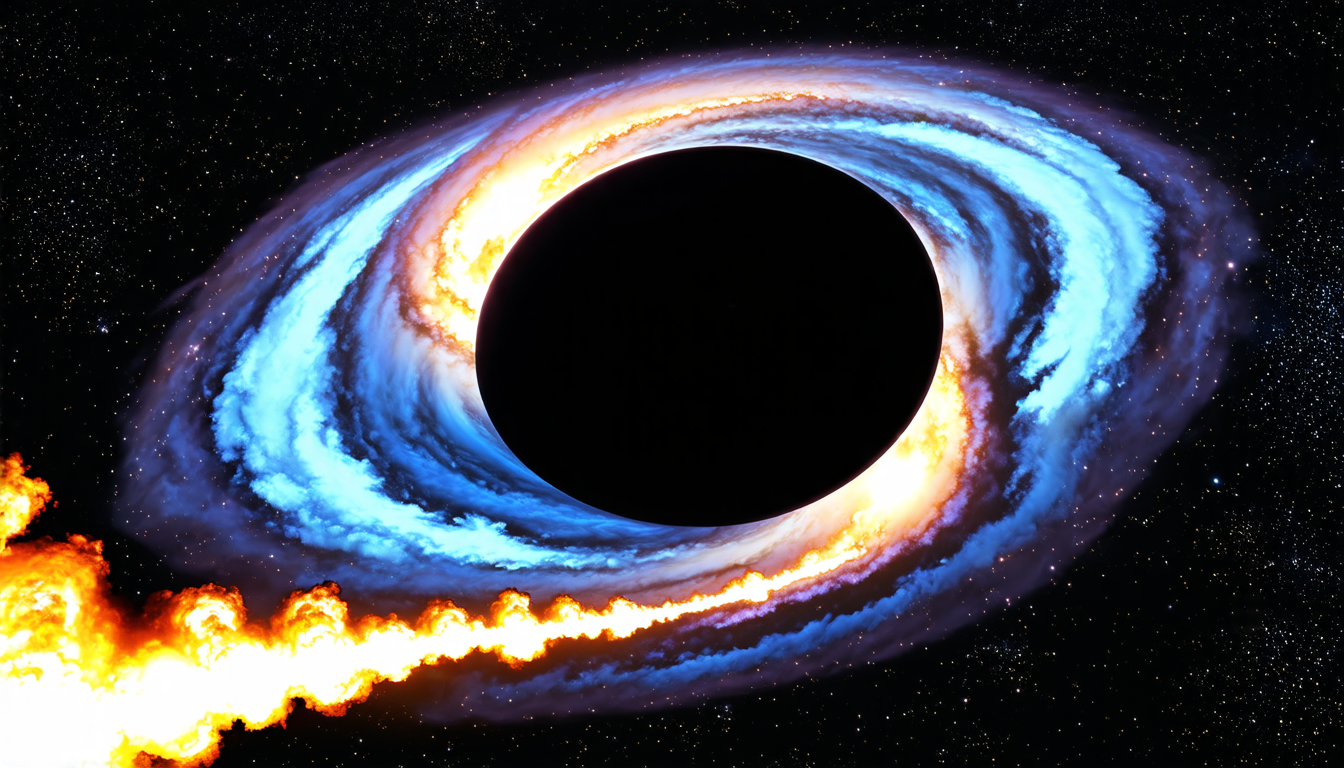
Using a new simulation technique, researchers were able to create a more accurate model of the hot gas around a supermassive black hole. They found that the gas is indeed turbulent, with hotspots forming where the magnetic field is strongest. This turbulence leads to fluctuations in the X-ray emission from the black hole, making it harder for scientists to study its behavior.
The researchers also discovered that the hot gas is not just a simple hot bubble surrounding the black hole. Instead, it’s a complex system of swirling gas and radiation that interacts with the magnetic field. This interaction creates powerful jets of energy that shoot out into space, affecting the formation of stars in the surrounding galaxy.
One of the most surprising findings was the variability in the X-ray emission from the black hole. The team found that the emission can change rapidly over a period of just 50 milliseconds, which is much faster than previously thought. This rapid variability could be used to study the behavior of supermassive black holes in more detail.
The research has important implications for our understanding of galaxy evolution and the role that supermassive black holes play in it. It also highlights the need for more accurate simulations of these complex systems, which will require even more powerful computers in the future.
In addition to its scientific significance, this study demonstrates the power of computational modeling in astrophysics. By using advanced computer simulations, researchers can gain insights into complex physical processes that are difficult or impossible to study directly. This approach is likely to play an increasingly important role in our understanding of the universe in the years to come.
Cite this article: “Unraveling the Turbulent Behavior of Supermassive Black Holes”, The Science Archive, 2025.
Supermassive Black Holes, Quasars, Computer Simulations, Turbulent Gas, Hotspots, Magnetic Field, X-Ray Emission, Galaxy Evolution, Computational Modeling, Astrophysics





