

Saturday 01 February 2025
In recent years, artificial intelligence has made tremendous progress in various fields, including robotics and computer science. One of the most significant breakthroughs is the development of distributed task allocation algorithms for multi-agent systems.
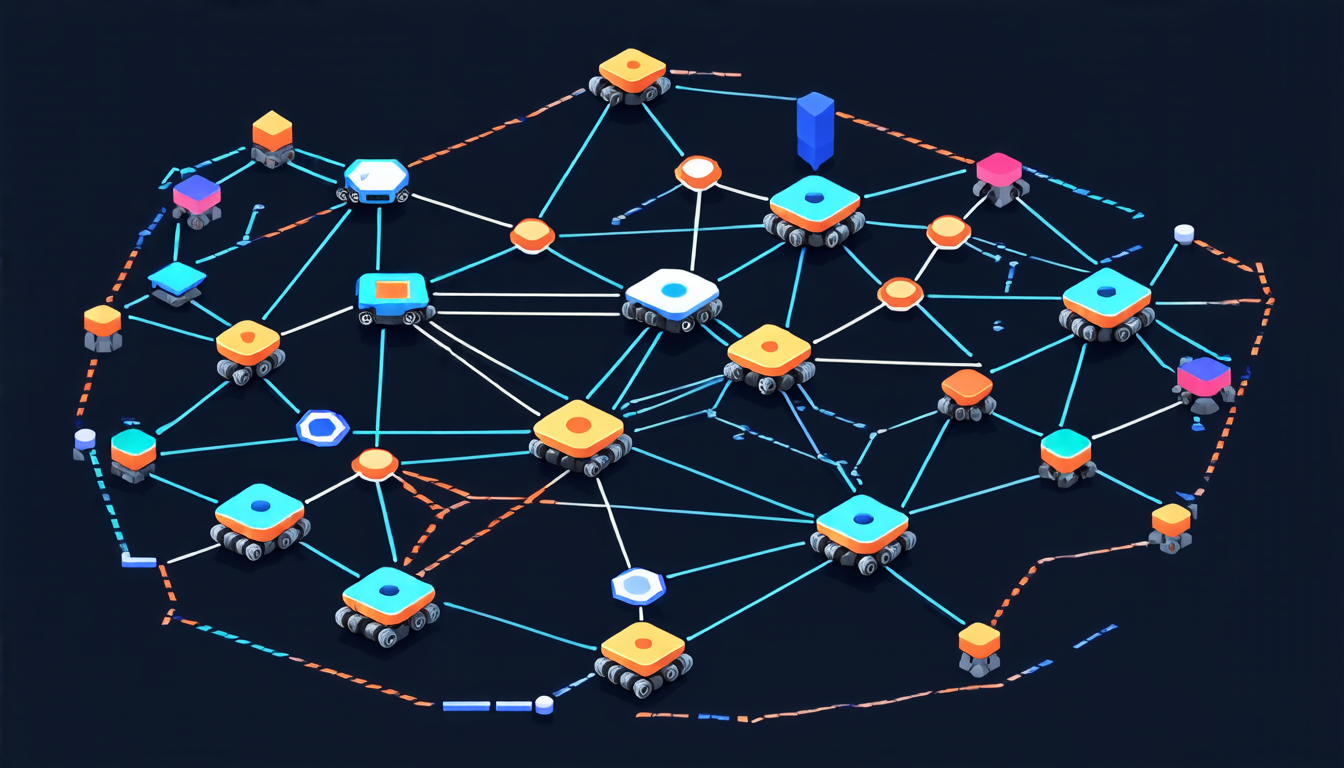
Distributed task allocation refers to the process of assigning tasks to multiple agents or robots in a network, where each agent has its own capabilities, constraints, and goals. This problem becomes increasingly complex as the number of agents and tasks increases, making it challenging to find an optimal solution that satisfies all the constraints and objectives.
Researchers have been working on developing algorithms that can efficiently allocate tasks among multiple agents while taking into account their individual characteristics and limitations. One approach is to use submodular optimization techniques, which are particularly well-suited for this problem due to its inherent structure.
Submodularity is a property of functions that states that the marginal gain of adding an element to a set decreases as the size of the set increases. In the context of distributed task allocation, submodularity can be used to model the relationships between agents and tasks, allowing for more efficient computation of optimal solutions.
The researchers have developed a novel algorithm that leverages submodular optimization techniques to solve the distributed task allocation problem. The algorithm is designed to work in a decentralized manner, where each agent makes decisions independently based on local information without requiring global knowledge or coordination.
The algorithm is tested on a range of scenarios, including robotic teams performing tasks such as search and rescue, surveillance, and environmental monitoring. The results show that the algorithm can efficiently allocate tasks among multiple agents while achieving optimal performance in terms of task completion time and resource utilization.
One of the key benefits of this approach is its scalability, allowing it to handle large numbers of agents and tasks without requiring significant computational resources or complex infrastructure. This makes it a promising solution for real-world applications where distributed task allocation is critical, such as autonomous systems, smart cities, and disaster response.
In addition to its practical applications, the research also has implications for our understanding of the fundamental limits of decentralized optimization. The results demonstrate that submodular optimization can be used to develop efficient algorithms for solving complex problems in multi-agent systems, which has important theoretical and computational implications.
Overall, this research represents an exciting development in the field of artificial intelligence, with potential applications in a wide range of areas. By leveraging submodular optimization techniques, researchers have been able to develop a novel algorithm that can efficiently allocate tasks among multiple agents, achieving optimal performance while handling complex constraints and objectives.
Cite this article: “Efficient Distributed Task Allocation in Multi-Agent Systems”, The Science Archive, 2025.
Distributed Task Allocation, Submodular Optimization, Multi-Agent Systems, Artificial Intelligence, Robotics, Computer Science, Autonomous Systems, Smart Cities, Disaster Response, Decentralized Optimization.





