
Sunday 02 February 2025
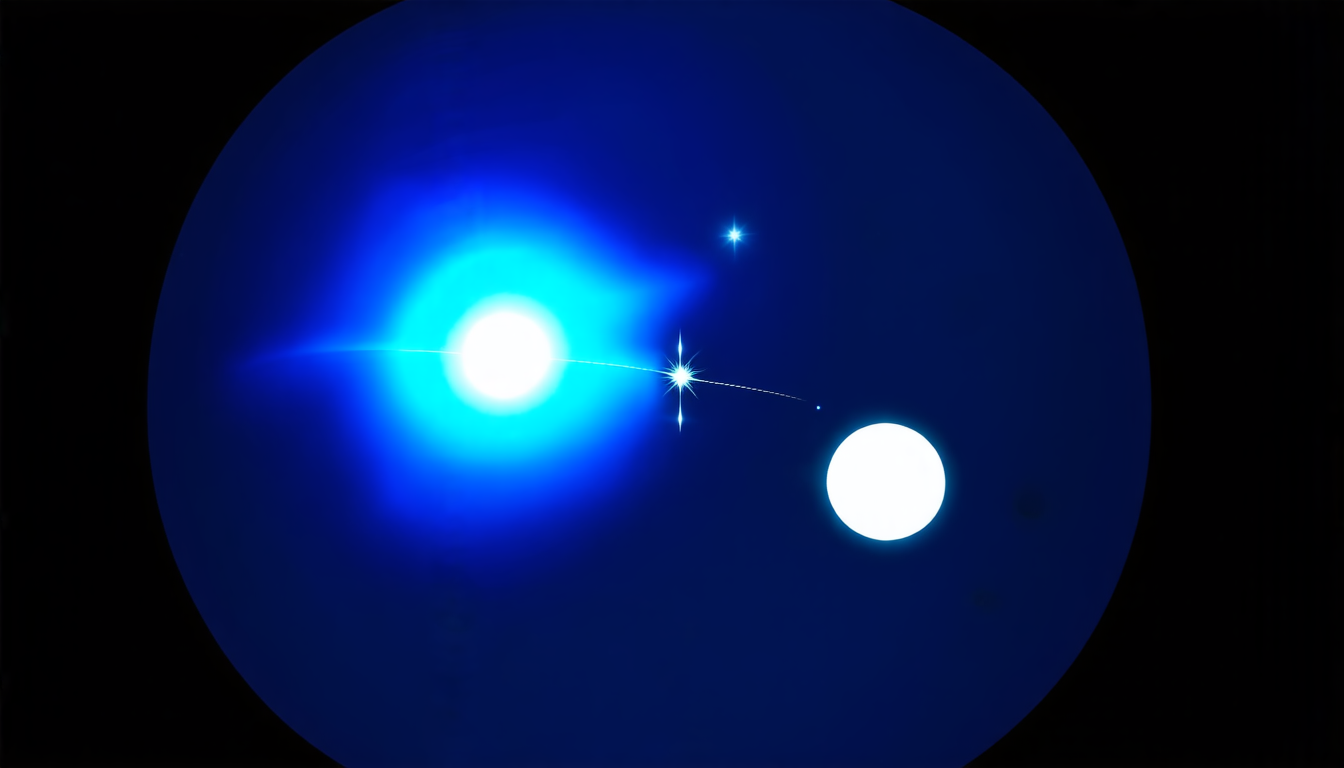
The quest for a deeper understanding of binary star systems has led scientists to uncover a fascinating new discovery. A team of researchers has identified a compact binary system, comprising an sdB (subdwarf B) star and a white dwarf, orbiting each other in just under 2 hours.
Located approximately 350 light-years from Earth, the binary system, known as J1710, offers scientists a unique opportunity to study the evolution of these celestial bodies. The sdB star, which is about half the size of our sun, is thought to have undergone a phase of helium shell burning, leaving it with a high surface temperature of over 25,000 Kelvin.
The team used data from the Gaia spacecraft and the Sloan Digital Sky Survey (SDSS) to analyze the system’s properties. By combining observations of the sdB star’s brightness variations with spectroscopic measurements, they were able to determine its mass and radius. The results indicate that the sdB star is about 0.44 times more massive than our sun and has a radius roughly one-quarter of its size.
One of the most intriguing aspects of J1710 is its extremely short orbital period. This suggests that the system may have undergone a phase of tidal synchronization, where the gravitational forces between the two stars cause them to rotate in sync with each other. If confirmed, this would be a rare occurrence among binary star systems.
The discovery of J1710 also has implications for our understanding of the evolution of white dwarfs. As these stars cool over billions of years, they can eventually merge with their companion stars, producing gravitational waves that could be detected by future space-based observatories like LISA (Laser Interferometer Space Antenna).
The study of binary star systems like J1710 offers a fascinating window into the complex and dynamic processes that shape the universe. As scientists continue to explore these celestial bodies, they may uncover new secrets about the fundamental laws of physics and the evolution of stars themselves.
In this era of rapid technological advancement, the discovery of J1710 serves as a reminder of the importance of sustained investment in scientific research and exploration. By continuing to push the boundaries of our knowledge, scientists can unlock new insights that will help us better understand the universe and our place within it.
The analysis of J1710’s properties has also shed light on its potential as a target for future studies. The system’s proximity to Earth and relatively short orbital period make it an attractive candidate for further observation and investigation.
Cite this article: “Unveiling the Secrets of Binary Star System J1710”, The Science Archive, 2025.
Binary Star Systems, Sdb Star, White Dwarf, Gaia Spacecraft, Sloan Digital Sky Survey, Tidal Synchronization, Gravitational Waves, Lisa, Laser Interferometer Space Antenna, Scientific Research, Stellar Evolution