
Sunday 02 February 2025
The gravitational waves emitted by massive black holes (MBHs) during their mergers can have a profound impact on the universe. A new study has shed light on this phenomenon, revealing that these recoil kicks can significantly affect the growth and evolution of MBHs.
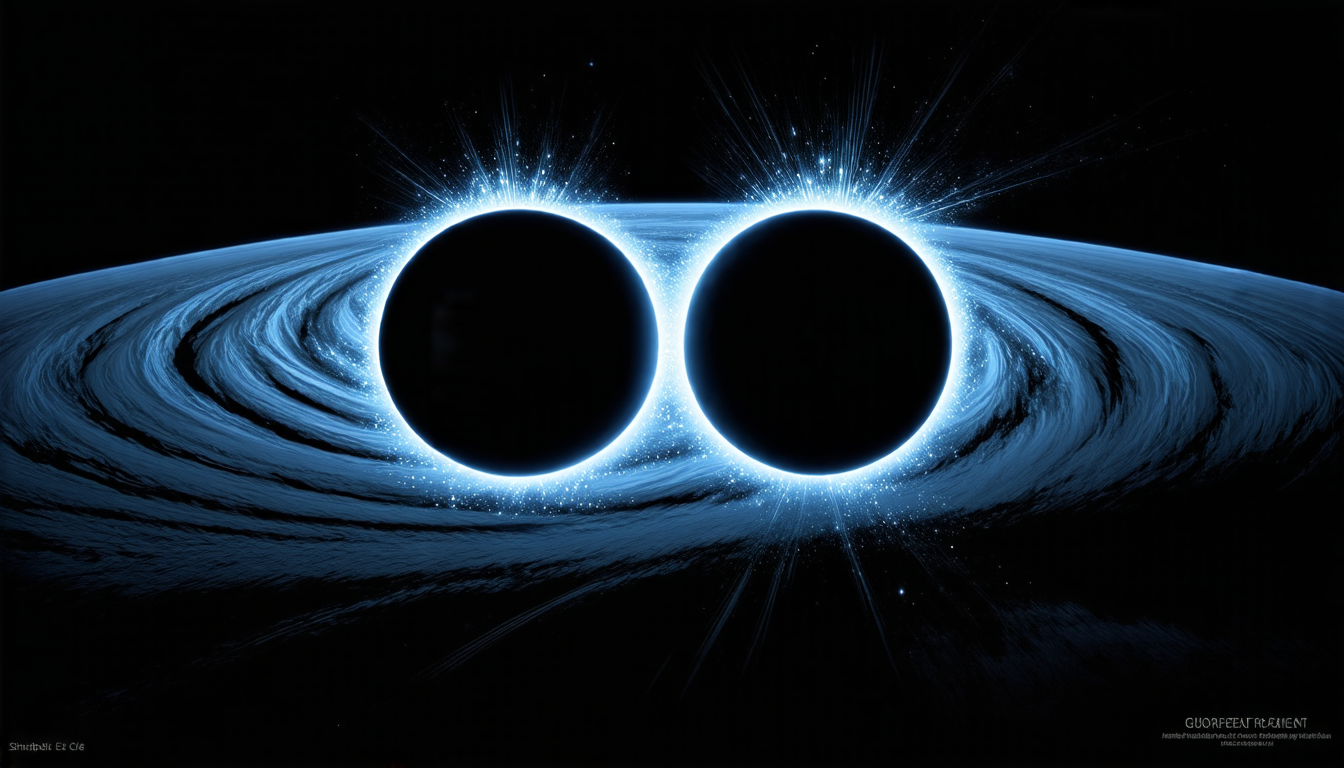
When two MBHs merge, they emit gravitational waves that carry away a significant amount of energy. This energy is transferred to the surrounding environment, causing the newly formed black hole to receive a powerful kick. The recoil velocity can be so strong that it can eject the MBH from its host galaxy or even expel it into intergalactic space.
Researchers used advanced computer simulations to study the effects of these recoil kicks on MBHs. They found that the kicks can significantly reduce the growth rate of MBHs, particularly in smaller galaxies. This is because the recoiled black holes are less likely to continue growing through accretion of gas and dust from their host galaxy.
The study also revealed that recoil kicks can have a profound impact on the distribution of MBHs within galaxies. Recoiled MBHs tend to migrate towards the outskirts of their host galaxies, where they can continue to grow through mergers with other black holes. This migration can lead to the formation of binary black hole systems, which are thought to be responsible for many of the gravitational wave events detected by LIGO and VIRGO.
The researchers also found that recoil kicks can affect the relationship between MBHs and their host galaxies. In particular, they discovered that recoil kicks can reduce the correlation between the mass of the MBH and the mass of its host galaxy. This is because recoiled black holes are less likely to be tied to their host galaxy through gas accretion.
The study’s findings have significant implications for our understanding of the universe. They suggest that recoil kicks play a crucial role in shaping the evolution of MBHs, and may even influence the formation of galaxies themselves. The researchers hope that their work will help to refine models of black hole growth and galaxy evolution, ultimately leading to a deeper understanding of the cosmos.
The study’s authors used advanced computer simulations to model the behavior of MBHs during mergers, taking into account factors such as gas accretion, stellar feedback, and gravitational waves. They also developed new methods for tracking the recoil kicks and their effects on MBH growth and galaxy evolution.
Overall, this study provides a fascinating glimpse into the complex interplay between massive black holes, galaxies, and gravitational waves.
Cite this article: “Recoil Kicks from Black Hole Mergers Shape the Growth of Galaxies”, The Science Archive, 2025.
Massive Black Holes, Galaxy Evolution, Gravitational Waves, Recoil Kicks, Black Hole Mergers, Computer Simulations, Galaxy Formation, Binary Black Holes, Ligo, Virgo