

Sunday 02 February 2025
The search for gravitational waves, those ripples in the fabric of spacetime predicted by Einstein’s theory of general relativity, has been an ongoing endeavor in recent years. With the discovery of these waves by LIGO and VIRGO, scientists have made significant progress in understanding the cosmos. However, there is still much to be learned about these mysterious signals.
One area of focus is the stochastic gravitational wave background, a type of signal that arises from the accumulation of many individual gravitational wave events. This background noise can provide valuable insights into the history of the universe and the types of cosmic phenomena that have occurred over time.
Scientists are using various methods to detect this background noise, including analyzing data from pulsars, binary black holes, and other astrophysical sources. The LISA (Laser Interferometer Space Antenna) mission, set to launch in the mid-2020s, will be a major player in this effort. With its ability to detect gravitational waves at frequencies as low as 10^-4 Hz, LISA is poised to uncover new information about the universe’s early days.
Recent studies have focused on using pulsars as a tool for detecting the stochastic background noise. Pulsars are rapidly rotating neutron stars that emit electromagnetic radiation in a consistent pattern. By analyzing the timing of these emissions, scientists can detect even small changes caused by gravitational waves passing through spacetime.
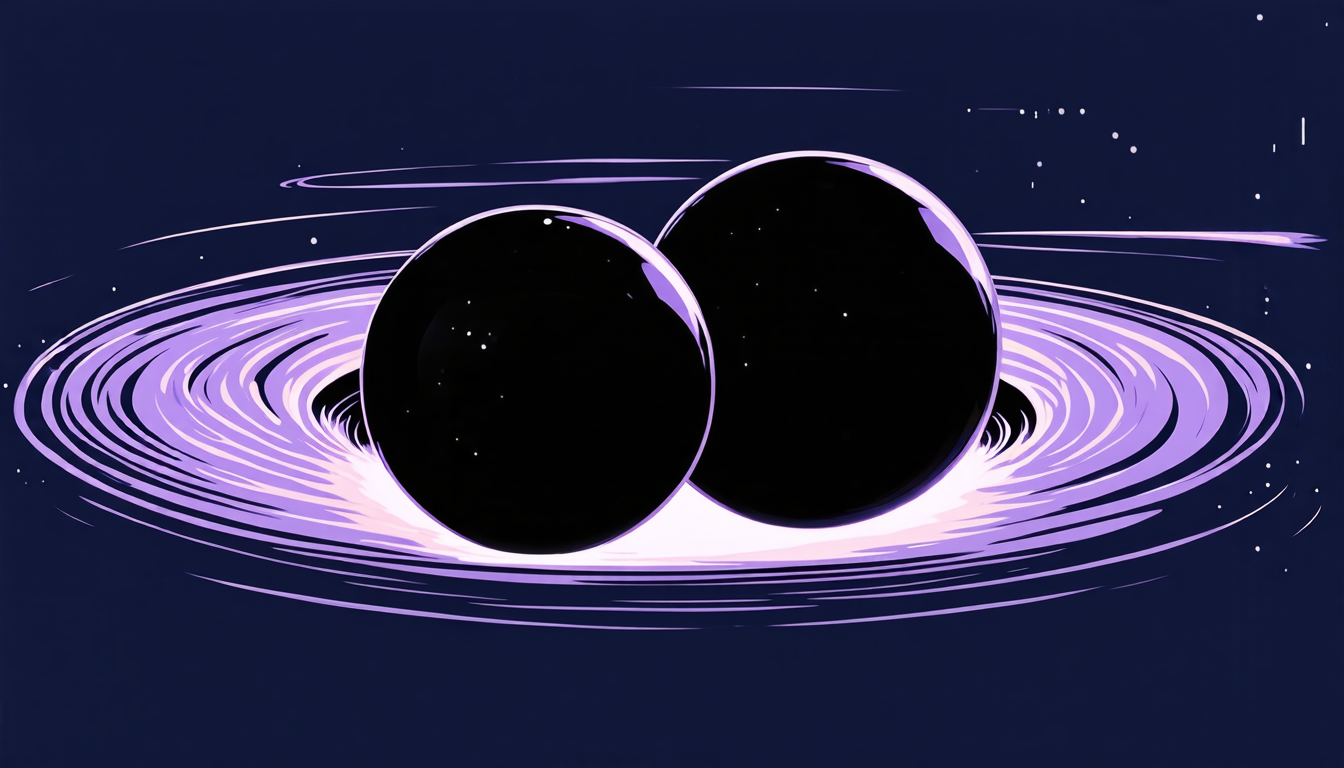
Another area of research is the use of binary black hole mergers to detect the stochastic background noise. These events occur when two massive black holes collide and merge, emitting powerful gravitational waves as they do so. Scientists are using simulations to model these events and predict what types of signals they would produce if detected by LISA or other gravitational wave observatories.
The search for the stochastic gravitational wave background is an ongoing effort that holds great promise for our understanding of the universe. With the help of advanced technologies like LISA and sophisticated data analysis techniques, scientists are working to uncover new information about the cosmos and the mysteries it holds.
Cite this article: “Unveiling the Secrets of Gravitational Waves”, The Science Archive, 2025.
Gravitational Waves, Ligo, Virgo, Stochastic Background Noise, Pulsars, Binary Black Holes, Neutron Stars, Laser Interferometer Space Antenna, Lisa, Cosmology





