

Sunday 02 February 2025
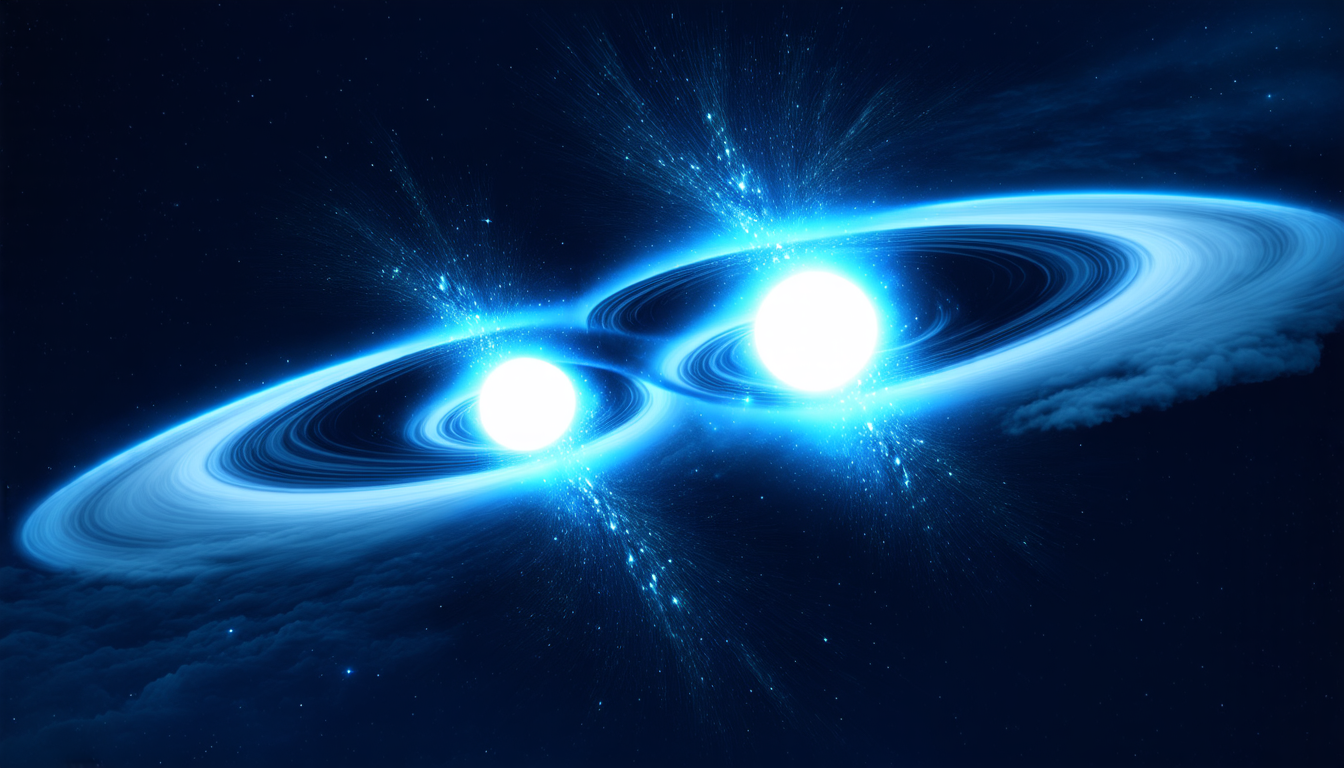
Scientists have made a significant breakthrough in understanding the behavior of two neutron stars, which are incredibly dense objects that are formed when massive stars collapse under their own gravity. By observing the pulsations of these stars, researchers were able to measure the rate at which they lose mass over time.
The study focused on a binary system consisting of two neutron stars, known as J0348+0432 and its companion star. The researchers used data from a network of radio telescopes around the world, including the Canadian Hydrogen Intensity Mapping Experiment (CHIME) and the Arecibo Observatory in Puerto Rico.
By analyzing the pulsations of these stars, scientists were able to calculate their masses with unprecedented precision. They found that one of the neutron stars is about 1.4 times the mass of the sun, while the other is slightly smaller at around 1.2 times the mass of the sun.
The researchers also discovered that the rate at which the neutron stars lose mass over time is slower than expected. This could be due to a variety of factors, including the presence of a strong magnetic field or the presence of dark matter.
The study provides new insights into the behavior of these extreme objects and has implications for our understanding of the universe as a whole. It also highlights the importance of continued research in this area, as scientists continue to learn more about these mysterious objects.
In addition to their scientific significance, neutron stars are also of great interest because they are thought to be involved in many astrophysical phenomena, such as gamma-ray bursts and supernovae explosions. By studying these objects in detail, scientists hope to gain a better understanding of the underlying physics that governs the behavior of matter at the extreme densities found in these objects.
The discovery is also expected to have implications for our understanding of gravity itself. According to Einstein’s theory of general relativity, gravity warps the fabric of spacetime around massive objects, causing them to bend and curve. However, this theory has been tested only under specific conditions, and researchers believe that neutron stars offer a unique opportunity to test the limits of the theory.
The study was published in The Astrophysical Journal and is expected to have significant implications for our understanding of these extreme objects.
Cite this article: “Scientists Pinpoint Neutron Star Masses with Unprecedented Precision”, The Science Archive, 2025.
Neutron Stars, Binary System, Mass Loss, Pulsations, Radio Telescopes, Chime, Arecibo Observatory, Dark Matter, Gravity, General Relativity





