

Sunday 02 February 2025
Scientists have long been fascinated by the properties of superconductors, materials that can conduct electricity with zero resistance when cooled to extremely low temperatures. Now, researchers have made a breakthrough discovery that could lead to new ways of harnessing the power of light and electricity.
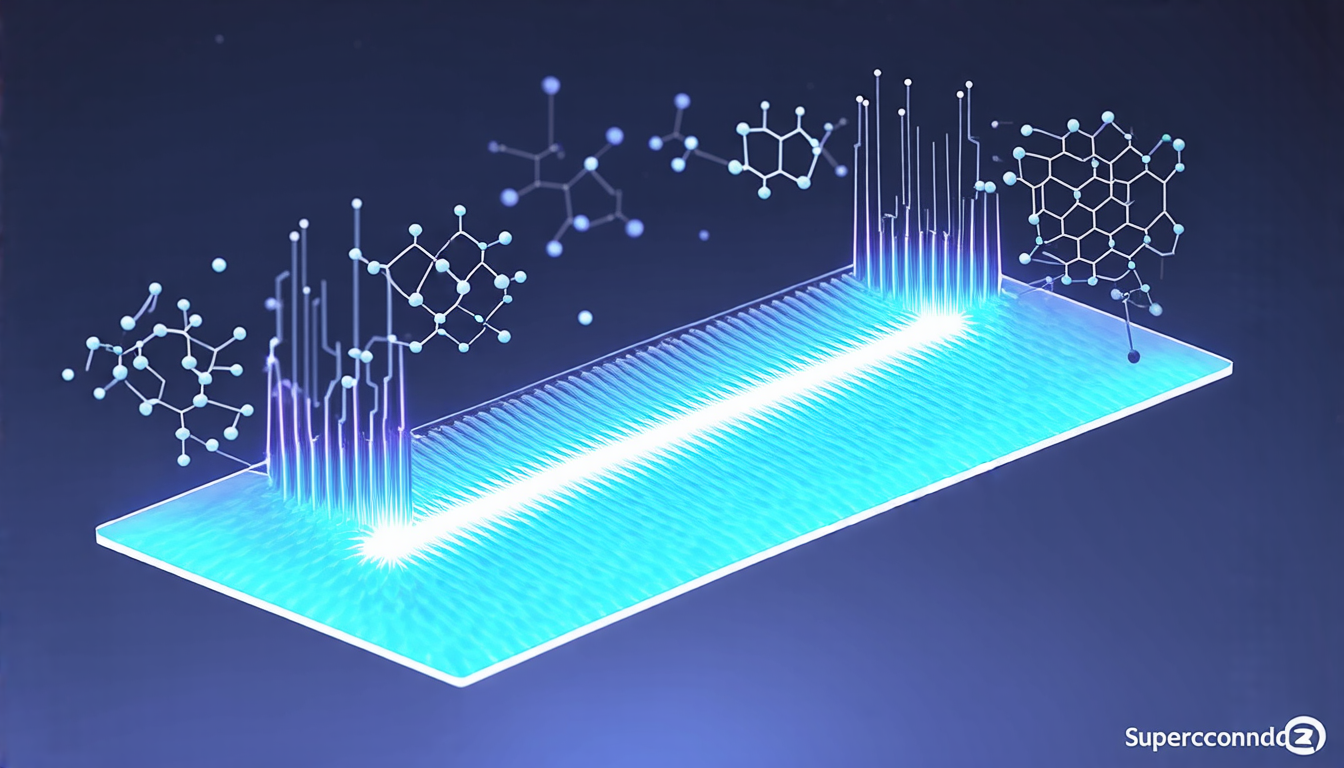
The team found that certain types of two-dimensional (2D) superconductors can be induced to generate an electric current when exposed to circularly polarized light. This phenomenon, known as photodiode effect, is caused by the interaction between the light and the Cooper pairs, which are the basic units of electrical current in a superconductor.
The discovery was made possible by advances in nanotechnology and materials science, which have enabled researchers to create ultra-thin layers of 2D materials with unique properties. These materials can be induced to become superconducting at relatively high temperatures, making them more accessible for practical applications.
In the experiment, the scientists used a special type of light called circularly polarized light, which is similar to the light emitted by a laser. They shone this light onto a 2D superconductor and observed that it generated an electric current in a direction perpendicular to the flow of light. This current was found to be proportional to the intensity of the light and the frequency of the circular polarization.
The researchers believe that their discovery could have significant implications for the development of new technologies, such as more efficient solar panels and more powerful magnetic resonance imaging (MRI) machines. The photodiode effect could also be used to create new types of sensors and detectors, which could be used in a variety of applications from medicine to astronomy.
The team’s findings were published in a recent issue of the journal Physical Review Letters and have sparked excitement among scientists and engineers. While the technology is still in its early stages, the potential for breakthroughs is vast, and researchers are eager to explore the possibilities further.
In addition to their practical applications, the photodiode effect could also shed light on some fundamental aspects of physics, such as the behavior of Cooper pairs and the properties of superconductors. The discovery has the potential to challenge our current understanding of these phenomena and may even lead to new theories that can help us better understand the universe.
As researchers continue to study and refine this phenomenon, it’s clear that their work could have far-reaching implications for a wide range of fields.
Cite this article: “Harnessing Light: Scientists Discover New Way to Generate Electricity in Superconductors”, The Science Archive, 2025.
Superconductors, Photodiode Effect, Circularly Polarized Light, Cooper Pairs, Nanotechnology, Materials Science, Electric Current, Solar Panels, Mri Machines, Sensors And Detectors.





