

Sunday 02 February 2025
Artificial Intelligence has long been touted as a revolutionary technology, capable of transforming various aspects of our lives. However, its potential is often limited by its inability to understand and interact with the physical world in a meaningful way. A recent breakthrough in robotics may be about to change that.
Researchers have developed a novel approach to teaching robots how to manipulate objects in their environment. The method, known as AffordDP, uses a combination of computer vision and machine learning to enable robots to learn from human demonstrations and then apply this knowledge to new situations.
The system works by first collecting data on the actions taken by humans when interacting with objects. This can include tasks such as opening doors or picking up cups. The data is then used to train an artificial intelligence model, which learns to recognize patterns in the way humans interact with objects.
Once trained, the robot is able to use this knowledge to perform similar tasks in its own environment. However, what sets AffordDP apart is its ability to generalize to new situations and objects that it has not seen before. This means that a robot trained on opening doors can then be used to open windows or pick up other objects.
One of the key challenges facing robotics is the ability to transfer knowledge from one situation to another. For example, a robot may learn how to open a door in a simulation, but struggle when faced with the same task in the real world. AffordDP overcomes this challenge by using computer vision and machine learning to recognize patterns in both the physical environment and the actions taken by humans.
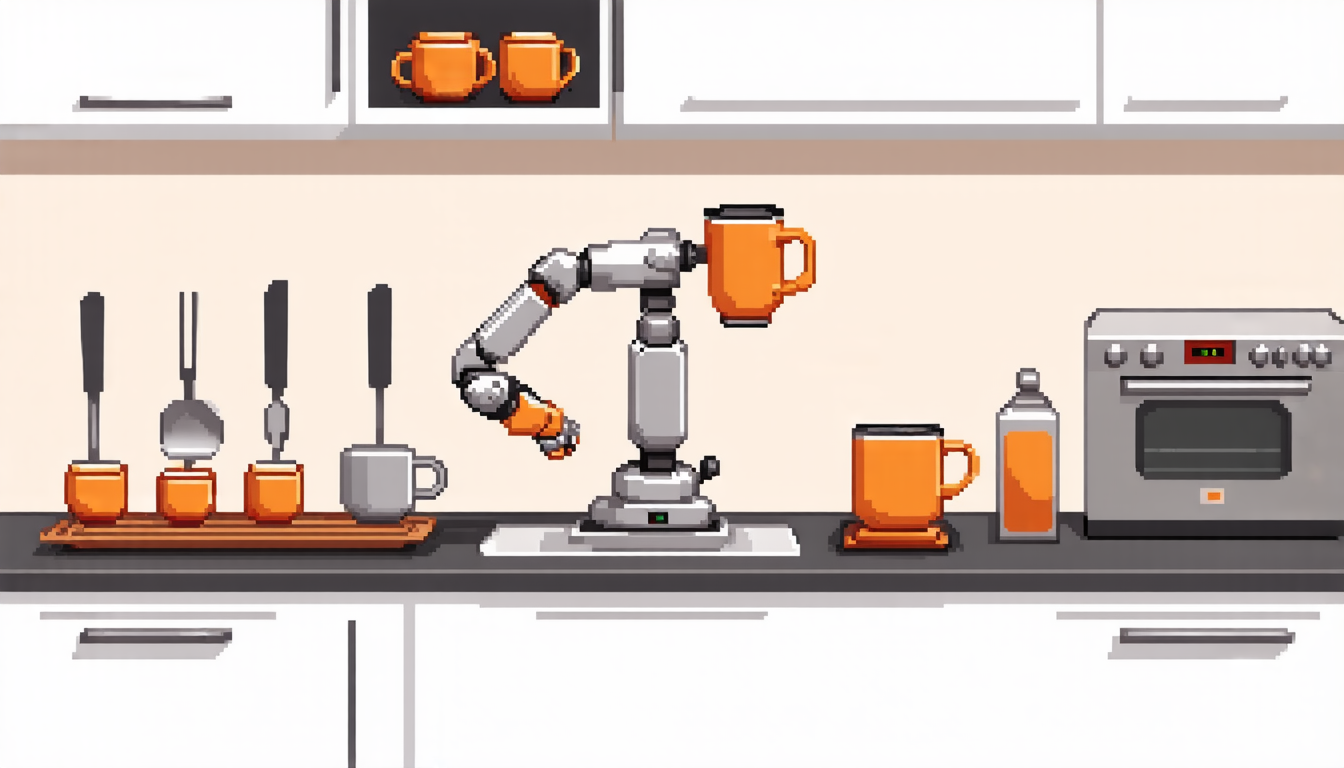
The potential applications of AffordDP are vast. Robots could be used to assist people with disabilities, perform tasks that are too dangerous or unpleasant for humans, or even help us explore new environments such as space. The technology has already been tested in a real-world kitchen setting, where it was able to successfully complete various tasks such as opening doors and picking up objects.
While there is still much work to be done before robots can truly interact with the physical world in the same way that humans do, AffordDP represents a significant step forward. It shows that artificial intelligence has the potential to learn from human demonstrations and apply this knowledge to new situations, and could ultimately enable robots to become more versatile and useful tools for us.
Cite this article: “Robots Learn to Manipulate Objects with AI-Powered AffordDP”, The Science Archive, 2025.
Artificial Intelligence, Robotics, Afforddp, Computer Vision, Machine Learning, Object Manipulation, Human Demonstrations, Pattern Recognition, Transfer Knowledge, Physical Environment





