
Monday 03 February 2025
The intricate dance of networks and reticulations has long fascinated scientists, who seek to understand the hidden patterns that govern their behavior. In a recent breakthrough, researchers have made significant progress in mapping out the vast expanse of possibilities within this complex landscape.
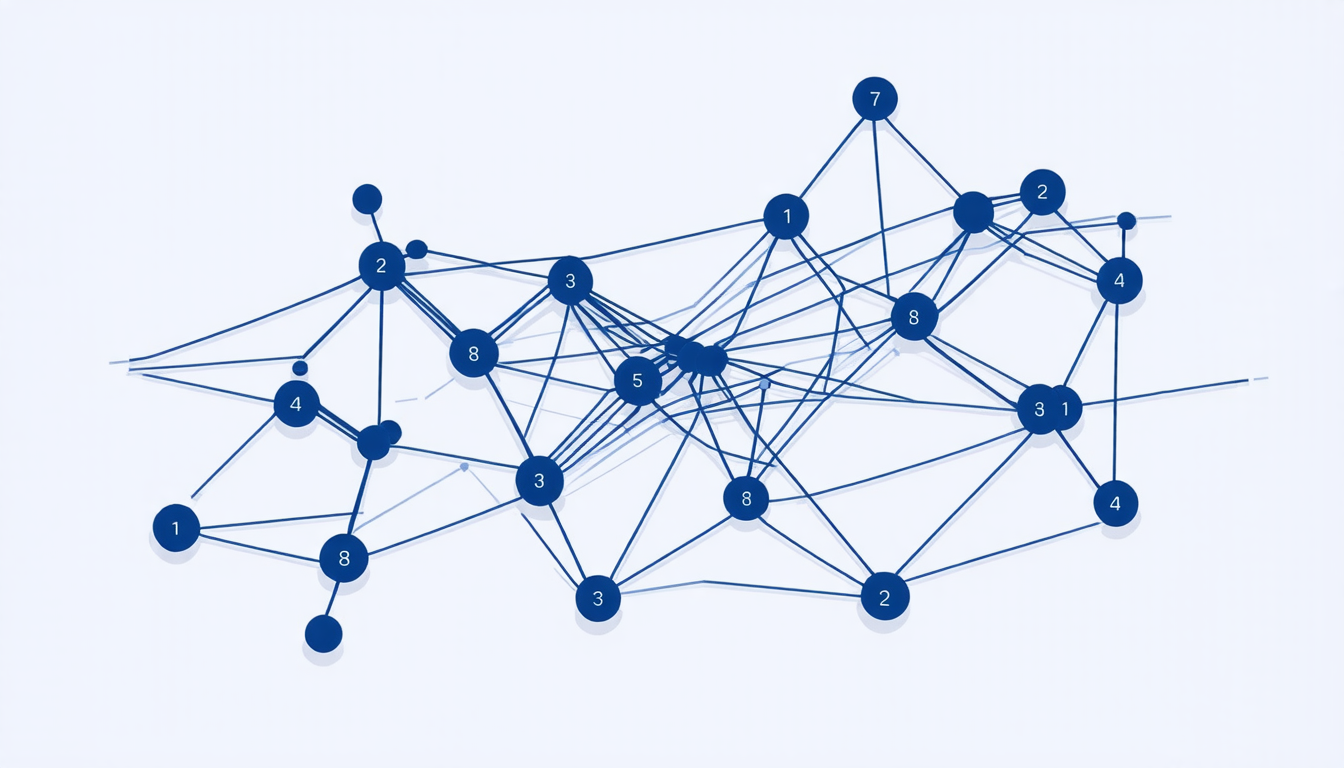
At its core, the study revolves around the concept of reticulation vertices – points where multiple networks intersect and interact with one another. By examining the various ways these vertices can be connected, scientists have been able to identify a staggering number of possible configurations.
In the simplest scenario, each vertex is attached to just two other networks, resulting in 14 distinct possibilities. But as the complexity increases, so too does the range of outcomes. In cases where multiple reticulation vertices are present, the sheer number of combinations becomes almost overwhelming.
One particularly fascinating aspect of this research is the emergence of shortcuts – connections between networks that bypass certain intermediate points. These shortcuts can significantly alter the flow of information and resources within a system, making them crucial for understanding how these complex networks function.
The study’s findings have significant implications for fields such as biology, sociology, and economics, where networks play a vital role in shaping behavior and outcomes. By better grasping the intricate web of relationships that underlies these systems, researchers can gain valuable insights into how they evolve and adapt over time.
Ultimately, this research represents a major step forward in our understanding of network science – a field that continues to reveal its secrets to us, one complex pattern at a time.
Cite this article: “Deciphering the Complexity of Network Intersections”, The Science Archive, 2025.
Networks, Reticulation, Vertices, Connections, Complexity, Possibilities, Shortcuts, Information Flow, Network Science, Relationships