

Saturday 22 February 2025
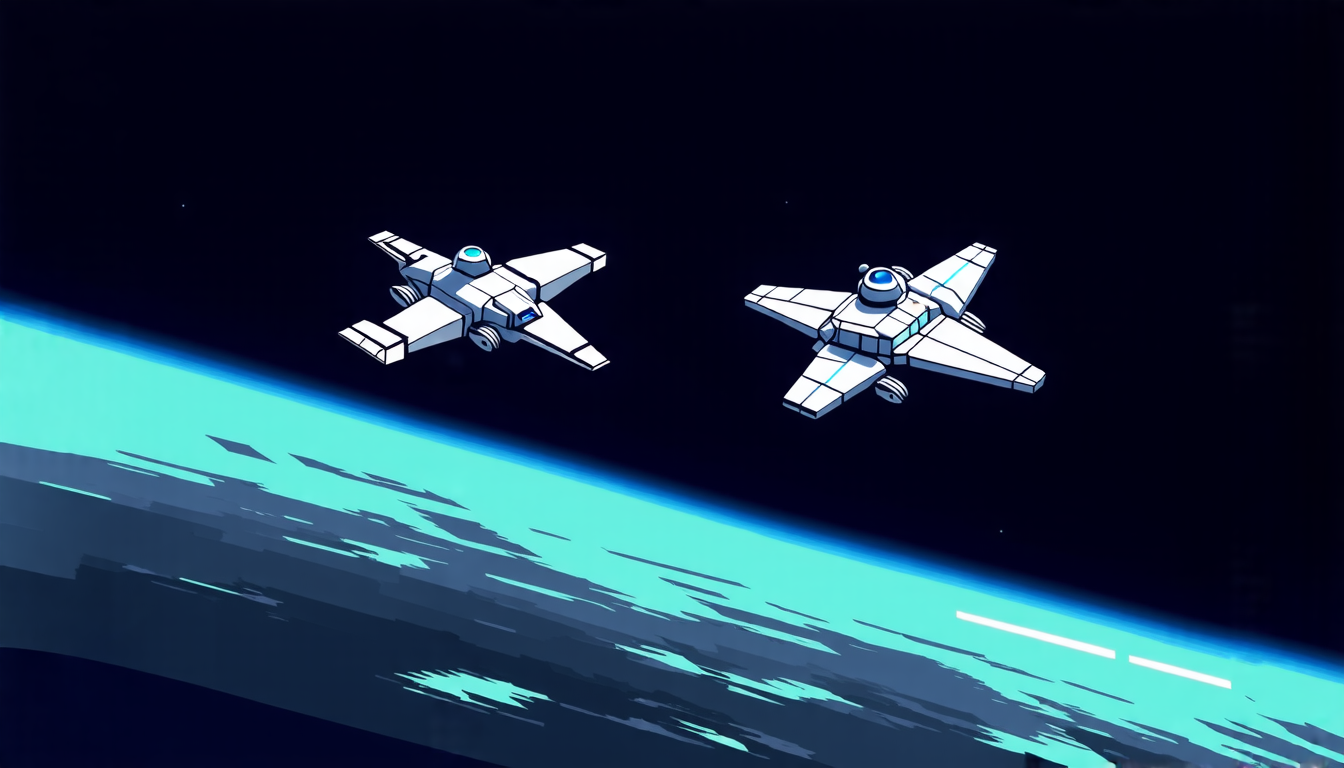
Spacecraft rendezvous, a crucial maneuver for satellites and space probes, has just gotten a whole lot smarter. Researchers have developed a new system that uses artificial intelligence to ensure a safe and efficient meeting between two spacecraft in orbit.
The traditional method of achieving rendezvous involves complex calculations and precise control of the spacecraft’s trajectory. However, this approach can be prone to errors and is often limited by the processing power of onboard computers. The new AI-powered system, on the other hand, uses machine learning algorithms to optimize the time shift governor, a critical component of the rendezvous process.
The time shift governor adjusts the reference trajectory of one spacecraft relative to the other, ensuring that they meet at the correct position and velocity. By using an AI-trained neural network to predict the optimal time shifts, the system can adapt to changing conditions in real-time, making it more robust and efficient than traditional methods.
One of the key benefits of this new approach is its ability to handle complex orbits and multiple constraints simultaneously. In a typical rendezvous scenario, there are several constraints that must be satisfied, such as maintaining a safe distance between the spacecraft and ensuring that they do not collide. The AI system can take all these factors into account and adjust the time shift governor accordingly.
The researchers tested their new system using simulations of various space missions, including a challenging rendezvous in an elliptical orbit. The results showed that the AI-powered system was able to achieve successful rendezvous in all cases, while traditional methods failed or required significant manual intervention.
This breakthrough has significant implications for future space missions. With the ability to adapt to changing conditions and handle complex orbits, spacecraft will be able to perform more efficient and accurate rendezvous maneuvers. This could enable new types of missions, such as satellite servicing and planetary exploration, which require precise control over the spacecraft’s trajectory.
The development of this AI-powered system is a major step forward in the field of space mission control. It demonstrates the potential for machine learning algorithms to improve the performance and reliability of complex systems, and opens up new possibilities for future space exploration.
Cite this article: “AI-Powered Rendezvous System Revolutionizes Spacecraft Navigation”, The Science Archive, 2025.
Spacecraft Rendezvous, Artificial Intelligence, Machine Learning Algorithms, Time Shift Governor, Neural Network, Complex Orbits, Multiple Constraints, Space Mission Control, Satellite Servicing, Planetary Exploration.





