

Saturday 22 February 2025
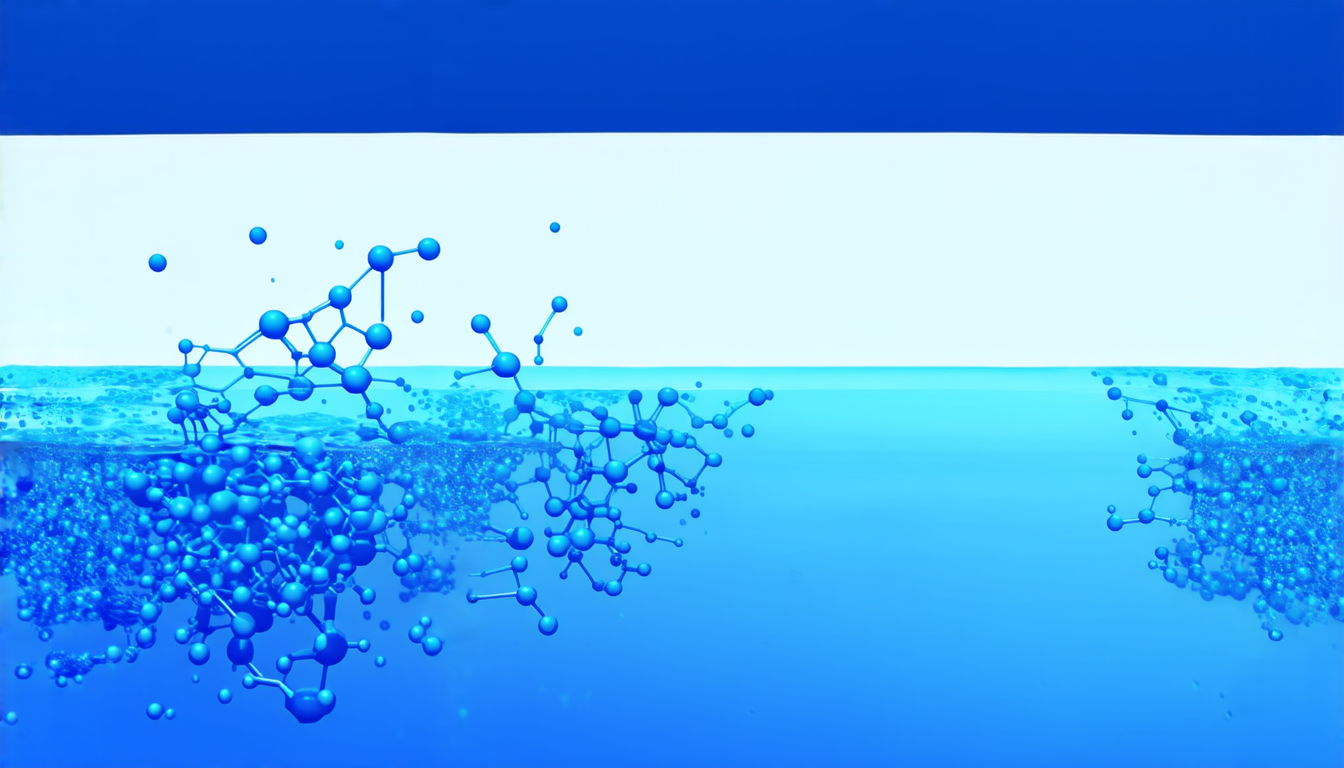
Water is a mysterious substance, and scientists have long been fascinated by its unique properties. One of these properties is its ability to change behavior when confined to small spaces. For example, water molecules move faster near a hydrophobic surface – one that repels water – than they do in the open.
Researchers at Uppsala University in Sweden recently used computer simulations to study this phenomenon further. They created a virtual model of water interacting with a smooth, non-reactive surface and observed how the water behaved.
What they found was fascinating. The water molecules near the surface moved much faster than those farther away, resulting in a significant increase in diffusion – or the rate at which particles spread out. This is important because it has implications for many areas of science and technology, from understanding biological systems to designing new materials.
The researchers used a technique called molecular dynamics simulation to model the behavior of water molecules near the surface. They started with a simple setup: a layer of water molecules in contact with a flat, non-reactive surface. Then they ran the simulation, observing how the water molecules moved over time.
One of the key findings was that the increased diffusion near the surface was due to a reduction in entropy – or disorder – among the water molecules. In other words, the molecules became more organized and structured when they were close to the surface, which allowed them to move faster.
This research has important implications for many areas of science and technology. For example, it could help us understand how proteins fold into specific shapes, which is crucial for understanding biological processes. It could also inform the design of new materials with unique properties.
The study’s findings also suggest that entropy plays a key role in determining the behavior of water molecules near surfaces. This has significant implications for our understanding of chemical reactions and biological systems.
In the future, researchers hope to build on these findings by studying more complex systems, such as water interacting with other substances or in different environments. By doing so, they may uncover even more surprising properties of this mysterious substance.
Cite this article: “Unraveling the Mysteries of Waters Surface Behavior”, The Science Archive, 2025.
Water, Molecular Dynamics, Simulation, Surface, Entropy, Disorder, Diffusion, Particles, Molecules, Chemistry





