

Sunday 23 February 2025
The quest for efficient graph coloring algorithms has been a longstanding challenge in computer science and mathematics. Recently, researchers have made significant progress in solving this problem by developing new decompositions of graphs into locally irregular subgraphs.
A graph is considered to be locally irregular if no two adjacent vertices have the same color degree – that is, no two adjacent vertices have the same number of edges connecting them with vertices of a specific color. Locally irregular coloring is an important concept in computer science and mathematics because it has applications in numerous fields such as network optimization, coding theory, and machine learning.
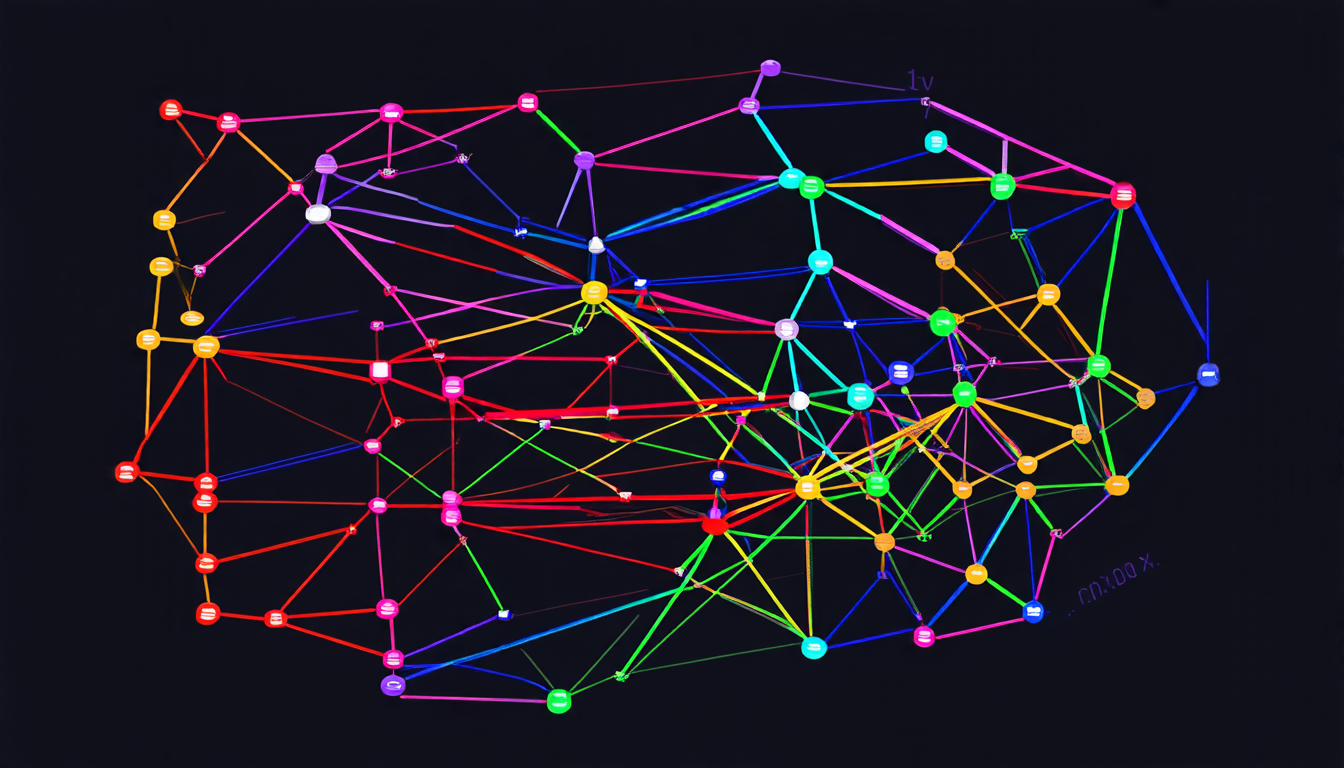
Researchers have been working tirelessly to develop algorithms for decomposing graphs into locally irregular subgraphs. These decompositions are crucial for solving the problem of graph coloring efficiently. In this context, a new approach has been proposed by Igor Grzelec and Mariusz Wo´zniak, which involves decomposing 2-multigraphs into locally irregular submultigraphs.
A 2-multigraph is a type of graph that contains multiple edges between each pair of vertices. These graphs are used to model real-world networks such as social media platforms, communication networks, and biological networks. The problem of coloring these graphs efficiently has significant implications for many applications including network optimization, coding theory, and machine learning.
The proposed approach involves decomposing 2-multigraphs into locally irregular submultigraphs using a combination of graph theoretical techniques and computer algorithms. The authors have shown that this decomposition can be used to solve the problem of coloring 2-multigraphs efficiently.
In addition to its applications in network optimization, coding theory, and machine learning, the proposed approach also has implications for other fields such as chemistry and biology. For example, the decomposition of molecules into locally irregular substructures can provide insights into their chemical properties and behavior.
The development of efficient graph coloring algorithms is an active area of research, and this new approach provides a promising solution to the problem. The authors’ work demonstrates that decomposing 2-multigraphs into locally irregular submultigraphs can be used to solve the problem of coloring these graphs efficiently. This has significant implications for many applications including network optimization, coding theory, and machine learning.
The proposed approach is not limited to 2-multigraphs but can also be applied to other types of graphs such as simple graphs and multigraphs with multiple edges between each pair of vertices. The decomposition of these graphs into locally irregular subgraphs provides a powerful tool for solving the problem of graph coloring efficiently.
Cite this article: “Decomposing Graphs into Locally Irregular Substructures for Efficient Coloring”, The Science Archive, 2025.
Graph Theory, Locally Irregular Graphs, Graph Decomposition, Coloring Algorithms, Network Optimization, Coding Theory, Machine Learning, Multigraphs, 2-Multigraphs, Computer Science





