

Sunday 23 February 2025
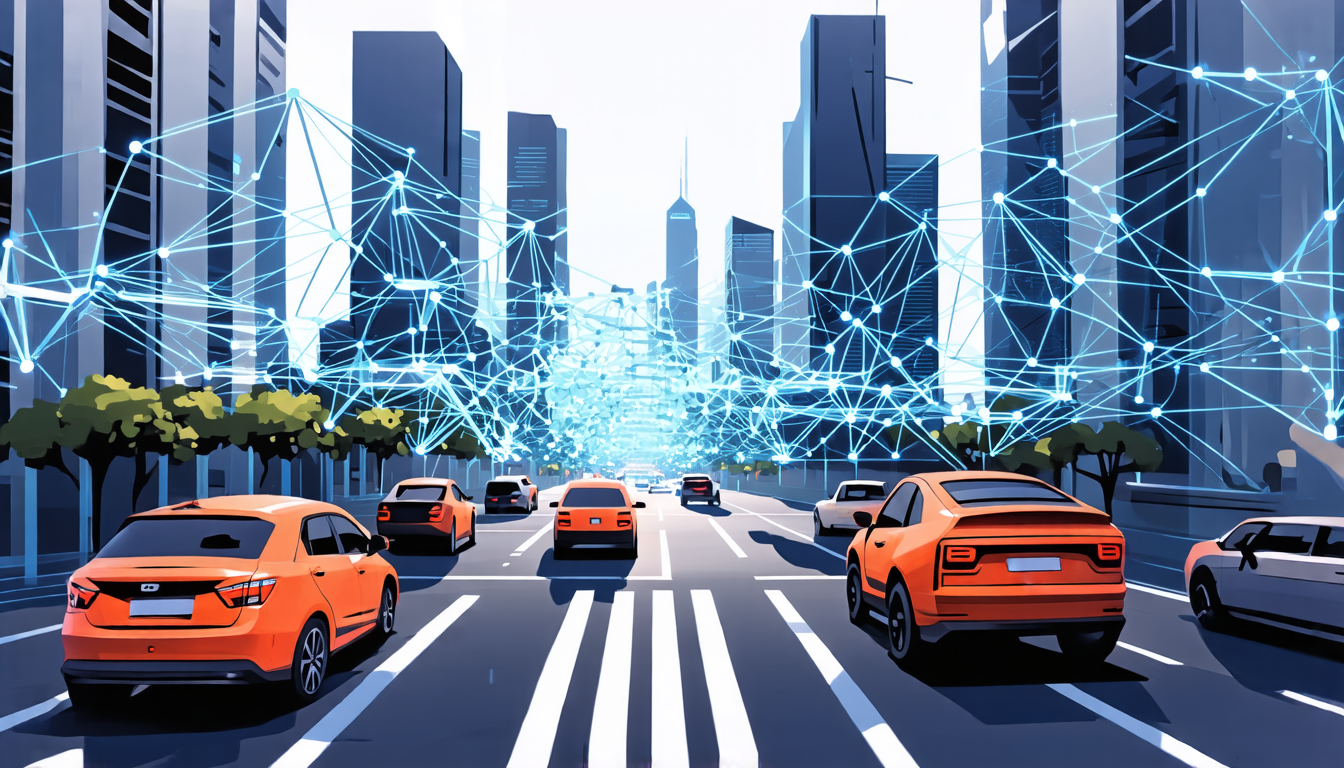
As cities become increasingly congested and polluted, the search for innovative solutions to improve traffic flow and reduce emissions has never been more pressing. A new study proposes a bold answer: harnessing blockchain technology to create a decentralized, secure, and efficient network of vehicles that can communicate with each other and the infrastructure around them.
The idea is simple yet revolutionary: by creating a blockchain-based system for vehicular ad-hoc networks (VANETs), researchers hope to enable cars to share information in real-time, reducing congestion and improving safety. The approach relies on two key components: software-defined networking (SDN) and network function virtualization (NFV).
First, SDN allows for the creation of a virtualized network infrastructure that can be reconfigured and optimized in real-time. This enables vehicles to dynamically adjust their routes, speed, and communication protocols to minimize congestion and reduce emissions.
Second, NFV provides a platform for deploying network functions as virtual machines, which can be easily scaled up or down as needed. This allows for the creation of a distributed, decentralized network that is resilient to failures and attacks.
The researchers propose a dual-layer blockchain system: a decentralized blockchain at the edge, where vehicles communicate with each other, and a centralized blockchain in the cloud, where data is verified and stored. This ensures both security and scalability, as well as enabling real-time data analysis and decision-making.
But what does this mean for drivers? For starters, it could significantly reduce traffic congestion by allowing cars to adjust their routes in real-time, based on current traffic conditions. It could also improve safety by providing real-time alerts about potential hazards, such as accidents or road closures. And with the ability to share information with other vehicles and infrastructure, drivers could potentially receive more accurate and up-to-date traffic information.
The implications of this technology extend beyond transportation, however. A decentralized, blockchain-based network has the potential to transform industries from logistics to energy management, enabling real-time data sharing and optimization across entire supply chains.
While there are still many technical challenges to overcome before this vision becomes a reality, the researchers’ proposal offers a promising glimpse into a future where technology and innovation come together to create a more efficient, sustainable, and connected world.
Cite this article: “Blockchain-Powered Vehicular Networks: Revolutionizing Traffic Flow and Sustainability”, The Science Archive, 2025.
Blockchain, Transportation, Traffic, Congestion, Emissions, Decentralized, Network, Vehicles, Infrastructure, Sdn, Nfv





