

Sunday 23 February 2025
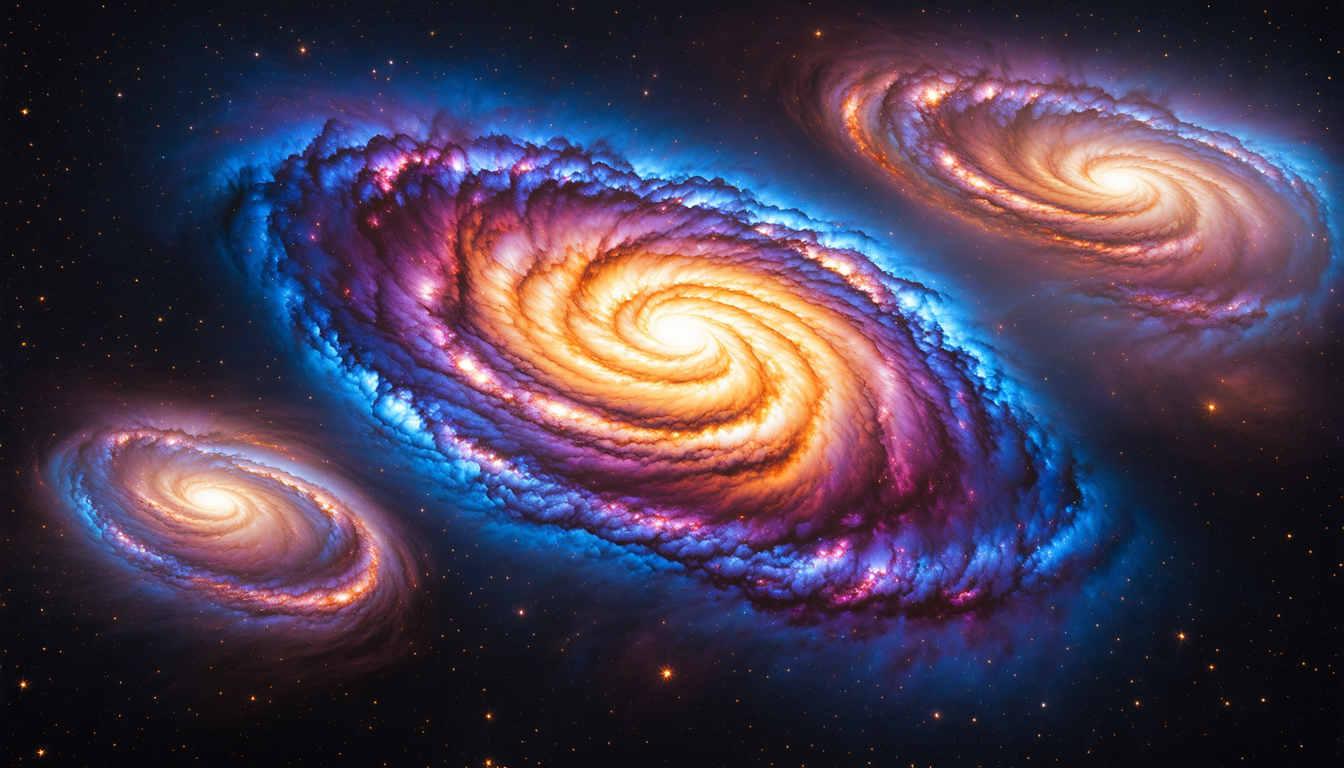
Scientists have been studying a type of galaxy that’s incredibly hot and luminous, known as Hot Dust-Obscured Galaxies or Hot DOGs for short. These galaxies are thought to be in the early stages of their lives, and by studying them, researchers can gain insights into how they formed and evolved over time.
One of the key challenges in studying Hot DOGs is identifying companion galaxies that might be nearby. By chance alignment, these companions could be seen in the same region of space as the Hot DOG itself, but they wouldn’t necessarily be related to it. To overcome this challenge, scientists have developed a new method for selecting potential companions using data from the Cosmic Evolution Survey (COSMOS2020).
The team analyzed images taken by the Hubble Space Telescope and the Inamori Magellan Areal Camera & Spectrograph (IMACS), which are capable of capturing light from distant galaxies. They used this data to identify candidate companion galaxies that might be related to the Hot DOGs.
The researchers found three Hot DOGs with nearby companions, and analyzed their properties using a combination of observations from the Hubble Space Telescope, the Gemini Multi-Object Spectrograph (GMOS-S), and other telescopes. By studying these companions, scientists hope to learn more about the environments in which Hot DOGs form and evolve.
One striking finding is that all three Hot DOGs have companions that are significantly over-dense compared to the average density of galaxies at similar distances from us. This suggests that Hot DOGs may be forming in regions with unusually high concentrations of matter, such as large galaxy clusters or superclusters.
The researchers also found that the companions are not just random galaxies; they appear to be actively forming stars, and some even have signs of intense starbursts. This could indicate that the Hot DOGs are triggering these star-forming events through their strong radiation fields, which can compress gas in nearby galaxies and spark new star formation.
These findings provide important insights into the early lives of Hot DOGs and the environments in which they form. By studying more of these galaxies and their companions, scientists hope to gain a better understanding of how galaxy evolution unfolds over billions of years.
The next step is to gather more data on Hot DOGs and their companions using even larger telescopes and more advanced instruments. This will allow researchers to explore the properties of these galaxies in greater detail and uncover new secrets about the universe’s early history.
Cite this article: “Unveiling the Secrets of Hot Dust-Obscured Galaxies”, The Science Archive, 2025.
Galaxies, Hot Dogs, Stars, Evolution, Radiation, Galaxy Clusters, Superclusters, Starbursts, Hubble Space Telescope, Cosmos2020





