

Sunday 23 February 2025
The quest for precision in metal manufacturing has led researchers down a path of innovation, culminating in the development of a novel data-driven model that can accurately predict distortions in 3D printed parts.
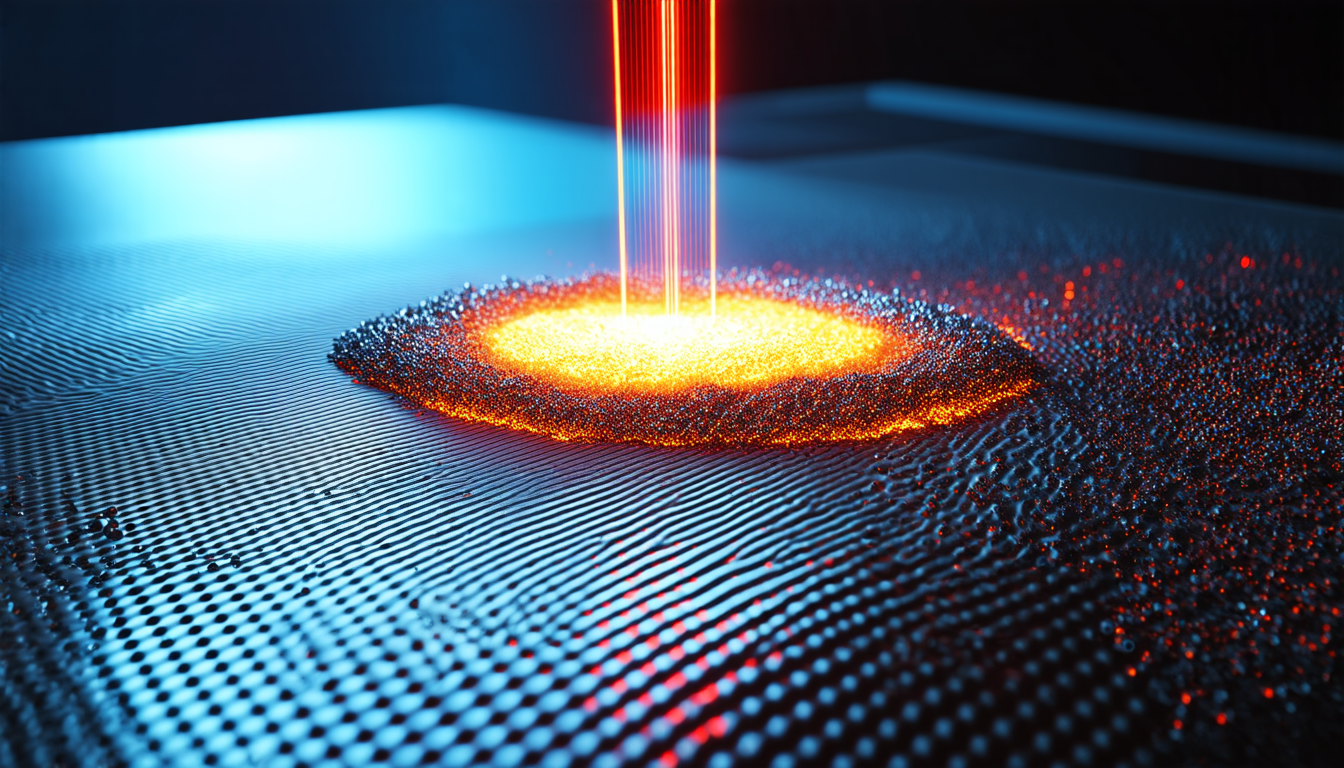
Laser Powder Bed Fusion (LPBF) is an additive manufacturing technique that involves layering metal powder and fusing it together with a high-energy laser. The process is complex, involving thermal gradients, melting, and solidification, which can lead to significant distortions in the final product. Accurate prediction of these distortions is crucial for optimizing the manufacturing process and ensuring that parts meet dimensional accuracy requirements.
Traditionally, manufacturers rely on trial-and-error methods or high-fidelity finite element models to predict distortions. However, these approaches are often time-consuming, computationally expensive, and limited in their ability to capture complex phenomena. Researchers have therefore turned to data-driven models, which can learn patterns and relationships from large datasets to make predictions.
The new model combines two techniques: Proper Orthogonal Decomposition (POD) and Gaussian Process Regression (GPR). POD reduces the dimensionality of the dataset by identifying dominant patterns in the data, while GPR maps these patterns to a given parameter value. The result is a highly accurate model that can predict distortions with an error margin of ±0.001 mm.
The model’s accuracy was tested using a dataset generated from LPBF simulations. The results showed that the model was able to accurately predict distortions for dwell times ranging from 20 to 80 seconds, outperforming traditional finite element models in terms of speed and accuracy. Furthermore, the model’s ability to generalize to unseen parameters demonstrates its potential for broader applications.
The implications of this research are significant. By enabling rapid and accurate prediction of distortions, manufacturers can optimize their processes, reduce waste, and improve product quality. Additionally, the model’s potential to be applied to other additive manufacturing techniques opens up new possibilities for precision engineering.
In a related development, researchers have also explored the use of graph convolutional autoencoders (GCAs) as an alternative approach to data-driven modeling. While GCAs showed promising results, they were limited by their reliance on large datasets and tendency to overfit. The POD-GPR model, on the other hand, offers a more robust and generalizable solution.
As additive manufacturing continues to evolve, the need for accurate prediction of distortions will only grow more pressing.
Cite this article: “Predicting Distortions in 3D Printed Parts with High Accuracy”, The Science Archive, 2025.
Laser Powder Bed Fusion, Additive Manufacturing, Data-Driven Modeling, Distortion Prediction, Proper Orthogonal Decomposition, Gaussian Process Regression, Finite Element Models, Graph Convolutional Autoencoders, Precision Engineering, 3D Printing.





