

Tuesday 25 February 2025
A new approach to predicting relationships in complex networks has been developed, which could have significant implications for fields such as supply chain management and social network analysis.
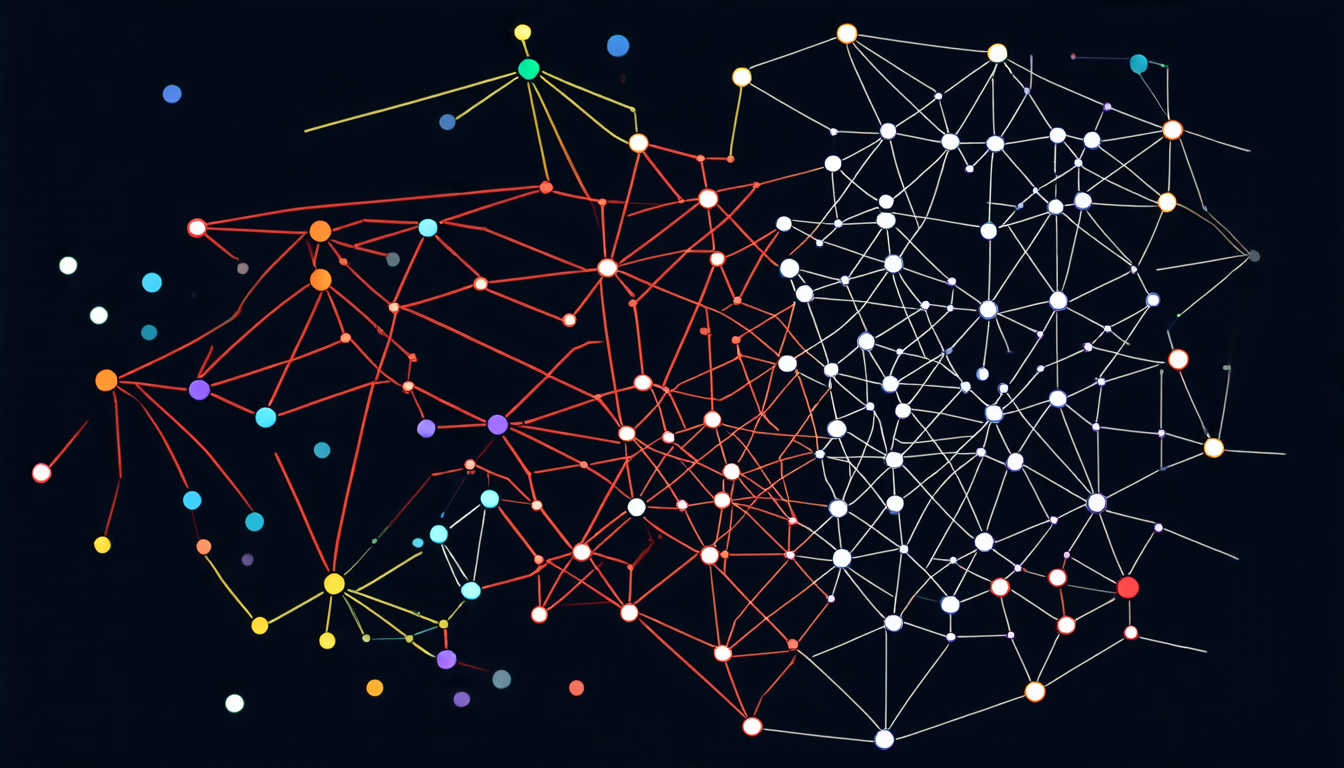
The researchers behind this work used a type of artificial intelligence called generative language models to predict relationships between entities in complex networks. These models are particularly well-suited to this task because they can learn patterns and structures from large datasets, and then generate new information that is consistent with those patterns.
In the past, predicting relationships in complex networks has been challenging because it requires identifying subtle patterns and connections between different entities. This is especially true for supply chain management, where understanding the relationships between companies and products is crucial for ensuring efficient and reliable delivery of goods.
The researchers used a type of generative language model called a pre-trained language model (PLM) to predict these relationships. PLMs are trained on large datasets of text and can learn to recognize patterns and structures in that data. They were then fine-tuned using a specific dataset related to supply chain management, which allowed them to adapt their learning to the specific task at hand.
The results of this study were impressive, with the PLM-based approach outperforming traditional machine learning methods in predicting relationships between entities in complex networks. This could have significant implications for fields such as supply chain management and social network analysis, where understanding these relationships is crucial for making informed decisions.
One of the key advantages of this approach is that it can handle large datasets and scale to complex networks with ease. This makes it particularly well-suited to real-world applications, where data is often vast and complex.
The researchers also found that the PLM-based approach was more robust than traditional machine learning methods, meaning that it could perform well even when faced with noisy or incomplete data. This is an important consideration in many fields, where data may be imperfect or uncertain.
Overall, this study demonstrates the potential of generative language models for predicting relationships in complex networks. With their ability to learn patterns and structures from large datasets and scale to complex networks, these models could have significant implications for a wide range of fields.
Cite this article: “Predicting Relationships in Complex Networks with Generative Language Models”, The Science Archive, 2025.
Supply Chain Management, Social Network Analysis, Complex Networks, Generative Language Models, Artificial Intelligence, Machine Learning, Pre-Trained Language Models, Predictive Relationships, Robustness, Scalability





