

Friday 28 February 2025
Scientists have been studying a peculiar phenomenon in the universe for years, and recent research has shed new light on this enigmatic behavior. It’s called long-term trends in Fermi-LAT jetted active galactic nuclei (AGN), and it’s fascinating.
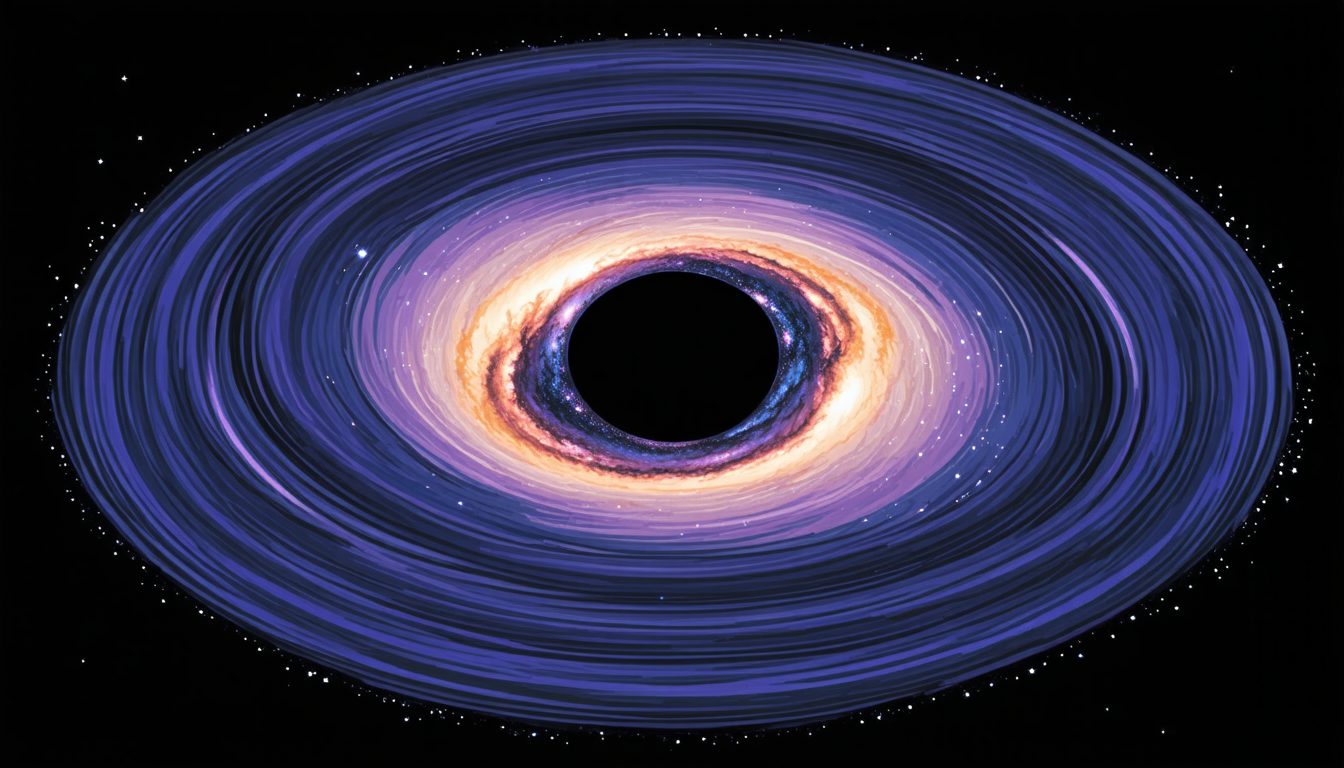
For those who may not be familiar with the term, AGN are incredibly powerful objects that reside at the centers of galaxies. They’re essentially supermassive black holes surrounded by a swirling disk of hot gas and matter. When this material spirals inward towards the black hole, it releases an enormous amount of energy in the form of light across the entire electromagnetic spectrum.
Now, Fermi-LAT is a satellite-based telescope that’s been monitoring these AGN for years, taking precise measurements of their gamma-ray emissions. And what scientists have found is astonishing: many of these AGN exhibit long-term trends in their gamma-ray activity. These trends are characterized by a steady increase or decrease in the amount of gamma radiation emitted over time.
To put this into perspective, imagine a light curve that shows the brightness of a star over several years. You might see some fluctuations and variability, but most stars follow a relatively consistent pattern. In contrast, these AGN have light curves that are more like a gentle slope or an oscillating wave. It’s as if they’re slowly rising or falling in brightness over time.
So what could be causing this strange behavior? One theory is that it’s related to the black hole’s activity level. Maybe the black hole is consuming more material from its surroundings, which increases the amount of energy released in gamma rays. Alternatively, perhaps there’s some kind of binary system at play, where two black holes are orbiting each other and influencing one another’s behavior.
To better understand these long-term trends, scientists have been analyzing data from Fermi-LAT and comparing it to observations made by other space-based telescopes like Swift and NuSTAR. They’ve also developed sophisticated computer models that simulate the behavior of AGN and try to reproduce these trends.
The research is still ongoing, but early findings suggest that these long-term trends could be an important tool for studying the evolution of black holes and the growth of galaxies. By analyzing these patterns, scientists may gain valuable insights into the physical processes that govern the universe on large scales.
In the end, this study highlights the incredible complexity and beauty of the universe.
Cite this article: “Unveiling the Mysterious Long-Term Trends in Active Galactic Nuclei”, The Science Archive, 2025.
Fermi-Lat, Agn, Gamma-Rays, Black Holes, Galaxies, Supermassive, Satellite Telescope, Long-Term Trends, Light Curves, Binary Systems





